

The adoption of AI for real estate agents is becoming increasingly evident. According to the National Association of REALTORS 2025 REALTORS® Technology Survey, 41% of REALTORS have incorporated AI or generative AI into their work
flows, while 70% are using some form of emerging technology. Notably, one in five uses AI as a daily assistant, and half of the survey respondents said the technology is having a clearly positive impact on their businesses.
Why AI for Real Estate Agents Matters Today

AI tools for real estate professionals
Real estate agents have to manage a wide range of daily responsibilities, including prospecting, client care, and market research. Knowing how to use AI for real estate agents can reduce the workload, streamline workflows, and help deliver the best possible results.
AI benefits not only sellers but also buyers, brokers, agencies, and investors. More specifically:
-
For homebuyers and renters: AI filters property information to match individual needs and provides essential details about price, location, and features, saving time during the search process.
-
For sellers and landlords: By analyzing customer behavior and sentiment, AI can consolidate data on prospective buyers, support property valuation, and shorten the transaction process to improve overall efficiency.
-
For brokers and agencies: Using AI for realtors in real estate business workflows helps streamline and reduce related tasks, qualify potential clients, and simplify customer information management.
-
For investors and developers: AI helps analyze real estate market trends and assess the risk and return potential of each project. It can also support project management, helping optimize profits and build a complete investment strategy.
Build Consistent Branding via AI Real Estate Agent Tools
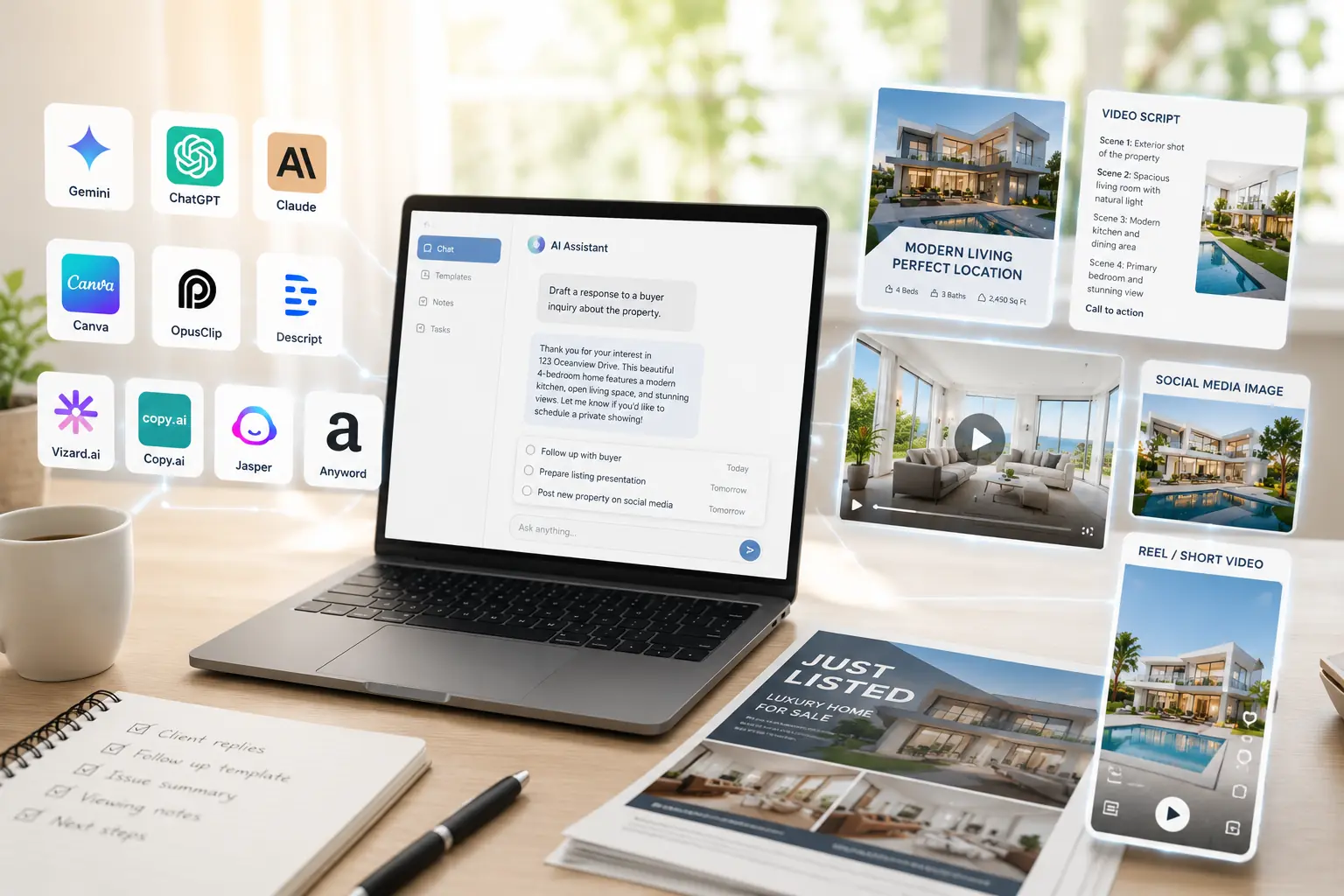
AI tools for real estate content creation
AI tools such as Gemini, ChatGPT, and Claude can support many daily tasks, including drafting customer response templates, summarizing issues, and organizing notes after property viewings. Some tools can also turn prompts into tasks and schedule them for completion throughout the day. This keeps your workflow proactive while optimizing productivity.
AI tools do more than draft text. Platforms such as Canva, OpusClip, Descript, and Vizard.ai also help real estate agencies create professional videos and adapt content and dimensions for different platforms.
Other tools, including Copy.ai, Jasper, and Anyword, are widely used to support more complex assignments such as:
-
Designing real estate flyers and advertising banners
-
Creating video scripts
-
Producing property introduction videos
-
Creating real estate image collections for social media
-
Editing property introduction Reels
Access Data-Driven Insights Using AI for Real Estate Agents
AI-powered real estate market analysis
Real estate agencies can also use AI for real estate agents to support market analysis through platforms such as:
-
Altos Research → Delivers live updates on local real estate market trends.
-
CoreLogic → Provides property valuations, risk analysis, and historical data.
-
Restb.ai → Uses AI image analysis to tag and organize property features.
-
Revaluate → Identifies contacts in your database who are most likely to move.
-
CanaryAI → Generates automated CMAs featuring advanced property comparison filtering.
Scale Property Businesses via AI for Realtors Ecosystems
As your prospect database expands, AI for realtors becomes a powerful assistant that helps ensure no one falls through the cracks. With automated functions such as follow-ups, lead scoring, and schedule reminders, you can maintain an organized way of working, even during peak season or when managing a large volume of clients simultaneously.
Readmore: The Best Real Estate AI Assistants of 2026 – Let’s Scale Your Business
Practical Applications of an AI Real Estate Agent
1. Speed Up Property Copywriting with AI for Realtors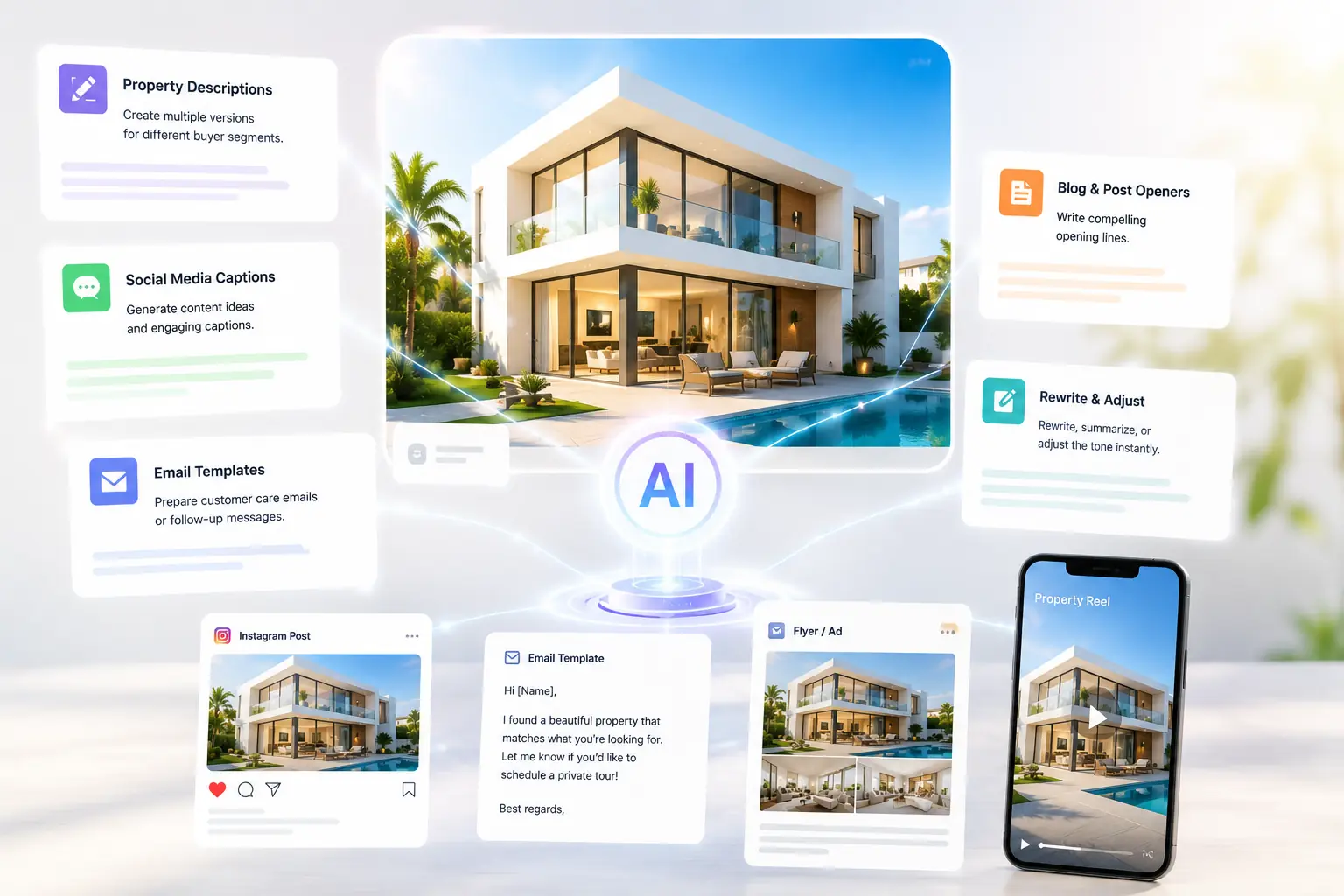
AI-generated content for property marketing
Working in real estate means writing continuously, from property descriptions and emails to social media posts, scripts, and event materials. Tools built around AI for realtors can help you:
-
Create multiple versions of a property description, each optimized for a different customer segment.
-
Generate content ideas and write engaging social media captions.
-
Prepare customer care email templates or client follow-up messages.
-
Write compelling opening lines for posts or blog articles.
-
Rewrite, summarize, or quickly adjust the tone of a piece of text.
Once AI has completed the rough draft, you only need to incorporate your personal style, local market knowledge, and factual information to make the content as complete as possible.
2. Drive Sales via Virtual Tours and AI Photography Retouching
AI virtual staging and real estate photo editing
Images optimized with AI technology make your listings considerably more distinctive and engaging, especially for vacant properties, outdated interiors, or homes undergoing renovation. These AI for real estate agents tools help you:
-
Virtually stage interiors in a variety of design styles, from modern and rustic farmhouse to coastal.
-
Flexibly transform scenes from daytime to nighttime.
-
Automate the creation of floor plans from existing images.
-
Build highly interactive 3D virtual tours.
-
Automatically balance lighting and remove unwanted details from the frame.
These visual improvements help buyers imagine their future living space more easily. At the same time, they make listings more competitive in digital environments without the expense of costly additional photo shoots.
Visual content plays a decisive role in online homebuying behavior, especially in the United States, where 96% of buyers used the internet during their home search, according to the National Association of REALTORS®. This is why technologies such as AI image optimization, interactive 3D tours, and virtual staging are expanding rapidly and becoming a new standard. More than 50% of real estate agents in the United States have now fully integrated virtual staging technology into their listing strategies.
Among these solutions, Matterport’s 3D virtual-tour technology has achieved a particularly strong position and is used by many major U.S. brokerages. According to the National Association of REALTORS’ 2025 Home Buyers and Sellers Generational Trends Report, nearly half of homebuyers consider virtual tours extremely useful during the selection process. Real-world data also shows that properties featuring Matterport 3D technology can close up to 31% faster and sell for up to 9% more than properties marketed with traditional photography alone, according to Matterport’s market research.
At the same time, Matterport’s AI-powered automated floor-plan feature, updated in 2025, has created a significant advance. The system automatically produces accurately dimensioned and fully labeled drawings from 3D scan data, reducing manual processing time from 45 minutes to only eight minutes per property, an 82% reduction in turnaround time. Matterport’s official Property Intelligence resources provide further information on its AI-powered automated measurements, layouts, editing, and reporting capabilities.
Meanwhile, AI virtual-staging solutions are helping real estate professionals save between 95% and 99% compared with renting and installing physical furniture. At an extremely low cost of only $1 to $15 per image, this technology can more than double listing click-through rates, from 1.8% to 4.5%, and shorten a property’s time on market by 40% to 60%.
However, U.S. real estate professionals must also pay closer attention to new legal rules requiring the disclosure of digitally altered images to protect transparency. The National Association of REALTORS® has also covered the legal and disclosure risks surrounding digitally altered listing photos.
Readmore: Top AI Tools for Real Estate Agents 2026 Update
3. Optimize CRM Lead Nurturing Using AI Real Estate Agent Systems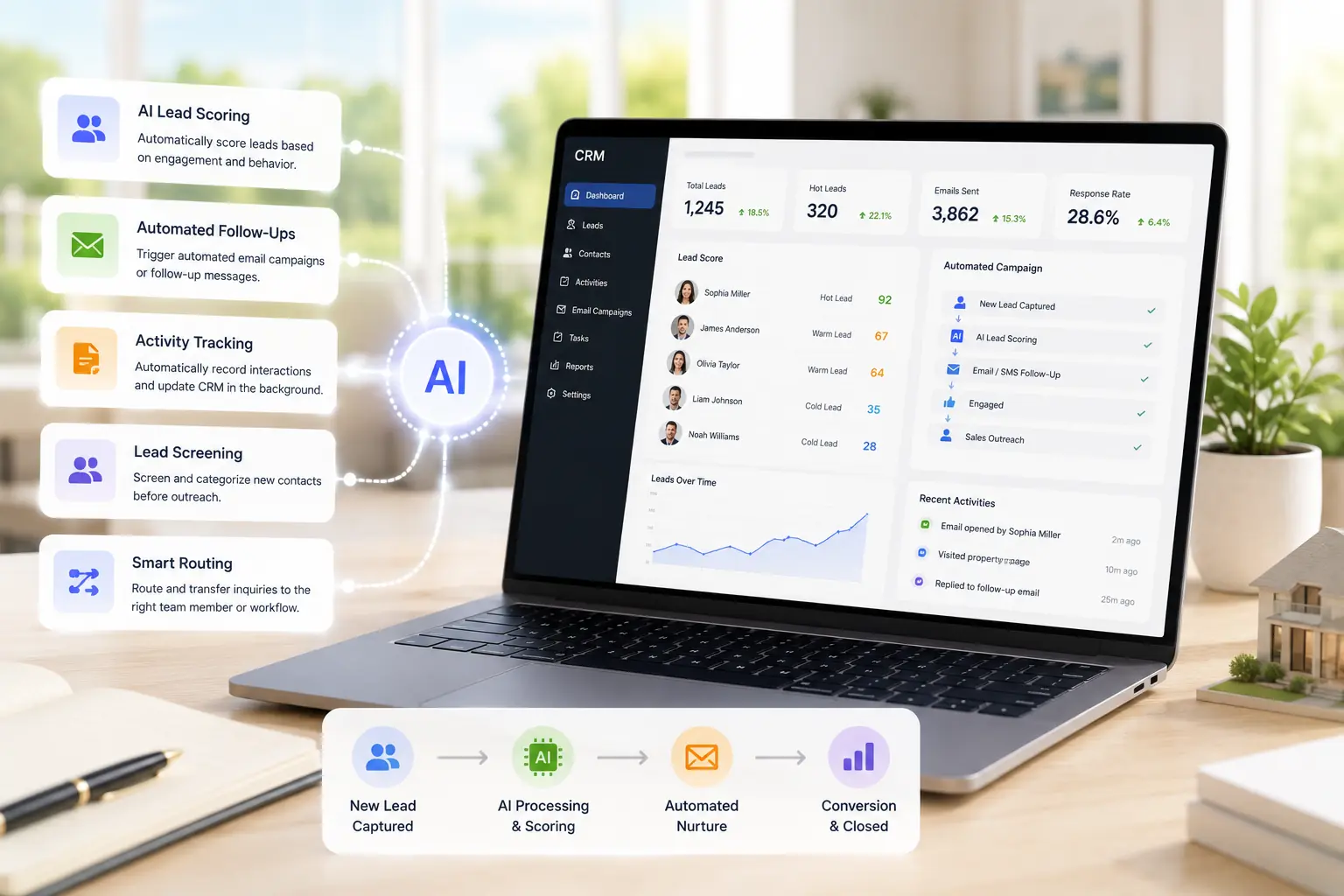
AI-powered CRM and lead management
CRM systems and AI-integrated marketing solutions can take over the repetitive tasks involved in lead nurturing. More specifically, an AI real estate agent system can:
-
Automatically score leads based on their engagement level and online behavior.
-
Trigger automated email campaigns or follow-up messages.
-
Automatically record interaction histories and update CRM data in the background.
-
Screen and categorize new contact lists before a response is sent.
-
Route and transfer customer inquiries to the right team member or appropriate workflow.
Support from these tools ensures that customer response times remain as fast as possible, a critical factor when incoming lead volume increases suddenly. It also helps you manage the sales funnel in an organized and efficient way.
4. Leverage Predictive Valuation Tools as an AI Real Estate Agent

AI property valuation and market insights
When preparing a comparative market analysis, or CMA, or advising a client on a listing price, AI for real estate agents helps improve accuracy and optimize the way information is presented. Platforms such as HouseCanary, Local Logic use machine-learning algorithms to analyze indicators such as school ratings, walkability, local property turnover, and price movements.
AI-powered CMA tools help you:
-
Identify microtrends that could affect how long a property takes to sell.
-
Clearly forecast how listing-price adjustments may change buyer sentiment and behavior.
-
Visualize comparable-property data so sellers can compare the information and understand it quickly.
As a result, pricing discussions with clients become professional strategic consultations that are easy to understand and fully supported by real-world data.
5. Automate Transaction Management via AI for Real Estate Agents

AI-assisted real estate transaction management
Going beyond automatic form filling, today’s intelligent transaction-management tools, such as Dotloop Premium, Lone Wolf Transact, and SkySlope DigiSign, can now:
-
Scan entire documents to automatically detect and flag missing signatures.
-
Quickly identify contradictions or inconsistent information across contract terms.
-
Suggest the next steps in the transaction process.
-
Automatically extract key deadlines and synchronize them directly with a working calendar.
-
Summarize property inspection findings in a concise, easy-to-understand format for clients.
For real estate professionals managing multiple escrow accounts at the same time, AI for real estate agents provides a reliable safety net that eliminates errors and effectively reduces the pressure of the workload.
6. Improve Response Latency Using AI for Realtors Chatbots

AI chatbot answering a property inquiry
AI-powered chatbot tools, such as Aisa Holmes by Structurely and Engati, can approach and engage prospective clients in natural, human-like conversations. These systems can automatically handle frequently asked questions, such as “When is the open house?”, qualify buyers by asking questions such as “Have you been pre-approved for a mortgage?”, or provide detailed property information while tactfully collecting essential customer data.
This AI for realtors solution is most effective in situations that involve:
-
Responding to inquiries submitted late at night or early in the morning.
-
Running large-scale lead-generation campaigns.
-
Giving immediate answers to website visitors who want information without delay.
-
Automating open-house registration through QR codes.
With this technological support in place, you no longer have to worry about missing a business opportunity because of time constraints or time-zone differences.
Readmore: How to Make AI Video for Real Estate Marketing
The Future of AI for Realtors: Core Operating Systems
Businesses should not view AI as a collection of isolated tools. Instead, they must turn AI for realtors into an operating advantage by redesigning their workflows around the following three emerging scenarios:
1. Deploy Next-Gen Infrastructure Powered by AI for Real Estate Agents
Centralized management: A building becomes “smart” through its ability to automatically turn signals into action. Every service request triggers an automated workflow. Data reports are generated as a by-product of execution rather than through an end-of-month race to assemble them.
The compounding effect: Every resolved incident becomes training data that allows the system to learn and prevent the next failure. Businesses should begin with disciplined execution around one core workflow, measure the results, and repeat.
2. Eliminate Middle Management via AI Real Estate Agent Networks
Streamline the organization: AI automates record tracking, approvals, and outcome reconciliation, reducing the need for layers of middle management. Employees move away from processing paperwork and toward managing outputs.
Reinvest the time saved: The time released can be redirected toward core value creation, including tenant experience, deal negotiations, and crisis management. People remain responsible for overseeing the system and making decisions at critical checkpoints.
3. Differentiate Your Brand with Proprietary AI for Realtors Data
The advantage is shifting: As the entire industry uses AI for realtors to standardize services, competitive advantage will belong to organizations that own a learning loop built from proprietary data and use it to optimize performance.
Preserve original value: Technology can sharpen, but cannot replace, trust, brand reputation, or deep customer relationships.
A note on selecting partners: Avoid generic platforms that standardize your service and pull you into price-based competition. Maintain proactive control over workflow design, tracking data, and the distinctive identity of your customer experience.
Conclusion
Across all industries, including real estate, measurable results can be achieved by integrating AI into real-world workflows. However, the rapid development of technology also creates numerous challenges and has yet to deliver clear financial returns.
Therefore, businesses need to focus on their core workflows to build a complete operating system and establish internal trust. Companies that can apply AI to operational tasks can significantly reduce errors and achieve better results.
In addition, using supporting tools without proper human oversight can reduce their effectiveness. AI-optimized images are one example, and this is exactly where Rotider creates a genuine competitive advantage for you. By combining professional post-production with a rigorous quality-control process carried out by expert editors, Rotider ensures that your final products are fully optimized and free from machine-generated errors.

.jpg)
-1.png)