

AI is driving and reshaping businesses across the globe, and the property sector is no exception. From product development and marketing to property management and customer care, AI in real estate is completely transforming how professionals operate. According to a recent report by McKinsey, AI in real estate is estimated to generate hundreds of billions of dollars in economic value for the global property market.
By leveraging advanced digital tools, companies can seamlessly process massive volumes of data regarding pricing, zoning regulations, location dynamics, and user behavior analytics to formulate highly effective sales strategies. This enables automated end-to-end workflows—spanning from qualified lead generation and targeted AI real estate marketing campaigns to automated document processing and post-sale customer relationship management.
However, as the integration of AI in real estate becomes deeper and more sophisticated, property professionals face a critical question: how can they leverage this technology to enhance the emotional connection required to convert cold prospects into loyal, lifelong clients?
Overview of AI in Real Estate

AI in Real Estate Market Growth and Innovation
Market Scale and Growth Trends of Real Estate AI
According to a comprehensive industry report published by The Business Research Company, the global AI in real estate market size reached $301.58 billion in 2025. Driven by a wave of technological integration, it is projected to skyrocket to $1,303.09 billion by 2030, exhibiting a remarkable compound annual growth rate (CAGR) of 33.9%.
This massive growth is fueled by the rapid adoption of the Internet of Things (IoT), serving as a powerful technological lever to optimize smart property management and facility operations. Furthermore, the market is expanding with the emergence of automated valuation tools that appraise asset values with incredible precision. Currently, North America leads the global market share, accounting for approximately 35% to 40% of the total revenue, thanks to its world-class technology ecosystem driven by giants like Google, Microsoft, AWS, OpenAI, and NVIDIA.
Read more: How to Buy Commercial Property and Avoid Common Risks
Key Application Trends of Real Estate and AI
The application of real estate AI solutions is shifting rapidly from simple content creation to sophisticated agentic AI—autonomous systems capable of executing complex workflows, scoring leads, and managing properties independently. The core trends redefining the industry include:
-
Agentic AI and Marketing Automation: Modern systems go far beyond basic chatbots. Today’s platforms can automatically generate interactive 3D virtual tours from flat, static photos and evaluate potential buyers based on behavioral signals to prioritize high-intent leads.
-
Automated Property Valuation: Automated Valuation Models (AVMs) have achieved unprecedented accuracy, reducing error margins to just 2.8% by analyzing massive datasets from recent transactions and neighborhood characteristics.
-
Predictive Investment Analytics: AI aggregates regional demographic and economic data to forecast zoning updates and identify undervalued assets, enabling investors to manage portfolios proactively rather than reactively.
Why AI Matters in Real Estate Today

AI in Real Estate Supports Smarter Daily Decisions
Real estate professionals work in an increasingly digital market where clients expect faster responses, relevant property recommendations and high-quality content across multiple platforms. At the same time, agents must process growing volumes of listing information, market data, documents and customer interactions. AI in real estate matters because it helps professionals manage this workload without manually completing every repetitive task.
The practical value of AI is not limited to saving time. When connected to reliable data and a clearly defined workflow, real estate AI can help professionals:
-
Respond to new leads more quickly.
-
Analyze property and market information at scale.
-
Produce marketing content for multiple channels.
-
Personalize communication based on client needs.
-
Reduce repetitive transaction and administrative work.
-
Spend more time on negotiation, strategy and client relationships.
However, using more AI does not automatically produce better business results. Its value depends on the accuracy of the data, the suitability of the tool and the quality of human review. The most effective approach is to use AI for speed and scale while keeping professionals responsible for property facts, client advice, compliance and final decision-making.
Practical Ways Agents Are Using AI in Real Estate Daily Workflows

AI in Real Estate for Smarter Listing Media
Real estate agents are actively integrating smart tools into their daily routines. Operating as a 24/7 virtual assistant, these tools respond to client inquiries instantly and utilize analytical algorithms to identify lucrative off-market opportunities before they hit the broader MLS listings. However, the investment that yields the absolute highest return for modern agents is visual optimization—utilizing tools for high-impact imagery and cinematic videos to capture buyer attention immediately.
Below are the most practical ways that technology is currently reshaping visual content production:
1. Automated Image Editing with AI Real Estate Software
Advanced software eliminates the tedious manual effort of photo enhancement through automated features such as intelligent color balancing, multi-exposure HDR blending, object removal, and sky replacement—turning dull, overcast skies into vibrant, golden-hour sunsets. This ensures agents always present a flawless portfolio to prospective buyers.
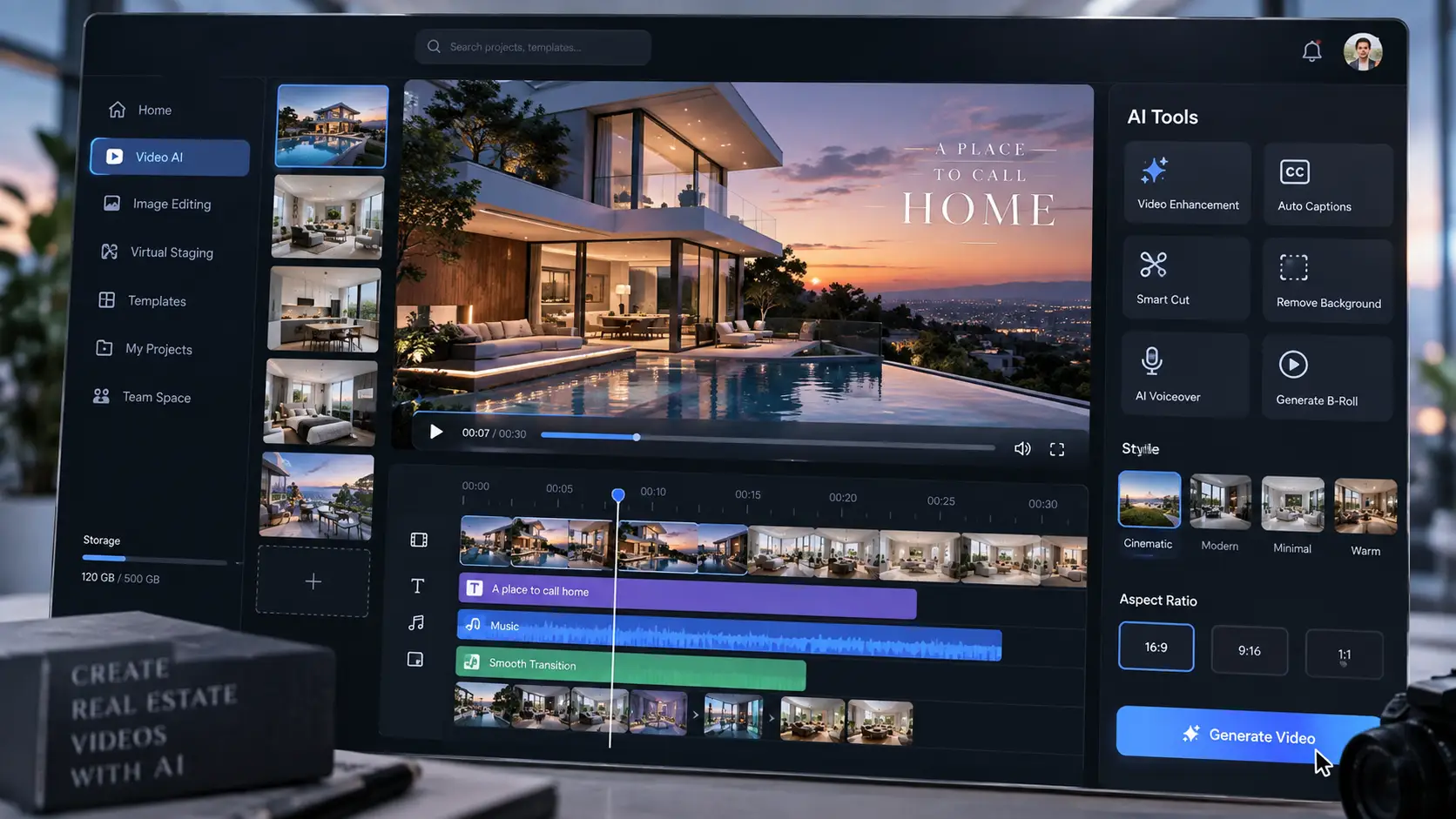
2. Crafting Cinematic Video Tours with AI for Real Estate
Furthermore, intelligent video editors can seamlessly transform raw smartphone footage into professional-grade cinematic tours. By applying smooth transitions, automated stabilization, and cinematic color grading, these video post-production services help properties stand out on social media platforms, capturing greater organic reach and engagement.
3. Virtual Staging and Spatial Decluttering Using Best AI for Real Estate
An empty or cluttered home often deters buyers and hinders their ability to visualize themselves living in the space. Modern virtual staging AI tools resolve this problem by digitally removing messy furniture and replacing it with beautifully scaled, photorealistic 3D interior designs, significantly boosting click-through rates and property inquiry volumes.
Read more: Insurance for Commercial Property: Tips for Owners
Best AI for Real Estate: What Should Agents Look For?
Choosing AI in Real Estate for Agent Workflows
There is no single best AI for real estate because each platform is designed for a different task. An agent who needs faster lead follow-up will evaluate different capabilities from a photographer who needs virtual staging or an investor who needs property valuation. The right tool is the one that solves a specific workflow problem without creating excessive correction, integration or compliance work.
Before choosing a real estate AI platform, agents should evaluate:
-
Workflow fit: Identify whether the tool addresses a clearly defined need, such as lead qualification, listing content, property valuation, virtual staging or transaction management.
-
Output accuracy: Test whether the results remain reliable across different properties, markets and input conditions, not only the examples shown in a product demonstration.
-
Human control: Confirm that users can review, revise and approve outputs before content is published or decisions are made.
-
System integration: Check compatibility with the existing CRM, MLS, email, document storage and transaction-management platforms.
-
Data protection: Review what information the provider stores, whether customer data is used for model training and whether users can export or delete their records.
-
Compliance support: Determine whether the platform provides controls for fair-housing risks, misleading property claims, image disclosure and user permissions.
-
Total operating cost: Calculate subscription fees, usage credits, advertising, onboarding, integrations, employee training and human-review time.
-
Scalability: Make sure the platform can maintain reliable performance as listing volume, users and workflow complexity increase.
From AI Real Estate Automation to Artistry: When Do You Need Professional Post-Production Services?

AI in Real Estate Meets Professional Post-Production
While automated tools provide exceptional speed and convenience for basic everyday tasks, they fall short when dealing with high-end luxury listings, complex architectural designs, or large-scale commercial developments. A poorly processed, inconsistent batch of photos with mismatched lighting and unnatural colors can severely diminish the perceived value of a premium property and damage an agent's brand reputation.
To guarantee that a property portfolio looks truly flawless and elite, the skilled hand of an expert editor remains indispensable. The ultimate "golden key" to conquering premium markets lies in a hybrid approach: leveraging fast automated tools for initial sorting, combined with a dedicated real estate photo editing and professional post-production service to deliver unmatched visual perfection that attracts high-net-worth buyers.
Conclusion
The rise of ai real estate is not about replacing the human element; it is about amplifying it. To win in today's competitive global market, property professionals must combine the speed of AI with the flawless quality of professional services.
This is where Rotider Media becomes your ultimate advantage. While you use ai in real estate to automate daily tasks, Rotider Media will provide you with services that technology cannot replicate.


.jpg)