
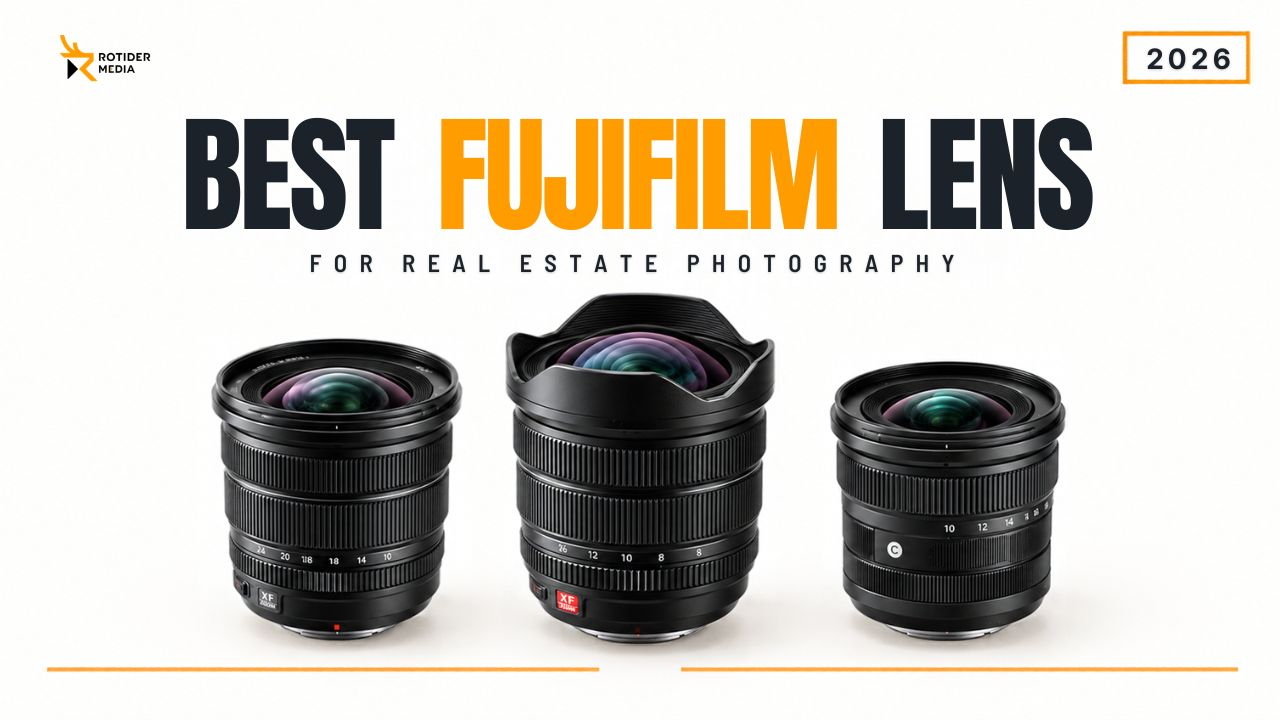
The best Fujifilm lens for real estate photography should give you enough interior coverage, flexible framing and usable detail across the finished image. For X-Series photographers, the XF 10-24mm f/4 R OIS WR is a practical starting point. The XF 8-16mm offers wider coverage, the Sigma 10-18mm provides a compact f/2.8 alternative, and the XF 8mm serves photographers who need an ultra-wide prime.
This guide focuses on Fujifilm X-mount options, with a separate section for GFX users. Recommendations reflect published specifications and their practical implications for property work, rather than hands-on testing by Rotider.
Best Fujifilm Lenses at a Glance
Choose your camera system first, then compare the coverage and handling each lens offers. Fujifilm XF lenses and the Sigma X-mount option below are intended for X-Series cameras.
|
Lens |
Approximate full-frame-equivalent coverage |
Maximum aperture |
Approximate weight |
Front filter thread |
Recommended role |
|
Fujifilm XF 10–24mm f/4 R OIS WR |
15–36mm |
f/4 |
385 g |
72 mm |
Versatile everyday property photography |
|
Fujifilm XF 8–16mm f/2.8 R LM WR |
12–24mm |
f/2.8 |
805 g |
No standard front screw-in thread |
Wider coverage with zoom flexibility |
|
Sigma 10–18mm f/2.8 DC DN Contemporary |
Approximately 15–27mm |
f/2.8 |
250 g in X mount |
67 mm |
Compact photo-and-video kit |
|
Fujifilm XF 8mm f/3.5 R WR |
Approximately 12mm |
f/3.5 |
215 g |
62 mm |
Lightweight ultra-wide addition |
Weights and filter specifications come from Fujifilm and Sigma. Equivalent focal lengths describe field of view; they do not change the actual focal length or exposure aperture of the lens. The recommended roles are editorial assessments, not optical rankings.
Best Fujifilm X Lenses for Real Estate Photography
A useful shortlist should explain what each option contributes to a working kit. These four lenses cover different priorities, from a flexible everyday zoom to wider specialist coverage. The Sigma is a third-party lens available in Fujifilm X mount.
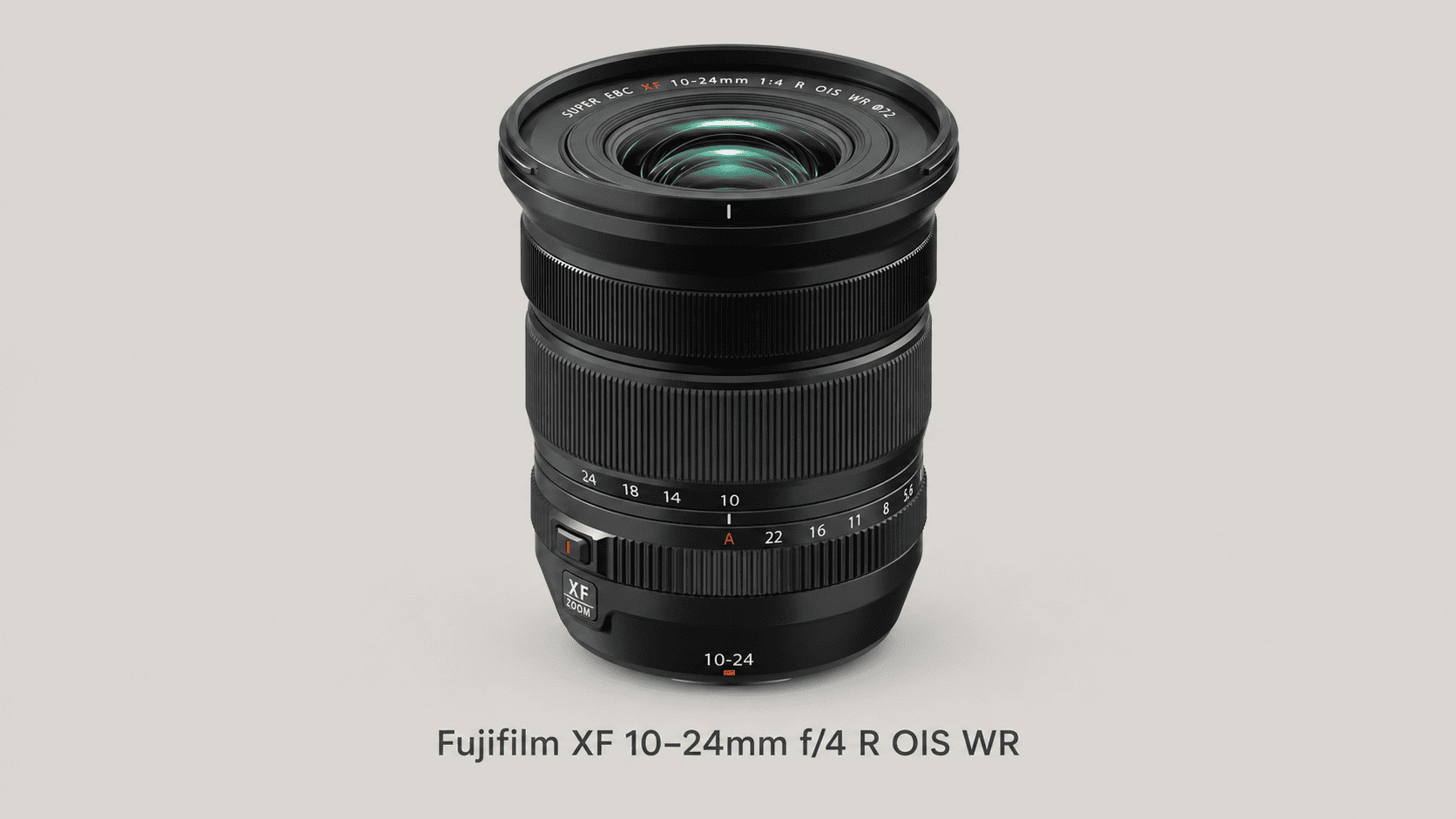
We recommend the XF 10–24mm f/4 R OIS WR as a starting point for Fujifilm X-Series property photography because it combines approximately 15–36mm-equivalent coverage, optical stabilization and a conventional filter thread. This is a workflow-based recommendation, not a claim that it produces the best image quality in every situation.
Its approximately 15–36mm-equivalent range covers wide interior views and tighter exterior compositions without changing lenses. It also features optical image stabilization and weather-resistant construction.
The longer end of the zoom range lets you tighten framing from a fixed camera position, excluding unnecessary floor, ceiling or edge distractions. Check the composition at capture rather than relying entirely on cropping later.
For static interiors on a tripod, f/4 can be sufficient when you can use longer exposures. Check whether 10mm provides the coverage your assignments require. If it does not, consider whether an 8mm option or a different camera position would solve the problem.
Fujifilm XF 8-16mm f/2.8 R LM WR
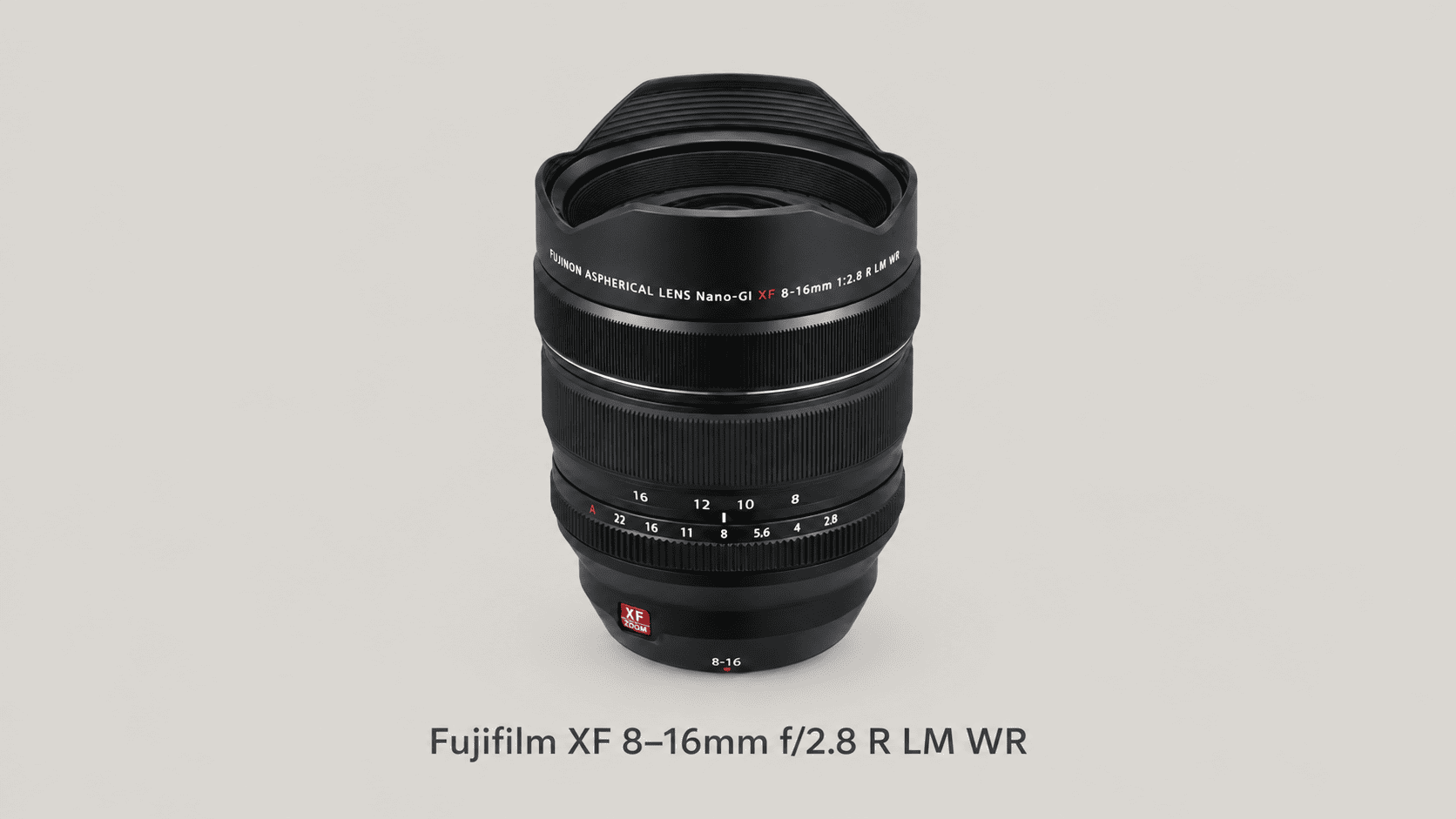
The XF 8-16mm f/2.8 R LM WR provides approximately 12–24mm-equivalent coverage with a constant f/2.8 maximum aperture.
Its main advantage for property work is the wider field of view. It unlocks more framing options in tight rooms, enclosed layout spaces, or fixed-furniture setups where backing up is impossible.
The trade-offs are significant: Fujifilm specifies its weight at approximately 805 g, and it lacks a standard front filter thread. Using filtration requires dedicated filter holder systems rather than standard screw-in filters.
Consider this lens when you regularly need coverage wider than 10mm and want to adjust framing without changing lenses. A larger, heavier lens does not automatically produce better images; check whether the additional width solves a recurring framing problem.
Sigma 10-18mm f/2.8 DC DN Contemporary
-1.png)
The Sigma 10–18mm f/2.8 DC DN Contemporary combines a constant f/2.8 aperture with a compact design. Sigma lists the Fujifilm X version at approximately 250 g, with a 67 mm filter thread.
This optic is a strong candidate for a lightweight hybrid setup for stills and video. Compared to the XF 10–24mm, its faster maximum aperture gives more exposure flexibility, while its lower weight reduces the load you carry. Check balance on your specific gimbal.
Both start at a nominal 10mm, so the Sigma is not a wider focal-length option. Compare corrected framing on your camera. Stopping at 18mm also limits your reach when tighter, more isolated framing is needed.
Double-check the lens mount before buying. The same model name comes in multiple camera mounts that are not interchangeable.
Fujifilm XF 8mm f/3.5 R WR
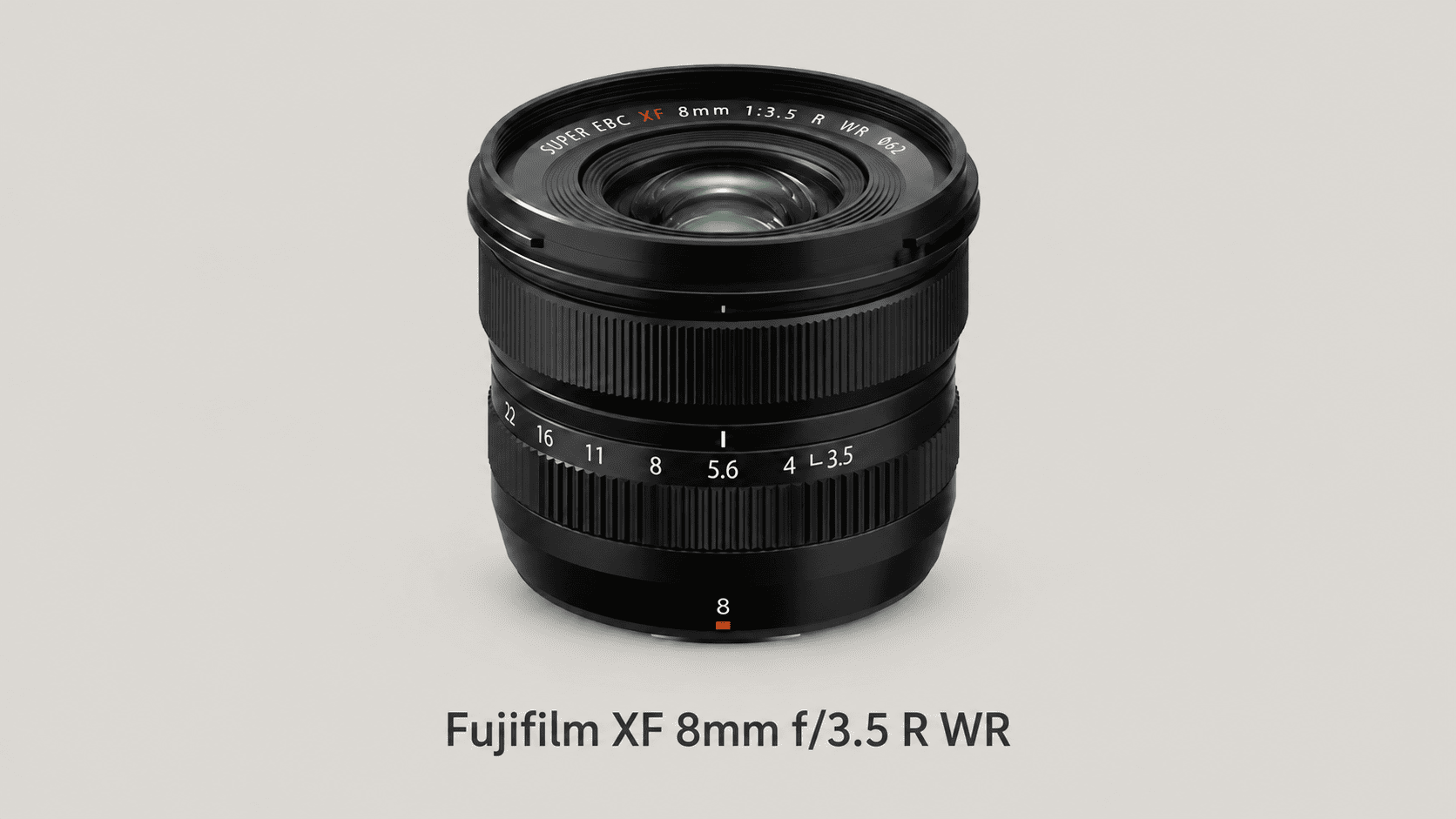
The XF 8mm f/3.5 R WR offers a fixed ultra-wide field of view in an approximately 215 g package, with a 62 mm front filter thread.
This lens primarily serves as a specialized complement to a more flexible optic. Photographers who use a 10–24mm zoom can carry this 8mm prime for compositions that need additional coverage.
The fixed focal length presents inherent limitations. When the 8mm captures too much excess scene detail, you must physically reposition, crop, or switch lenses. Moving closer alters spatial perspective, yielding a different result than zooming from a fixed position.
It is a valuable niche tool for solving specific coverage challenges. Using it as your only lens may slow the workflow if the assignment requires frequent changes in framing.
Which Fujifilm Lens Fits Your Property Photography?
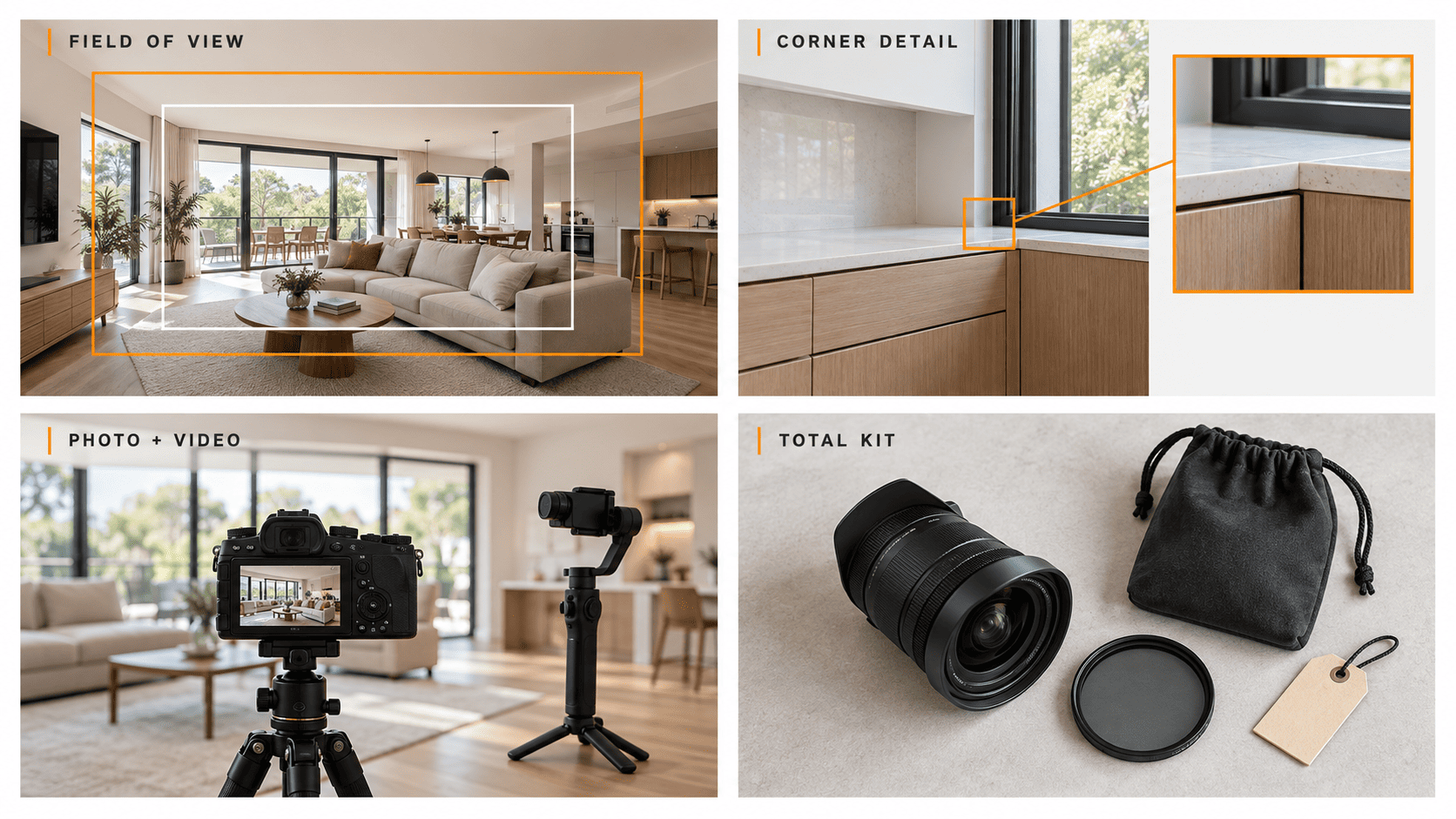
Choosing the best Fujifilm lens for real estate photography starts with identifying what your current setup lacks: wider coverage, more framing flexibility or a faster maximum aperture.
XF 10-24mm vs. Sigma 10-18mm
Both are practical everyday options in this shortlist. Both start at a nominal 10mm, but the Fujifilm extends to 24mm while the Sigma offers a wider f/2.8 maximum aperture.
Choose the Fujifilm XF 10–24mm if framing versatility and optical stabilization are essential to your workflow. Select the Sigma if you prioritize a lighter footprint and a faster aperture for your shooting needs.
With both lenses set to the same working aperture, shutter speed and ISO, nominal exposure is similar, although actual light transmission can differ. The f/2.8 maximum aperture can help with video or handheld work when you need more light at a particular shutter speed.
No spec sheet conclusively proves which optic delivers superior overall image quality. Evaluate processed sample files shot on the same camera body at matched focal lengths, apertures, and export sizes.
When the XF 8-16mm Is Worth Considering
Consider the XF 8-16mm if you regularly require a field of view wider than 10mm and need framing adjustments without swapping lenses.
For instance, constrained camera positions may demand 8mm to capture a full room overview, while a subsequent angle works better at 12mm or 16mm. A zoom range allows these modifications directly from your setup spot.
A wider view can help show room connections when a tighter composition leaves out important context. Check camera distance, foreground proportions and stretching near the frame edges.
When an 8mm Prime Makes Sense
An 8mm prime lens is a practical choice when ultra-wide shots are an occasional requirement rather than a staple of every assignment.
It complements a daily walkaround zoom without adding the bulk of an 8–16mm optic. Furthermore, its standard filter thread offers straightforward compatibility for photographers accustomed to traditional screw-in filtration.
However, a lighter lens does not guarantee a faster workflow. Frequent lens swaps can disrupt shooting momentum. If your work demands constant switching between 8mm and other wide-angle focal lengths, a zoom lens may be more practical.
Read more: Best Canon RF Lens for Real Estate Photography in 2026
What to Check Before Buying a Fujifilm Real Estate Lens
When choosing a Fujifilm real estate lens, evaluate it on your intended camera and through your normal editing process. Specifications help identify candidates; representative files help you assess their suitability.
Actual Focal Length and Full-Frame-Equivalent Coverage
For Fujifilm X-Series APS-C cameras, applying the 1.5× crop factor simplifies field-of-view comparisons against full-frame systems.
Accordingly, an 8mm lens provides a 12mm equivalent field of view, 10mm corresponds to 15mm, and 16mm equates to 24mm. These figures illustrate why a zoom starting at 16mm may be restrictive for interiors with limited camera positions.
A wider maximum aperture does not by itself provide a wider angle of view. Compare focal length, sensor format and corrected framing separately from aperture.
Corner Detail and Lens Corrections
Inspect cabinetry, door frames and other details near the edges. Compare images at apertures you expect to use, rather than judging a lens solely from wide-open sample photographs.
Adobe explains that lens profiles in Lightroom and Camera Raw can correct common aberrations, including geometric distortion and vignetting. It also distinguishes profiles for RAW and non-RAW files.
For image-quality comparisons, use the same camera, a shared focal length and working aperture, and the same processing and export size. Test the widest settings separately to compare coverage.
Check whether your software has already applied a built-in lens profile before adding further corrections. Review the final corrected framing as well as detail: an important feature may be lost after straightening and cropping.
Aperture, Stabilization and Property Video
For static interiors, a stable tripod often lets you use longer exposures while keeping the aperture needed for depth of field. An f/4 maximum aperture can therefore be sufficient without raising ISO simply to compensate for handheld camera shake.
Video requirements often differ. A faster maximum aperture helps when shutter speed options are constrained, though you must still maintain sufficient depth of field across the spatial composition.
Image stabilization requires evaluation at the system level. Lens stabilization (OIS), in-body stabilization (IBIS), and digital stabilization operate via distinct mechanisms. Verify which combination your camera body supports, and account for any potential frame crop introduced by your intended video recording mode.
Filters, Weight and Total Cost
When making a purchasing decision, carefully evaluate factors such as filter integration, transport options, and video support requirements.
If you need filters, check whether a lens without a standard front thread requires a compatible holder system. Furthermore, a heavier lens directly alters the setup balance when mounted on a tripod head or gimbal stabilizer.
Always compare current pricing for the exact lens version and correct mount specification. Condition (new vs. pre-owned), warranty coverage, and included accessories can substantially alter the overall value of a listing.
Read more: Best Sony FE Lens for Real Estate Photography in 2026
Should You Buy the Original XF 10-24mm or the WR Version?
The original XF 10-24mm f/4 R OIS can remain worth considering when its condition and price are attractive. The WR version brings handling and construction updates, rather than a completely redesigned optical formula.
In its WR launch announcement, Fujifilm states that the newer lens uses the same optical design as the original. Updates include weather resistance, improved stabilization, an aperture scale and an A-position lock. Fujifilm also reports a 25 g weight reduction.
The WR version may justify a higher price if weather resistance, updated stabilization and aperture-ring controls matter to your work. For indoor tripod photography, a well-maintained original version may still meet your needs. Compare condition, handling and current prices before deciding.
When buying pre-owned glass, carefully inspect optical integrity, autofocus consistency, and edge-to-edge sharpness. Do not assume that every older model is a bargain or that the WR designation guarantees better image quality.
What About Fujifilm GFX for Real Estate Photography?
GFX is a separate camera system, so the X-mount shortlist above does not transfer directly.
For an interchangeable-lens GFX camera, the GF 20-35mm f/4 R WR is a relevant wide-angle option to examine. Fujifilm specifies approximately 16-28mm-equivalent coverage, a constant f/4 aperture, a 725 g weight and an 82 mm filter thread.
Whether a medium-format GFX system makes business sense depends on delivery requirements, system cost and the workload involved in processing the files. Large-format commercial prints, highly detailed architectural documentation, and aggressive cropping demands create distinct technical needs compared to standard digital web deliveries.
Evaluate the system as a whole, including file handling overhead, storage infrastructure, and post-processing turnaround times. A larger format size does not eliminate the fundamental need for precise lighting control, deliberate composition, or consistent retouching workflows.
Frequently Asked Questions
What Is the Best Budget Lens for Fujifilm Real Estate Photography?
Compare the current price of the Sigma 10-18mm f/2.8 with used original XF 10-24mm lenses. The better value depends on condition, warranty, required zoom range and whether you need f/2.8. There is no fixed budget winner across every market.
Is 10mm Wide Enough for Real Estate Interiors?
It can be. On Fujifilm X, 10mm provides approximately 15mm-equivalent coverage. Whether that is sufficient depends on camera position and the features the photograph needs to show. Test your most restricted compositions before deciding you need 8mm.
Is 8mm Too Wide for Property Photography?
Not automatically. It can provide useful coverage where access is limited, but it requires careful composition. Watch foreground objects and frame edges, and use a tighter view when it communicates the space more clearly.
Do You Need f/2.8 for Real Estate Photography?
No. Static interiors photographed on a tripod can often be captured with a slower shutter speed. F/2.8 becomes more useful when handheld work, video or other assignments require additional light at a particular shutter speed.
Can You Use a 16-55mm Lens for Real Estate Photography?
Yes, particularly for exteriors, details and interiors where you have enough working distance. However, 16mm on Fujifilm X gives approximately 24mm-equivalent coverage. It may not replace an ultra-wide lens for restricted interior compositions.
Can Fujifilm XF Lenses Be Used on GFX Cameras?
XF lenses are designed for Fujifilm X mount and are not native fits for GFX’s G mount. GFX users should choose lenses designed for that system or investigate a specifically supported adapted solution, including its coverage and functional limitations.
Conclusion
The best Fujifilm lens for real estate photography depends on the coverage and flexibility your assignments require. The XF 10-24mm f/4 R OIS WR is a practical everyday starting point, while the Sigma 10-18mm f/2.8 offers a compact alternative. Consider the XF 8-16mm when wider zoom coverage is essential, or the XF 8mm as a lightweight addition for specific compositions.
Before buying, compare representative corrected files and include filters, handling and camera compatibility in the decision. A lens should solve a recurring production need.
Once the files are captured, consistent post-production helps create a cohesive property gallery. Rotider supports photographers and media teams with real estate photo editing, allowing capture decisions to remain focused on composition, lighting and accurate property presentation.

.jpg)
-1.png)



 (1).png)



.png)