
July 23, 2025
Real Estate Insights
Discover Real Estate Photography Pricing in 2026
Real Estate Photography Pricing in 2026 offers flexible options for every type of listing, from small rentals to luxury estates. With rates starting as low as $50, services range from basic interior shoots to high-end twilight and drone photography. In this guide, we break down the latest pricing trends and what to expect when investing in professional property visuals.
How Much Does Real Estate Photography Cost in 2026?
The cost of real estate photography in 2026 depends on property size, location, photographer’s expertise, turnaround time, and services provided. Quality listing photos are widely considered a necessary investment for attracting buyers and closing deals faster.
Standard photography typically ranges from $150 to $500, with low-end packages starting at $100–$200 for smaller homes and high-end packages exceeding $1,000 for luxury properties. Most residential listings include 20–30 professionally edited photos, while luxury listings may require 40–60, along with additional marketing materials.
Add-on services like drone photography, twilight sessions, and 3D tours come at a premium due to the extra equipment and editing involved, with commercial shoots commanding the highest rates overall. Most photographers charge per property or per delivered image, making it easy for agents to budget accordingly.
Real Estate Photography Pricing by Service Type in 2026
Standard Photography (from $150 to $500) is the most common option, covering 15–30 high-resolution interior and exterior shots with professional editing and MLS-ready delivery. Ideal for condos, townhomes, and most residential listings.
Twilight Photography (from $200 to $750) captures properties during sunset for a warm, dramatic look. Popular for luxury homes and standout listings. Pricing varies based on home size, number of shots, and shoot complexity.
Aerial / Drone Photography (from $100 to $500) showcases property layout, lot size, and surroundings from above. Especially useful for large estates, waterfront homes, farms, and commercial buildings. Standalone drone video packages may cost more.
Commercial Real Estate Photography (from $150 to $5,000+) covers apartment complexes, office buildings, hotels, and retail or industrial properties. Small commercial shoots start around $150–$500, while full-day or multi-day productions can exceed $5,000.
Photo-Based Floor Plans (from $300 to $1,200+) give buyers a visual layout reference before scheduling a viewing. Pricing depends on property size, complexity, and whether a basic or 3D floor plan is requested.
What Factors Affect Real Estate Photography Pricing?
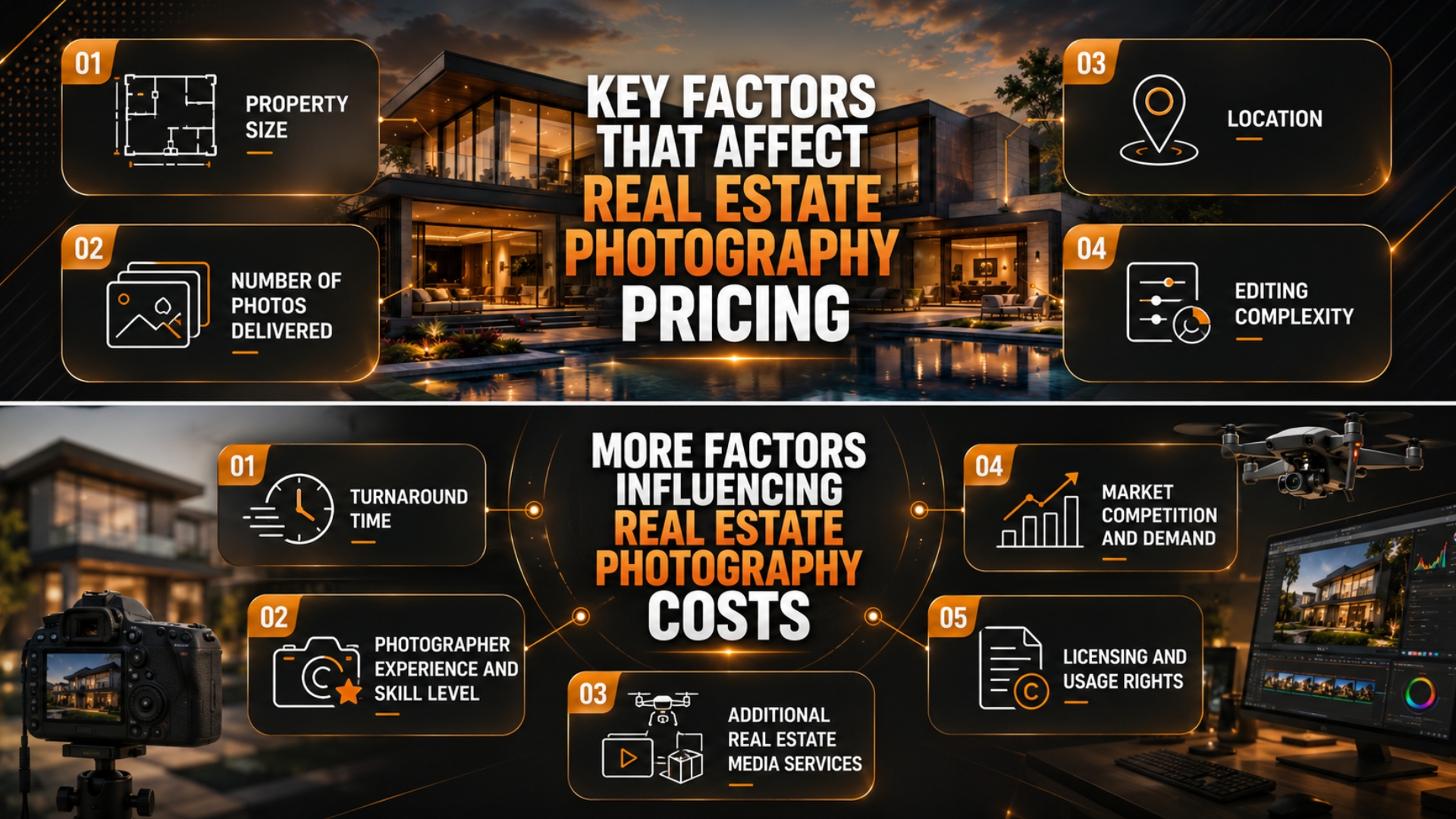
Real estate photography pricing isn’t one-size-fits-all. Several variables influence what a photographer charges, and understanding them helps you budget accurately and compare quotes fairly.
Property Size
Propertyt size will be the biggest determinant of the total cost of any photography session. The larger the space, the more time that you will need. It will take you more time to cover more spaces, angles, equipment movements, and ultimately post-production editing of more images. This problem is solved by most photographers in two ways:
The most prevalent method would be to price per square foot as follows, however, you should always ask your service provider for the exact pricing change:
- Under 1,500 sq ft: $150-$250
- 1,500-2,500 sq ft: $200-$350
- 2,500-3,500 sq ft: $300-$450
- 3,500-5,000 sq ft: $400-$600
Per-room rates are not as common but are still used by some photographers, especially in the case of small properties. Here, the basic fee includes all the primary spaces, and the fee per extra bedroom, bathroom, or loft costs between $15-$40.
Pro tip: Square footage does not paint the whole picture. A home of 1,800 sq ft that has an open-plan floor design goes quickly compared to a home of 1,800 sq ft that has eight small and cluttered rooms. If your home has a complicated layout, mention it ahead of time; some photographers will include it in the price, and it is always better to know the true cost.
Common mistake: Thinking that all rooms are made equal. A finished basement, detached guest house, and garage apartment are some examples of places where you have to pay separately, despite being included in the total square footage.
Number of Photos Delivered
Some photographers will give you an unlimited number of pictures as long as there are pictures to be taken. Some of these photographers have set package deals. When you are comparing prices, make sure that you are comparing the same output – 25 edited photos and unlimited photos are different.
Pro tip: Bigger does not necessarily mean better, especially if you are talking about listing in MLS. Multiple studies have found that the listings that post between 30 and 40 excellent photos have performed better than those that post more than 60 poor photos. Buyers browse fast – what counts are the images that they will appreciate the most.
Common mistake: Buying an unlimited package deal that gives them a hundred or more pictures, even though their 900 sq ft condo really only needs 20.
Location
Location plays a key role in determining how much a photographer can charge for their services. Professional photographers working in high-cost-of-living areas incur higher costs such as rent, insurance, and vehicle costs, depending on the area’s economy.
Cities in the premium category, such as New York City, San Francisco, Los Angeles, Boston, Seattle, and Miami, tend to have higher base prices than those seen across the country. While a photography session might cost about $200 in a moderately priced Midwest city, it might go as high as $350-$450 in the Big Apple.
Medium price cities such as Nashville, Denver, Phoenix, Austin, and Raleigh fall in the middle of the pricing range. Suburban and rural areas are usually at the lower end of the base prices scale. However, there is a critical factor here – travel costs.
Travel Fees: Most photographers work within a defined service radius, typically 15–30 miles from their base of operations.
Pro tip: If you’re listing a rural or vacation property, look for photographers who specialize in your region rather than hiring a city-based photographer and absorbing the travel cost. Local specialists often produce better results and charge less in total.
Common mistake: Ignoring travel fees when comparing quotes. A $250 quote from a photographer 60 miles away may end up costing $350 after travel charges, more than the $299 quote from a local specialist.
Editing Complexity
Basic editing, such as exposure corrections, white balancing, perspective adjustments, and color grading, is all part of a typical commercial photography session for properties. The amount of additional post-processing that may be required and could be costly is what sets one property shoot apart from another.
Standard Editing (Included in Base Price)
- Exposure and brightness correction
- Color balancing and white balance adjustment
- Lens distortion correction
- Basic sky replacement (overcast to blue sky)
- Horizon and vertical alignment
One of the most valuable and popular extras is the addition of virtual staging. This means that the photographer digitally adds furniture inside an empty room instead of renting actual items. While it will undoubtedly increase the overall cost of your shoot significantly, it always brings better results compared to empty rooms. The HDR merging technique involves putting together several exposures of the same shot, resulting in one balanced image. Most photographers offer a simple HDR merging as part of the base package, with multi-exposure HDR charged as an extra. Alternatively, you may have twilight editing done – converting the daytime exterior to the beautiful golden hour using digital processing on a per-image basis. Or you may book a golden hour visit as an add-on.
Several other services, although small-scale, might accumulate to quite a considerable sum. Among those, there is an object/clutter removal from your photo, as well as grass and lawn enhancement for the wintertime or when a property looks bad due to drought. These are inexpensive individually, but could considerably increase your bill when you combine several types of retouching per photograph.
Pro tip: Before your shoot, ask specifically what editing is included in the base price and what costs extra. Photographers vary widely on this. Getting clarity upfront prevents sticker shock when you receive the invoice.
Common mistake: Assuming that because you’ve seen beautiful day-to-dusk images in a photographer’s portfolio, that service is included in their standard rate. It almost never is.
Turnaround Time
Timing is key in real estate; for instance, an advertisement posted on Thursday requires pictures to be available the previous night, and in cases where a property reverts to the market after a collapsed deal, pictures may be required within the same day. It should be noted that a 24-48 hour turnaround is considered standard within the cost of most photographers.
For a $300 shoot, same-day delivery could add $75–$120. For a luxury $800 shoot, rush fees can push the total well past $1,000.
Expert tip: Plan whenever possible. Locking in your shoot date 5–7 days before your desired listing date gives you buffer time for reshoots, weather delays, or last-minute staging changes, and saves you the rush surcharge.
Pro mistake: Scheduling a shoot the day before a listing goes live with no backup plan. If the home isn’t ready, if weather prevents exterior shots, or if the photographer encounters technical issues, you’re either paying rush fees or delaying the listing.
Photographer Experience and Skill Level
Not all real estate photographers charge the same rates, and experience is one of the biggest reasons why. A beginner photographer may offer low-cost packages to build a portfolio, while an established professional with years of real estate experience will typically charge premium rates for consistent quality and reliability.
Experienced photographers often invest heavily in professional-grade cameras, wide-angle lenses, drone equipment, lighting systems, editing software, insurance, and backup gear. More importantly, they understand how to photograph spaces in a way that makes properties appear brighter, larger, and more appealing to buyers.
Expert tip: Review full property galleries rather than only looking at highlight images on Instagram or a website homepage. Consistency across an entire listing is a much better indicator of professional skill than a few impressive portfolio shots.
Pro mistake: Choosing the cheapest photographer available without considering image quality, reliability, or turnaround consistency. Poor photography can reduce buyer interest and may ultimately cost far more than the money initially saved.
Additional Real Estate Media Services
Modern real estate marketing rarely relies on photography alone. Many photographers now offer complete media packages that combine photos with video, drone footage, virtual tours, floor plans, social media reels, and virtual staging services. While these add-ons improve listing presentation and marketing performance, they also increase the overall project cost.
Drone photography is one of the most common upgrades, especially for waterfront homes, large estates, farms, or properties with attractive surroundings. Real estate videography, cinematic walkthroughs, and vertical social media content have also become increasingly popular in competitive housing markets.
Bundling multiple services together is often cheaper than ordering each service individually, which is why many photographers offer tiered media packages for agents and brokerages.
Expert tip: Think carefully about which media services genuinely help market your property type. A downtown condo may benefit more from social media reels and lifestyle videos, while a large rural estate may gain more value from drone photography and aerial mapping.
Pro mistake: Ordering every available add-on without considering ROI. Not every listing requires cinematic video, drone footage, twilight photography, and virtual staging at the same time.
Market Competition and Demand
Local market conditions can significantly influence real estate photography pricing. In highly competitive housing markets where listings move quickly and presentation quality matters more, professional photographers are often able to charge higher rates due to stronger demand.
Busy real estate seasons can also affect pricing. During spring and summer, typically the peak months for property listings, photographers may become fully booked weeks in advance and raise prices because of limited availability. In slower markets or off-season periods, discounts and promotional packages are more common.
Luxury markets also tend to command higher photography rates because sellers and agents expect more advanced production quality, faster turnaround times, and premium editing standards.
Expert tip: Build relationships with photographers before peak listing season begins. Agents who consistently book with the same photographer often receive priority scheduling, bundled pricing, or preferred rates during busy months.
Pro mistake: Waiting until the peak spring market to search for a photographer at the last minute. High-demand photographers may already be booked out, leaving only limited or overpriced options available.
Licensing and Usage Rights
This is probably the most underrated aspect of pricing for real estate photography, but it could also be the most important from a legal standpoint. Each set of photographs is accompanied by certain rights to use them, which are outlined in the photographer’s contract.
Standard MLS Licensing
The base pricing from virtually every real estate photographer includes rights for MLS listing purposes. This covers:
- Posting images on the MLS
- Sharing on the agent’s and brokerage’s website
- Standard social media posts tied to the active listing
- Email marketing to client databases
What Standard Licensing Typically Does NOT Cover
- Print advertising in newspapers or magazines
- Billboard or large-format advertising
- Use in television commercials
- Reuse of images for future listings at the same property (by a different agent)
- Use in a developer’s portfolio or architectural publication
- Permanent use by the brokerage after the listing closes
If you intend to use listing photos for any of these purposes, you’ll need to negotiate an extended or commercial license, which can add anywhere from $100 to several thousand dollars, depending on the scope.
In most contracts, the rights to the photos remain the property of the photographer, and what you are paying for is a license to use them. This is typical when dealing with photographers commercially; however, it always surprises agents and sellers that once they have paid for a set of photos, the rights to those photos remain with the photographer. If full ownership is what you need, then it can be arranged, but at a higher cost.
Pro tip: If you and your team plan on using the photos in various formats, including print, as well as for branding and marketing purposes, it would make sense to talk directly to your photographer regarding licensing before any contract.
Common mistake: Using photos that were taken during the sale of a property for another listing. It is an actual risk for you, legally speaking, and happens quite frequently.
How to Get the Best and Most Cost-Effective Real Estate Photos
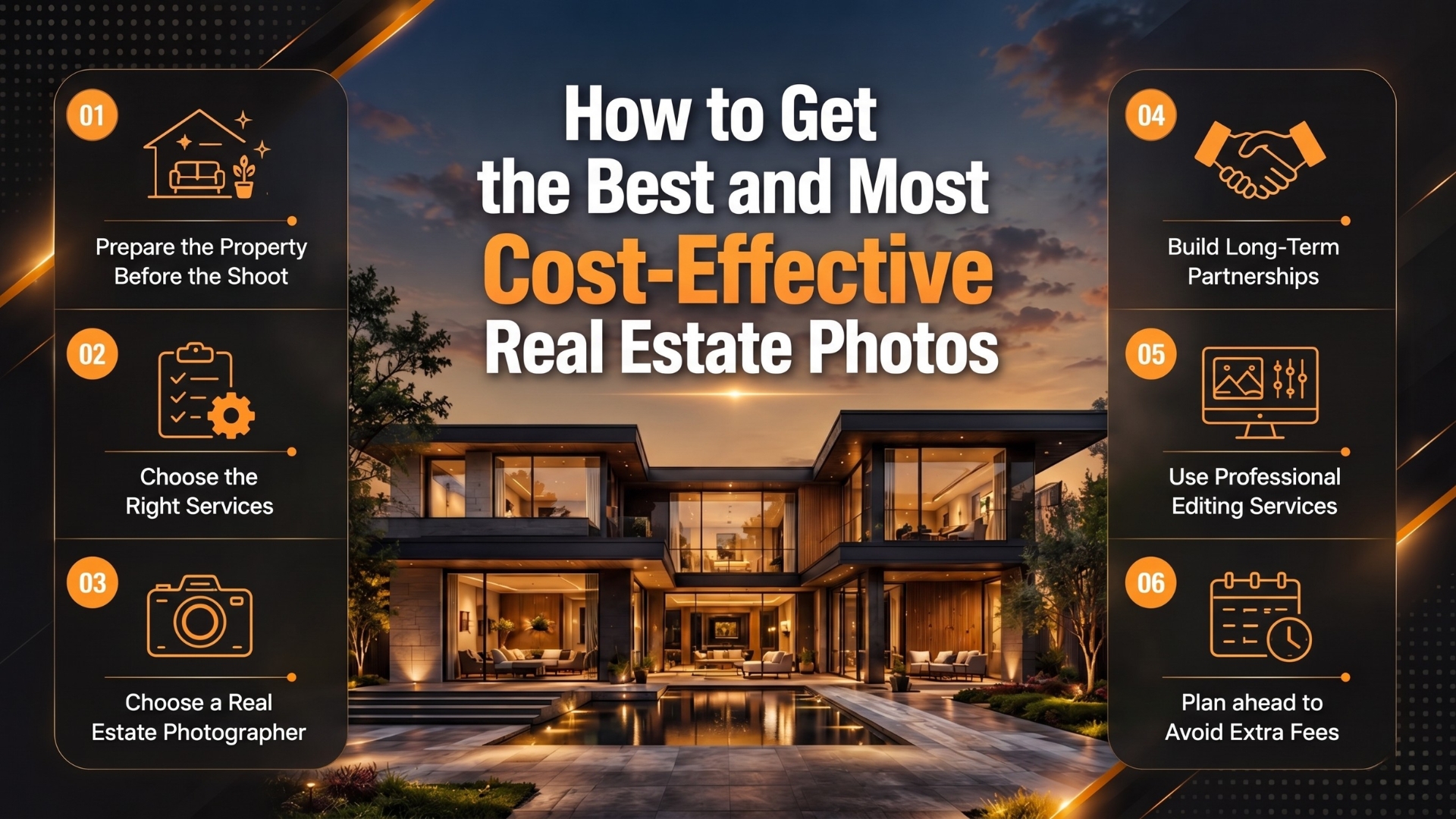
Prepare the Property Before the Shoot
One of the most effective ways to get better real estate photos without increasing costs is proper property preparation. Clean, decluttered, and well-organized spaces photograph more efficiently and usually require less editing afterward. Simple steps such as opening curtains, turning on lights, cleaning windows, and improving curb appeal can significantly improve the final images while helping the shoot run faster.
Choose the Right Services
Not every listing needs every type of real estate media service. Standard homes may only require professional HDR photography and basic editing, while luxury properties may benefit from drone photography, video tours, or virtual staging. Choosing services based on the property’s actual marketing needs helps keep photography costs under control while still delivering effective listing visuals.
Choose a Real Estate Photographer
Choosing the right real estate photographer can make a significant difference in how your property is perceived online, save time, and be effective. With so many photographers offering similar services, it’s important to look beyond just pricing and focus on experience, quality, and reliability. Here’s what to consider when hiring a real estate photographer:
- Portfolio and Style: Start by reviewing the photographer’s portfolio. Look for clean, bright, and well-composed images that reflect a consistent visual style. The right portfolio should match the aesthetic you want for your listings.
- Experience in Real Estate: A skilled real estate photographer knows how to capture the flow of a room, create depth, and showcase features such as kitchens, views, or architecture. Experience with real estate means they understand what sells and how to shoot with buyers in mind.
- Services and Pricing: Ask what’s included in their packages: number of images, photo editing, turnaround time, twilight or drone options. Compare this with their pricing. A lower price doesn’t always mean better value. Sometimes, a slightly higher cost includes editing, fast delivery, or more professional output that helps you sell faster.
- Equipment and Expertise: Professional real estate photographers use wide-angle lenses, tripods, lighting kits, and HDR techniques to create polished results. Ask about their equipment and workflow. Their technical knowledge directly affects how your photos look, especially in challenging spaces with poor lighting or limited angles. Especially if you are interested in aerial photography, ask about equipment and permits in advance, as aerial shooting may require a license in some areas.
- Reviews and References: Always remember to check client testimonials or ask for references. Past reviews offer insight into the photographer’s reliability, communication, and consistency. A strong reputation is often the best indicator of future success.
Build Long-Term Partnerships
Working consistently with the same photographer or editing company can improve both efficiency and pricing over time. Many real estate media providers offer discounts, faster turnaround times, and more consistent editing styles for recurring clients. Long-term partnerships also improve communication and help create a more consistent visual identity across multiple listings.
Use Professional Editing Services
For photographers, outsourcing editing can be a practical and affordable way to maintain image quality while increasing productivity. Professional editors can handle HDR blending, perspective correction, color balancing, sky replacement, and other post-production tasks more efficiently. This allows photographers to focus more on shooting properties and managing clients instead of spending excessive time on editing.
Plan Ahead to Avoid Extra Fees
Most real estate photographers include a standard turnaround time of 24 to 48 hours within their regular pricing. However, rush delivery or last-minute bookings often come with additional fees. Scheduling shoots in advance and preparing the property ahead of time can help avoid unnecessary costs while ensuring smoother project management.
Rotider Media – Affordable and High-quality Real Estate Photo Editing Services
Instead of paying premium rates for fully edited photography packages, agents and photographers can outsource post-production to Rotider Media, gaining tighter control over per-listing costs while maintaining professional output. With transparent pricing, scalable workflows, and fast turnaround times, Rotider Media supports both individual agents and high-volume real estate teams.
Core Real Estate Photo Editing Services at Rotider Media
Rotider Media offers six core editing services designed to cover every listing scenario:
- HDR photo editing: Natural HDR blending with balanced exposure, color correction, and detail enhancement.
- Day to dusk editing: Converts daytime exterior shots into warm, atmospheric sunset scenes to increase buyer engagement.
- Twilight editing: Premium twilight effects including sky replacement and enhanced interior lighting for high-impact listings.
- Object removal editing: Removes distracting elements such as vehicles, trash bins, signage, or cables.
- Flash photo editing: Blends flash and ambient exposures to achieve accurate colors and sharp detail.
- Single photo editing: Basic enhancement for single-exposure images, covering exposure correction and color grading.
How Outsourcing to Rotider Media Reduces Real Estate Photography Costs
By outsourcing editing to Rotider Media, photographers and agents can lower their per-listing production costs without lowering visual standards. This approach enables faster delivery times, consistent quality across all listings, and the flexibility to scale, whether handling five listings a month or five hundred.
Want to optimize your real estate photography pricing without sacrificing quality? Start your order here.
FAQs about Real Estate Photography Pricing
How much should I budget for real estate photography?
If you are looking at normal-sized residential property listings, a budget between $200 and $500 will be sufficient for capturing the listing in professional photographs, with around 25 to 40 images edited professionally. For luxury listings or larger properties, along with special photography services such as drone photos and twilight shoots, you might have to budget from $500 to $1,200. Some real estate agencies even pay up to $1,500 for their photography in order to maximize the visual impact of the listing.
Is it worth paying for professional real estate photography?
Indeed, that is always the case. Properties that are listed with professional pictures tend to move much faster, and they usually go at a price close to the asking price compared to other properties that don’t have professional photographs. According to Redfin statistics, properties with professional photographs go for about $3,400 more compared to other similar properties taken with a smartphone or amateur cameras. When it comes to properties above $250,000, the photography cost pays for itself several times over.
How many photos do I need for a real estate listing?
A general guideline is around one photograph for every 100 square feet of living space, plus photographs of the outside and details. This means that for a 1,500 square foot condominium, 20 to 25 pictures should be enough. A 3,500 square foot house with a pool, landscaping, and many rooms would require 40 to 60 photographs in order to provide an adequate representation. The number of photos that can be uploaded on any MLS service usually cannot exceed 50.
Do real estate photographers charge by the hour or per property?
Almost all cases on a per-property basis for residential homes. The flat-rate, per-property model will be the accepted norm in the year 2026, which benefits the real estate agent because he knows what his fee is going to be, and the photographer has no reason to waste time taking pictures. The hourly rate is sometimes used for commercial properties or larger properties, such as those over 5,000 square feet.
Should I hire a local photographer or use a national photography service?
There are pros and cons of both. The advantage of national services such as Snappr or other platforms is that they offer fixed pricing, easy booking online, and wide coverage – this can be especially beneficial for agents who deal with large amounts of business in different cities. Local photographers may give you better personal attention, knowledge about the local style and flexibility in time and type of work. For complicated and luxury listings where photography matters most, a reputable photographer from your local market would be more appropriate.
Annie Doo
Professional Video Editor
Hi, I’m Annie Doo, a professional video editor specializing in real estate post-production. Through hands-on experience with real-world projects, I’ve developed a strong understanding of visual storytelling, pacing, color, sound, and the workflows behind polished real estate videos. Here, I share practical insights, editing techniques, and production knowledge drawn from my day-to-day work in video post-production.
Was this article helpful?
Your feedback helps us create more useful real estate media guides.
Share this article


No Spam, Just Updates
Our fresh blogs provide technical and industrial information that helps strengthen your business. Sign up to be the first to receive the new updates
Related Posts

AI in Real Estate: A New Leap for Property Professionals
Sep 9, 2026
AI for Real Estate Marketing: A Practical Guide for Agents and Agencies
Sep 9, 2026
AI for Real Estate Agents: Practical Uses and Future Trends
Sep 7, 2026
15 Real Estate AI Companies to Know in 2026
Sep 5, 2026
How to Find Real Estate Image Editing Jobs in the USA
May 2, 2026