
June 28, 2025
Photo Editing
Professional Outsource Real Estate Photo Editing Guide in 2026
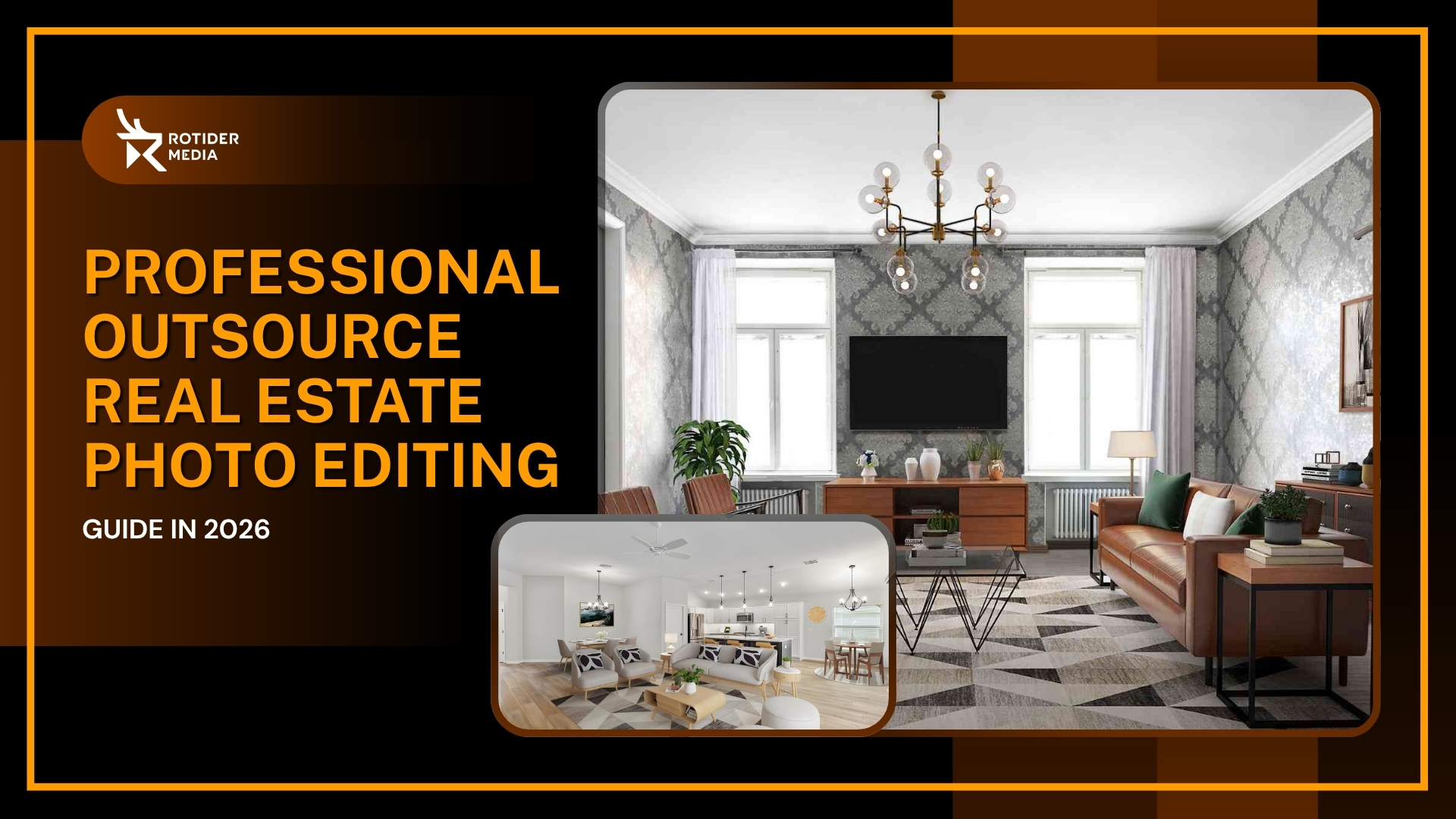
Online real estate marketing is the best way to upsell. Professionally edited photos are essential to attracting buyers, creating a strong first impression, and increasing property value.
However, real estate photo editing can be time-consuming and requires specialized skills. That’s why many agents and photographers choose to outsource real estate photo editing as a smart way to save time, reduce workload, and ensure consistent results.
What Does It Mean to Outsource Real Estate Photo Editing?

To outsource real estate photo editing means to hire a third-party editing company or remote team to handle the post-production of property photos instead of editing them in-house. This helps real estate photographers and agencies maintain consistent image quality while saving time and scaling faster.
Real estate photo editing involves improving raw property images by correcting lighting, colors, exposure, sky appearance, and overall presentation to create marketing-ready photos for MLS listings, real estate websites, and property advertisements.
In a typical outsourcing workflow, photographers send RAW, CR2, or JPEG files to an editing partner, who applies edits based on the client’s style guide and returns the finished images within the agreed-upon turnaround time.
What Tasks Are Typically Outsourced?
Not all editing tasks are equal in time, skill, or cost. The most commonly outsourced real estate photo editing tasks include:
- Color Correction and Exposure Balancing: Adjusting white balance, correcting overexposed windows, lifting shadows, and ensuring color consistency across an entire shoot.
- HDR Blending: Combining 3–5 bracketed exposures into one naturally lit image that captures both interior detail and exterior views simultaneously.
- Sky Replacement: Swapping grey or washed-out skies with clean blue skies and natural cloud formations, a standard expectation in most markets today.
- Window Pull: Compositing separately exposed interior and exterior views so neither appears blown out, requiring precision masking.
- Perspective and Lens Correction: Fixing barrel distortion, aligning vertical lines, and correcting wide-angle warping for architectural accuracy.
- Object and Clutter Removal: Removing power lines, parked cars, temporary furniture, or personal items left by homeowners.
- Virtual Staging: Digitally furnishing empty properties with rendered furniture and décor to help buyers visualize the space.
- Lawn and Greenery Enhancement: Replacing dry or patchy grass with lush turf and enhancing garden areas for stronger curb appeal.
- Twilight and Day-to-Dusk Conversion: Transforming daytime exteriors into golden-hour scenes at a fraction of the cost of an actual twilight shoot.
The Best Way to Outsource Real Estate Photo Editing Services for Your Company
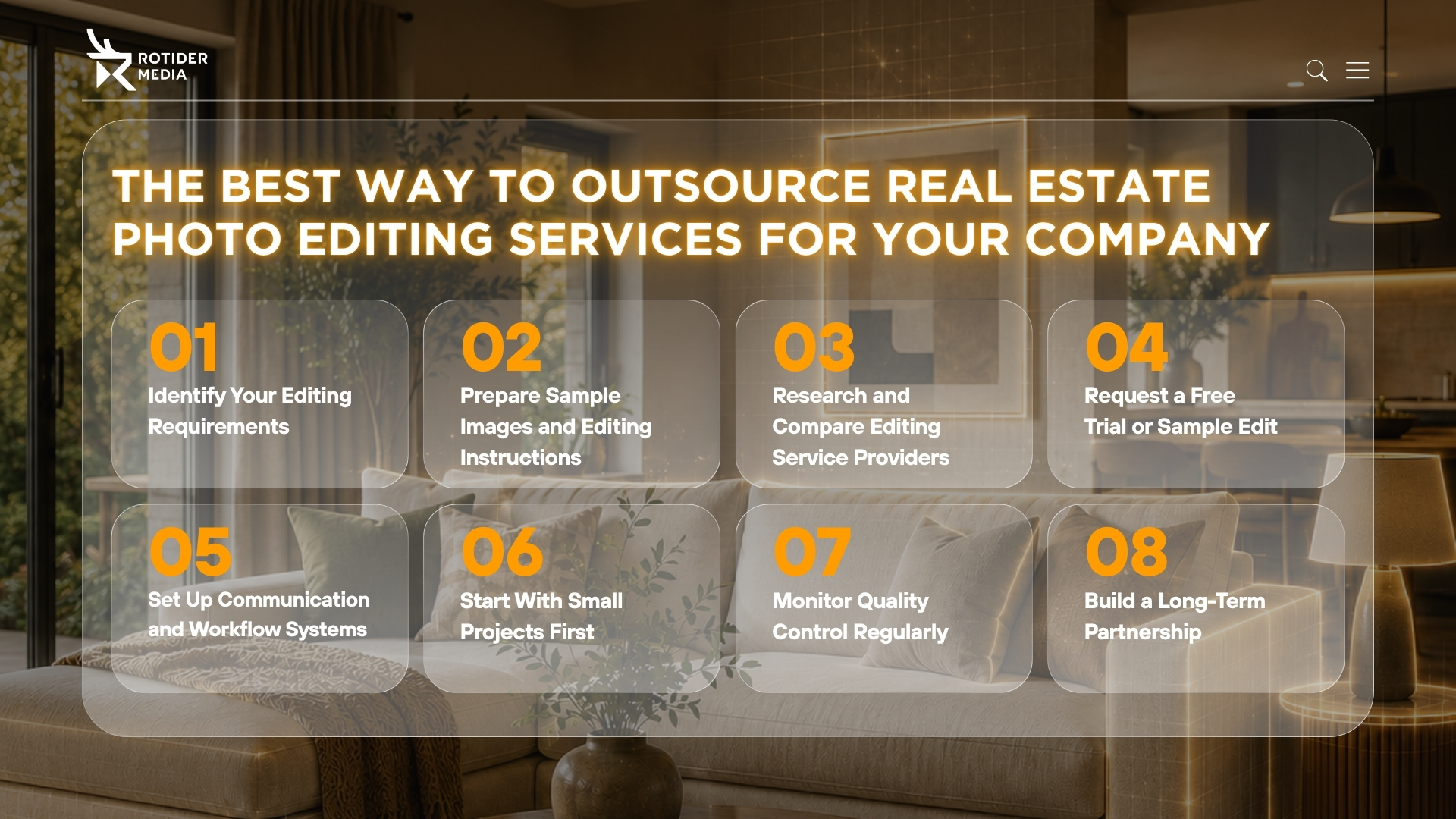
Step 1: Identify Your Editing Requirements
Before contacting any editing company, define exactly what kind of editing you need. Different industries require different editing styles and workflows. Clearly identifying your editing requirements helps avoid misunderstandings and ensures the outsourcing company can handle your workload properly.
Step 2: Prepare Sample Images and Editing Instructions
The next step is organizing sample images along with clear editing guidelines. Most professional editing companies ask for reference files so they can understand your preferred style and quality standards.
Your instructions should include:
- Preferred color tone
- Brightness and contrast preferences
- Retouching level
- File format requirements
- Delivery resolution
- Turnaround expectations
Providing detailed instructions from the beginning reduces revision requests and creates a smoother workflow.
Step 3: Research and Compare Editing Service Providers
Not all outsourcing companies offer the same level of quality, speed, or specialization. Research multiple providers before making a decision. A reliable outsourcing partner should have experience handling projects similar to yours and provide consistent editing quality.
When comparing photo editing companies, it is important to evaluate several key factors to ensure you choose a reliable outsourcing partner. Look at the quality of their portfolio, their experience within your specific industry, and whether their pricing structure fits your budget. You should also consider turnaround times, customer reviews, revision policies, and how responsive they are in communication, as these factors directly affect workflow efficiency and overall service quality.
Step 4: Request a Free Trial or Sample Edit
Make sure that the shortlisted firms modify a sample photo of the property before sealing the deal with any firm. Select a picture that is indicative of what your job usually looks like – be it a dimly lit interior shot, a poorly exposed window, or even an unorganized mess that requires de-cluttering. Assess their level of expertise when it comes to adjusting the lighting of a photo, bringing out the best colors, straightening lines, and making the place look as good as it should be on paper.
Step 5: Set Up Communication and Workflow Systems
After selecting your outsourcing company, create an effective communication plan. Effective communication plays an important role during the process of outsourcing photo editing work. This is usually built on Google Drive, Dropbox. WeTransfer. Trello, Slack, but you should always ask your chosen company for their usual working platform.
You should also establish clear workflow guidelines to avoid confusion during the outsourcing process. This includes defining how files will be uploaded, setting consistent file naming conventions, and outlining how revision requests should be submitted. It is also important to agree on delivery schedules and emergency contact methods so both parties can communicate efficiently and handle urgent projects without delays.
Step 6: Start With Small Projects First
Starting with smaller projects allows you to evaluate the company’s long-term consistency and ability to meet deadlines reliably. It also helps you assess communication quality, how efficiently they handle revision requests, and whether they can scale their services as your editing volume grows over time.
Step 7: Monitor Quality Control Regularly
Even after building a long-term outsourcing partnership, regular quality control is still essential to ensure consistent results. Outsourcing should improve workflow efficiency without compromising image quality, so delivered photos should be reviewed carefully for color consistency, straight lines, and proper perspective, retouching accuracy, export quality, and organized file delivery. Providing regular feedback also helps the editing team better understand your preferences and maintain your quality standards over time.
Step 8: Build a Long-Term Partnership
The most successful outsourcing relationships are long-term collaborations. As the editing team becomes familiar with your style and expectations, turnaround times become faster, and revisions decrease.
A long-term partnership can provide benefits such as:
- Consistent editing style
- Faster delivery
- Better communication
- Priority support
- Scalable production capacity
This is especially valuable for businesses with recurring editing demands like real estate photography, wedding photography, or ecommerce product photography.
Why Do Global Photography Companies Choose to Outsource?
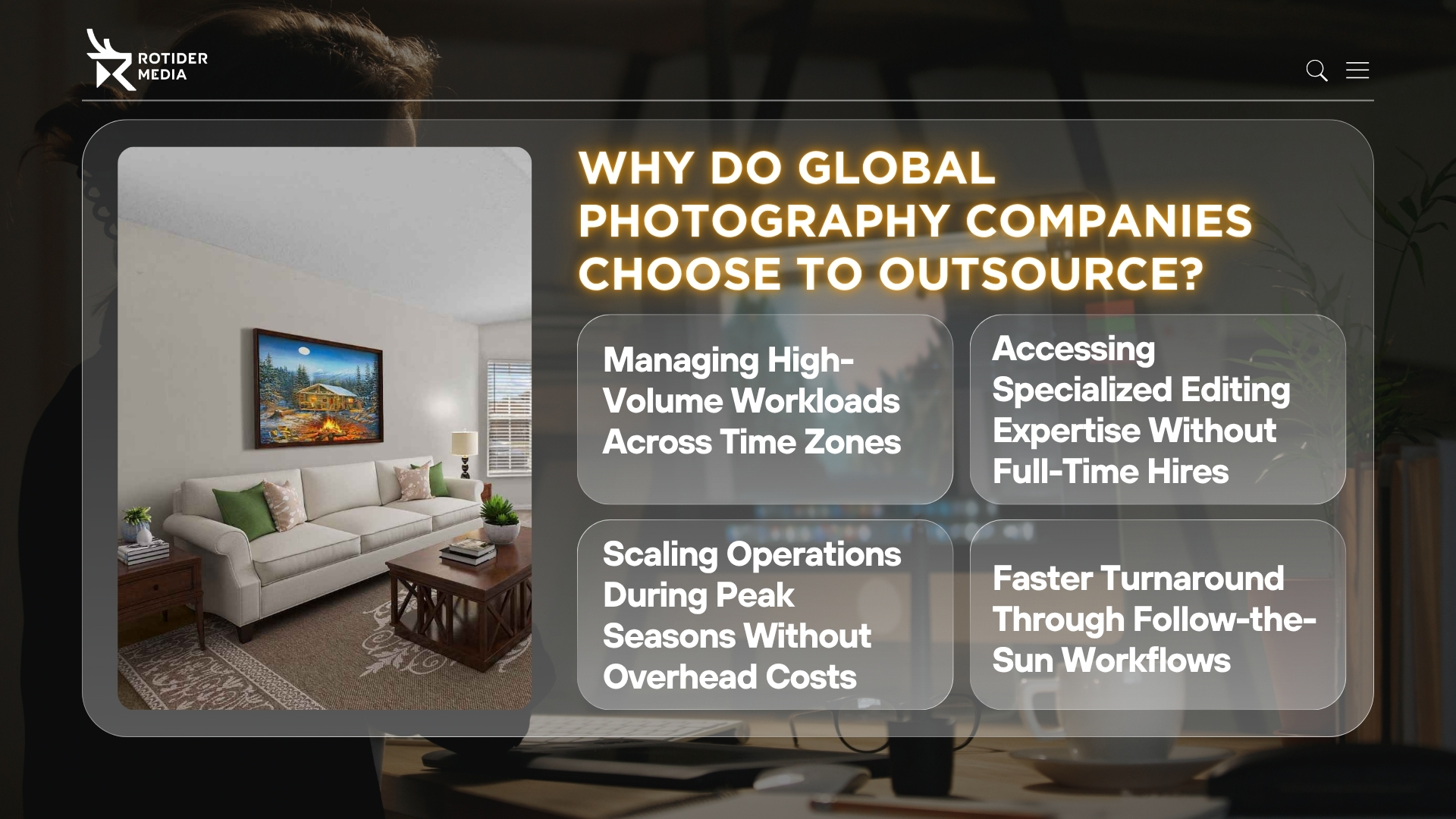
Managing High-Volume Workloads Across Time Zones
Global real estate photography companies often manage peak seasons across multiple markets at the same time. Handling hundreds of property photos daily can overwhelm an in-house editing team, especially when large projects arrive outside regular business hours.
Outsourcing real estate photo editing helps companies maintain fast and consistent turnaround times by using editing teams that operate across different time zones and work in shifts. For example, a 600-photo upload submitted in the evening can already be in production overnight.
This allows real estate photo companies to scale efficiently, manage high-volume workloads, and deliver edited images to clients faster without increasing internal staffing costs.
Accessing Specialized Editing Expertise Without Full-Time Hires
Real estate photo editing includes both basic tasks, such as color correction and exposure adjustments, and advanced services like virtual staging, object removal, and day-to-dusk conversions. These high-end editing services require specialized skills but are not always needed every day.
Outsourcing allows real estate photography companies to access experienced specialists only when projects require them, without the cost of hiring full-time in-house experts. Professional editing partners often have dedicated teams for specific services, ensuring consistent quality across different types of real estate photo editing projects.
This gives companies more flexibility, reduces staffing costs, and makes it easier to scale advanced editing services on demand.
Scaling Operations During Peak Seasons Without Overhead Costs
Real estate photography demand often increases during peak listing seasons, large commercial projects, or sudden market surges. An in-house editing team built for these busy periods can become costly and underutilized during slower months.
Outsourcing real estate photo editing gives companies the flexibility to scale editing capacity up or down based on workload. During high-volume periods, the outsourcing partner handles the additional projects without requiring the company to hire more full-time staff.
This helps real estate photography businesses manage seasonal demand efficiently, control overhead costs, and maintain consistent editing quality throughout the year.
Faster Turnaround Through Follow-the-Sun Workflows
Many real estate photography companies outsource editing to teams in different time zones using a follow-the-sun workflow. This model allows editing work to continue 24/7 without requiring in-house staff to work overnight shifts.
For example, a photography company can upload property photos at the end of its business day, while an overseas editing team starts processing the files immediately and delivers completed images by the next morning.
This approach helps real estate photo companies achieve faster turnaround times, improve workflow efficiency, and provide same-day delivery without increasing internal labor costs.
How Much Does It Cost to Outsource Real Estate Photo Editing?
The price of outsourcing services is usually the first consideration when an entity begins to analyze outsourcing, and understandably so. However, a more relevant question might be not only about the cost of such a service but also whether or not it is cheaper than the one you are paying now, and whether you are receiving anything extra for that. The price of outsourcing the editing of photographs of real estate may go from just pennies per picture to several hundred dollars for high-end services like virtual staging, and everything depends on a number of factors. Understanding all of these aspects beforehand will make sure your budget does not experience any unpleasant shocks.
Typical Pricing Models: Per Image vs. Monthly Retainer vs. Project-Based
Outsourced editing partners generally offer three core pricing structures, each suited to different operational profiles:
Per-Image Pricing:
The most common model, where each edited image is billed at a fixed rate based on the service type. This is straightforward, easy to track, and scales directly with volume.
Monthly Retainer:
A fixed monthly fee covering an agreed volume of images and service types. Retainers typically offer a lower effective per-image cost in exchange for volume commitment and payment predictability. This model suits multinational companies with consistent, forecastable editing demand; it simplifies budgeting, builds a tighter working relationship with the vendor, and often comes with priority turnaround and a dedicated editing team.
Project-Based Pricing:
Used for discrete, defined scopes of work, a new development launch requiring 800 virtually staged images, for example, or a one-time batch processing job for a client onboarding. Pricing is quoted per project based on volume, complexity, and turnaround requirements. This model is common in commercial real estate photography, where large, irregular projects are the norm.
What Factors Affect the Price?
Many factors drive changes in the cost of outsourced photo editing of real estate images, and recognizing these will allow companies to benchmark prices appropriately, thus preventing overpayment for services that do not necessitate high prices.
Complexity of the edit is the single largest pricing driver. An average exposure adjustment of a properly lit interior can take just minutes; a detailed virtual staging of a space with personalized pieces of furniture and naturalistic light and shadow effects may take up to an hour or longer per photo. The more complicated the assignment, the higher the fee, and quite rightfully so.
Turnaround time carries a meaningful premium. Delivery in 24–48 hours is already included in the usual base prices for photo editing services. Urgent delivery, which is usually completed in less than one day or even a few hours, can cost an additional 20–50%. This issue especially concerns multinational corporations that make quick deliveries a part of their promises.
Volume works in the client’s favor. Most of the editing partners have tiered pricing systems in which the per-image cost decreases as the monthly volume goes up. For example, a firm that processes 5,000 images per month will pay less per image compared to another one processing 500 images, despite belonging to the same price bracket.
The region of the outsourcing partner affects base rates significantly. Editing firms based in the regions of Southeast Asia, South Asia, and Eastern Europe have the lowest rates compared to their counterparts in North America, Western Europe, and Australia, owing to varying cost structures and not quality differences. In many cases, some of the top global real estate image editors in terms of volume are based in the Philippines, India, and Vietnam. These editing companies have highly skilled editing teams that can edit large volumes at favorable prices.
File format and shooting style also play a role. The RAW file requires more processing compared to the pre-converted JPEG. HDR shots also need several exposures to blend.
What Are the Risks of Outsourcing Real Estate Photo Editing?
Quality Inconsistency and How to Set Editing Standards
Inconsistency in quality ranks number one on the list of problems faced by photography businesses that have had bad experiences with outsourcing, but it is seldom due to the fact that the vendor lacks expertise. It is due to the lack of detailed communication from the client about what makes for “good” work.
A group of editors tasked with the job of editing for many different clients will not be able to guess what color temperature you favor, how you deal with shadows, or how strong you want the skies to be. They can only act based on their own judgment, which differs from person to person.
Data Security and Image Ownership
When an international photography firm transmits image files to another vendor for processing, it is transmitting property belonging to its clients, which may include unpublished images of property, photographs taken during development projects, and, in some instances, commercially sensitive architectural photos. Data security is not a matter of bureaucracy but rather of client trust.
There are two major threats in this regard, both of which can be managed using contractual and procedural measures.
Communication and Revision Workflow Challenges
The time differences that allow follow-the-sun shift handoffs also provide opportunities for misunderstandings to persist for hours before being corrected. An incorrectly understood note submitted in the evening in London may only become apparent when a whole batch has been processed incorrectly overnight, emerging the next morning in the customer’s email with incorrect sky tones on 200 photographs.
Best Practices for Outsourcing Real Estate Photo Editing at Scale
Building a Style Guide Your Vendor Can Follow Consistently
The style guide is the most essential element in any outsourced partnership, as well as the most often underconstructed one. Businesses usually include just a handful of reference pictures and assume that the partner company will be able to extend the guidelines from these images. At a low output, this may work, but once the volume goes up, hundreds of photos daily need to be edited by several editors working in shifts; this approach fails.
Setting Up a File Management and Delivery System
When dealing with small volumes, such ad hoc systems for transferring files, such as sharing folders on Dropbox, using attachments via email, or sending files through temporary links via WeTransfer, work just fine. With large volumes, however, such methods will cause more trouble than they’re worth. It is the nature of a large multinational photography company to handle thousands of images weekly, and they require an effective file management system tailored to their needs.
Establishing SLAs and Feedback Loops
Vendor relationships that lack formal service level agreements (SLAs) operate on good faith until the volume, personnel issues, or other clients’ needs put that goodwill to the test. Service level agreements turn good faith into responsibility. They delineate what has been agreed upon, what the requirements are for achieving that agreement, and what will happen in the event of failure. In the case of an international photography business where the client turnaround guarantees depend on the vendor’s delivery, SLAs are essential to their operations.
FAQs About Outsource Real Estate Photo Editing
What is the average turnaround time?
Most real estate photo editing services deliver images within 12 to 24 hours. Some providers also offer express delivery options (6–12 hours) for an additional fee. Consistency is just as important as speed, so it’s better to choose a service that reliably meets deadlines rather than one that is occasionally faster but unpredictable.
Can outsourcing firms be trusted by international clients?
Certainly. Most outsourcing firms, especially those from Asian countries, are well-versed in dealing with international clients. Such firms normally have organized workflow processes, speak English, and work effectively with people from other parts of the world.
Are there any editors who are able to create US or Australian-style houses?
Most editors will be able to cater to a certain region’s style, whether this is bright and airy US style or a more natural style found in Australia. It is also common practice for most editing platforms to have users provide sample pictures or settings that can be matched.
Are revisions available?
Yes, most reliable agencies provide free revisions to some extent. These revisions can include corrections on lighting, coloring, and minor alterations. But if there are substantial revisions and further requests, then extra costs will be required.
Annie Doo
Professional Video Editor
Hi, I’m Annie Doo, a professional video editor specializing in real estate post-production. Through hands-on experience with real-world projects, I’ve developed a strong understanding of visual storytelling, pacing, color, sound, and the workflows behind polished real estate videos. Here, I share practical insights, editing techniques, and production knowledge drawn from my day-to-day work in video post-production.
Was this article helpful?
Your feedback helps us create more useful real estate media guides.
Share this article


No Spam, Just Updates
Our fresh blogs provide technical and industrial information that helps strengthen your business. Sign up to be the first to receive the new updates
Related Posts
Real Estate Post-Production: A Complete Guide for Photographers and Media Teams
Oct 2, 2026
AI in Real Estate: A New Leap for Property Professionals
Sep 9, 2026
AI for Real Estate Marketing: A Practical Guide for Agents and Agencies
Sep 9, 2026
AI for Real Estate Agents: Practical Uses and Future Trends
Sep 7, 2026
15 Real Estate AI Companies to Know in 2026
Sep 5, 2026