

Choosing the best lens for real estate photography starts with your camera system and the spaces you photograph. A useful lens should provide enough coverage for interiors, preserve architectural detail and let you adjust compositions without making rooms look unnecessarily stretched.
This guide covers five wide-angle lenses for selected mirrorless systems. The shortlist considers mount compatibility, sensor coverage, focal range, aperture, and suitability for property stills or video. It also explains when primes, tilt-shift lenses, and faster apertures make sense.
Best Real Estate Photography Lenses at a Glance
For many tripod-based residential shoots, a compatible wide-angle zoom is a practical starting point. Around 16–35 mm on full frame, or a comparable APS-C range, offers useful flexibility. Choose wider coverage or a faster aperture when your typical spaces and shooting method require it.
|
Lens |
Intended sensor format |
Mount |
Maximum aperture |
Reason to consider / Check before buying |
|
Sony FE PZ 16–35mm f/4 G |
Full-frame |
Sony E |
Constant f/4 |
Flexible full-frame range and power zoom. Check whether 16 mm covers your smallest rooms. |
|
Canon RF 14–35mm f/4 L IS USM |
Full-frame |
Canon RF |
Constant f/4 |
Additional width at 14 mm. Inspect corrected corner detail and final crop. |
|
Nikon NIKKOR Z 14–30mm f/4 S |
Full-frame |
Nikon Z |
Constant f/4 |
Ultra-wide range with front-filter support. Check working-aperture sharpness and coverage. |
|
Sigma 10–18mm f/2.8 DC DN Contemporary |
APS-C |
Sony E, Fujifilm X, Canon RF and L-mount versions |
Constant f/2.8 |
APS-C coverage with f/2.8. Confirm the exact mount version and body compatibility. |
|
Canon RF-S 10–18mm f/4.5–6.3 IS STM |
APS-C |
Canon RF |
Variable f/4.5–6.3 |
Compact Canon APS-C kit. Compare total cost and handheld low-light requirements. |
The suggested uses are editorial recommendations based on specifications and practical workflow considerations, not laboratory rankings. This shortlist covers selected mirrorless systems rather than every available lens mount. Check the linked manufacturer information for current compatibility and specifications.
Read more: Best Camera for Real Estate Photography in 2026
Best Lenses for Real Estate Photography
There is no single lens that suits every photographer. Start with your camera mount, then evaluate focal coverage, handling, and final-image requirements. The following five lenses are options for the mirrorless systems covered in this guide.
Sony FE PZ 16-35mm f/4 G
.png)
The Sony FE PZ 16–35mm f/4 G is a full-frame E-mount zoom with a constant f/4 maximum aperture and power zoom. Its range lets photographers adjust from wider room views to tighter compositions without changing lenses.
For Sony creators producing photographs and walkthrough videos, power zoom allows controlled focal-length changes during recording. For stills, the main benefit is the flexible zoom range.
This serves as a practical option if you require a reliable wide-angle setup for routine real estate assignments. That said, verify that 16mm provides sufficient coverage for the tightest spaces you typically capture. When mounted on a Sony APS-C body, the field of view narrows, meaning it should not be considered an equivalent substitute for a dedicated 10–18mm crop-sensor lens.
Canon RF 14-35mm f/4 L IS USM
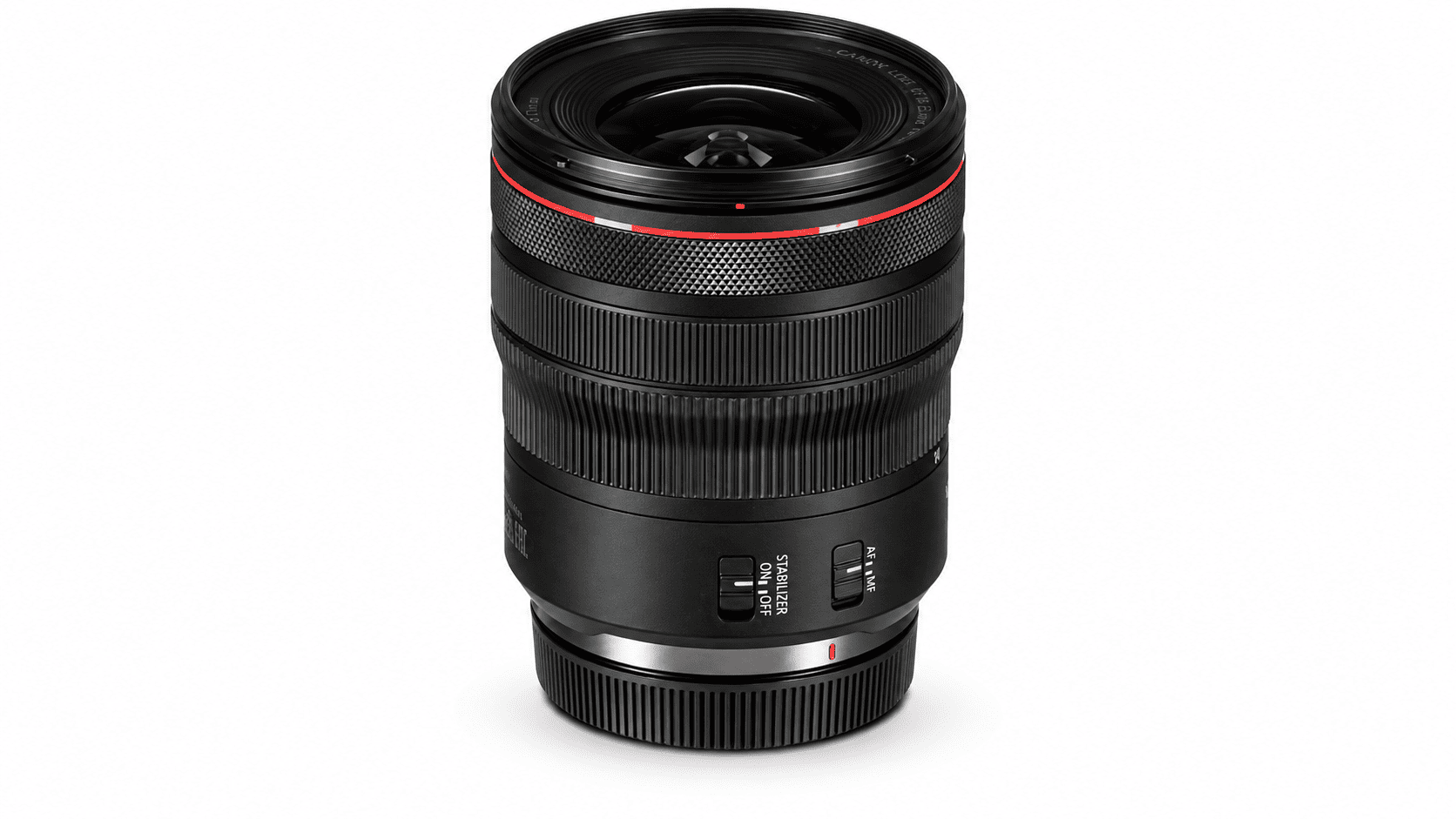
The Canon RF 14–35mm f/4 L IS USM is a full-frame RF-mount zoom lens featuring a constant f/4 maximum aperture and optical image stabilization. The 14mm focal length on the wide end offers added framing flexibility compared to standard ultra-wide zooms that start at 16mm.
The extra coverage can help in compact bathrooms or narrow interiors. When space permits, choose a camera position that keeps proportions believable, then use a slightly longer focal length if the composition allows.
This lens is an option for Canon full-frame users needing coverage wider than 16 mm. Before buying, review corrected sample images at your intended focal lengths. Check corner detail, geometry, and the amount of cropping required.
Nikon NIKKOR Z 14-30mm f/4 S
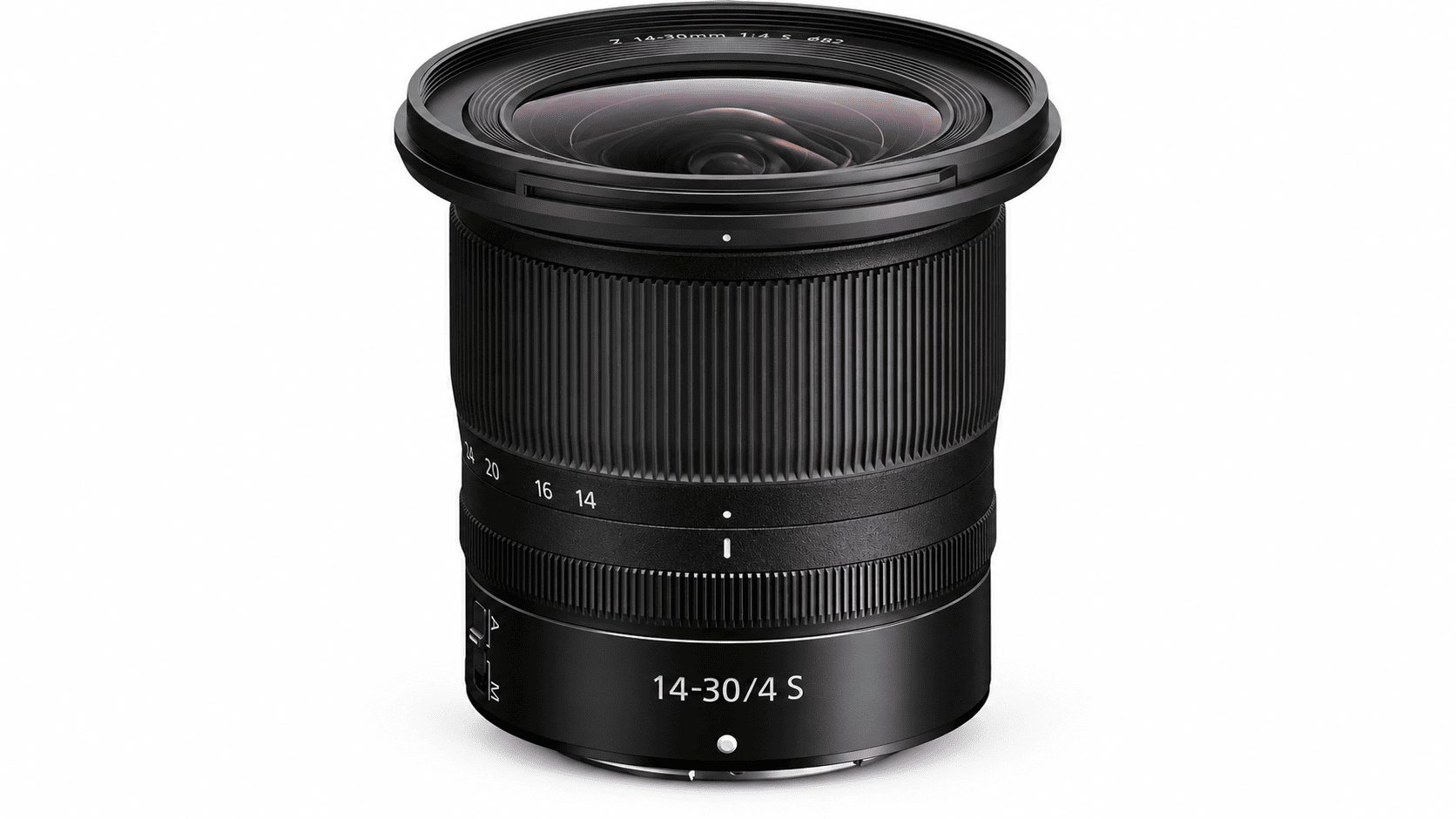
The Nikon NIKKOR Z 14–30mm f/4 S is an ultra-wide zoom lens designed for full-frame Z-mount cameras, featuring a constant f/4 maximum aperture. It also supports screw-on front filters, a practical advantage when capturing exterior stills or video.
The focal range effectively handles both expansive wide shots and tighter interior compositions. For Nikon full-frame Z users, it represents a strong option to evaluate before committing to heavier or faster glass.
For bracketed interiors on a tripod, coverage and sharpness at the working aperture usually matter more than maximum aperture. Handheld work in dim light may place more emphasis on lens speed.
Sigma 10-18mm f/2.8 DC DN Contemporary
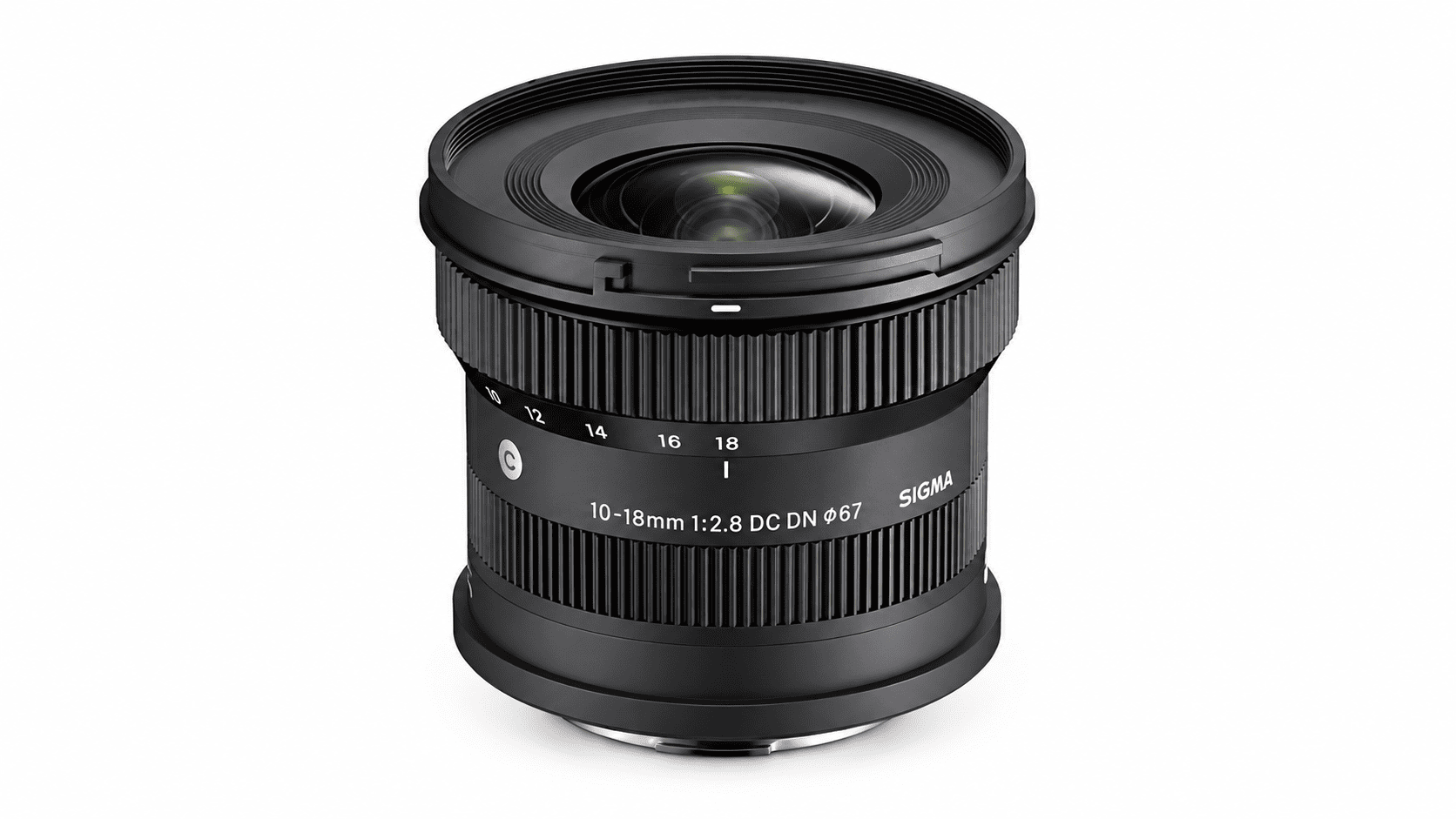
The Sigma 10–18mm f/2.8 DC DN Contemporary is designed specifically for APS-C mirrorless cameras. Sigma produces dedicated versions for Sony E, Fujifilm X, Canon RF, and L-mount, all sharing a constant f/2.8 maximum aperture. Because these represent distinct native mounts, buyers must ensure they select the specific variant built for their camera system.
This lens delivers a practical balance of an ultra-wide field of view and a fast maximum aperture. It is a compelling option for APS-C photographers handling interior stills as well as handheld video or low-light capture.
On a 1.5× crop camera, 10–18 mm provides a field of view approximately equivalent to 15–27 mm on full frame. On Canon APS-C with a 1.6× crop factor, the equivalent range is approximately 16–28.8 mm. These calculations compare angles of view; the lens’s physical focal length does not change.
This lens should not be selected for full-frame bodies simply because the mount connects physically. APS-C image circle coverage must be evaluated separately from mechanical mount compatibility.
Canon RF-S 10-18mm f/4.5-6.3 IS STM
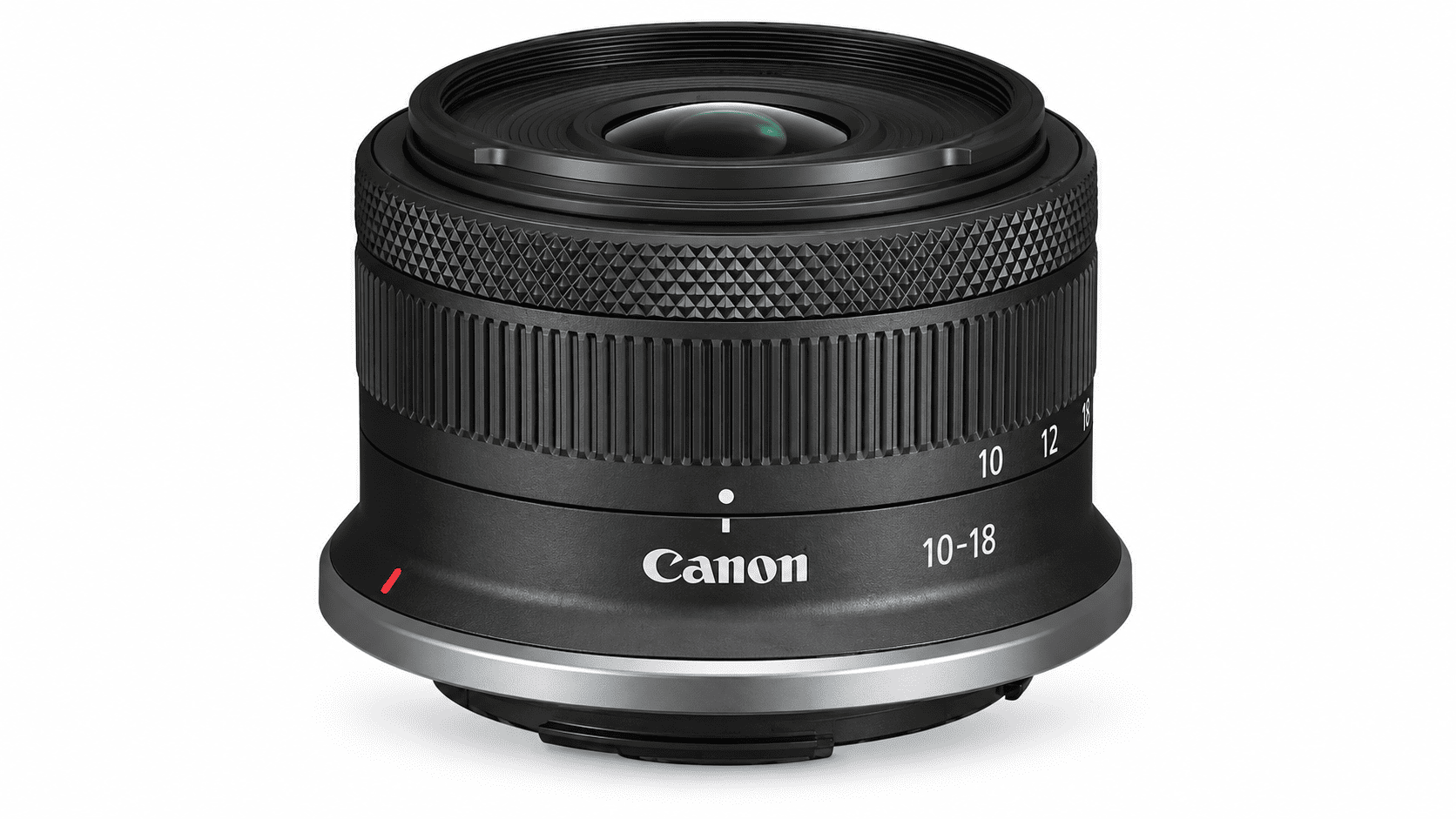
The Canon RF-S 10–18mm f/4.5–6.3 IS STM is an ultra-wide zoom lens engineered for crop-sensor Canon EOS R bodies. It pairs optical image stabilization with a variable maximum aperture design.
The focal coverage makes it a practical addition to a compact Canon APS-C interior setup. It is particularly valuable when a standard kit zoom fails to capture the full scope of a small room from an ideal camera position.
The narrower maximum aperture can limit handheld shooting in dim light, but is usually less restrictive for static interiors on a tripod. For Canon APS-C users, compare this lens with other budget options by total price, corrected image quality, stabilization, and low-light requirements.
Which Lens Type Fits Your Real Estate Photography Needs?
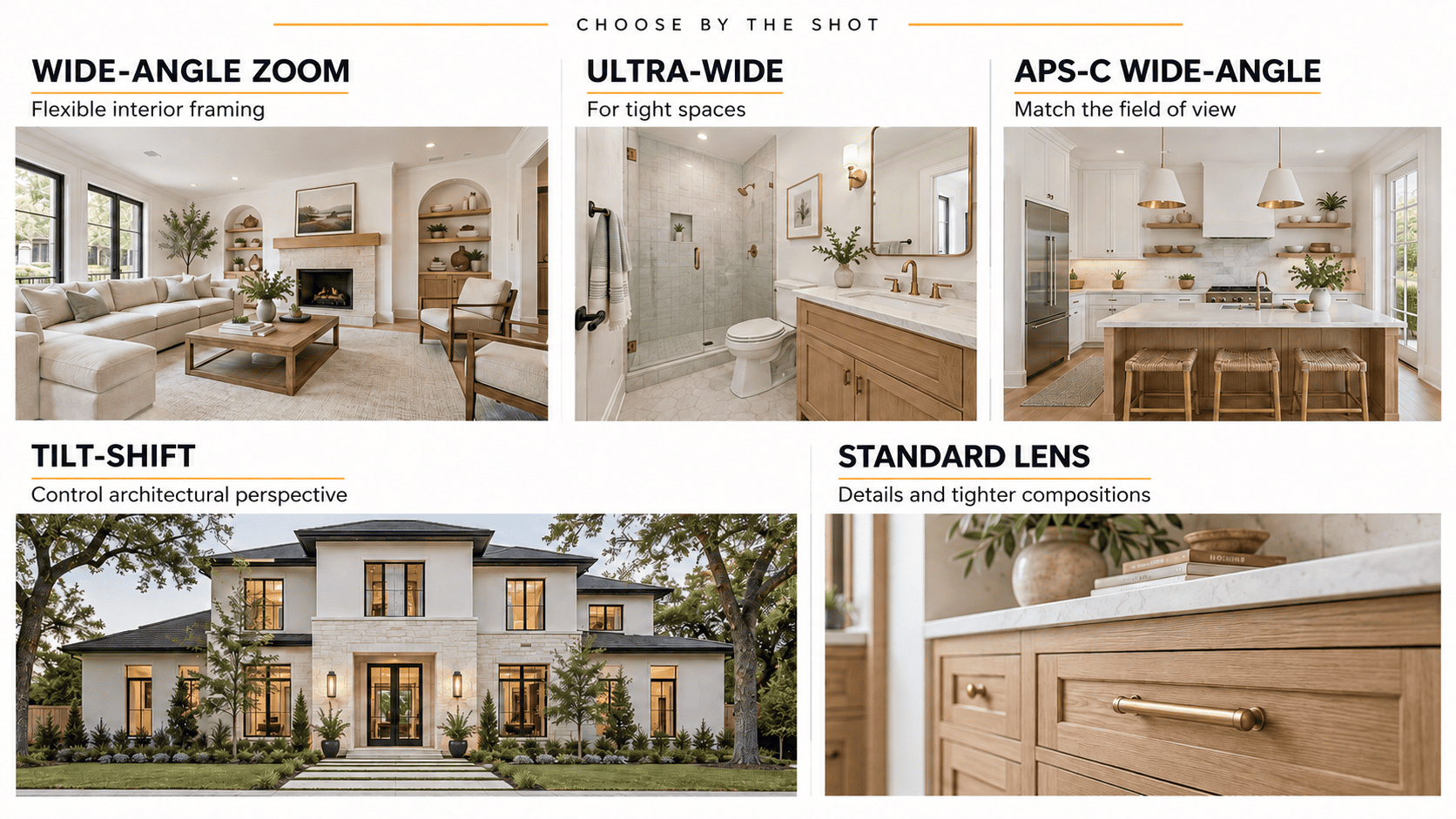
A property shoot can require more than one kind of composition. Wide-angle lenses cover rooms, while other lenses can help with architectural control, exterior views and detail photographs.
Wide-Angle Zooms for Most Interiors
A full-frame zoom lens covering roughly 16–35mm serves as a versatile starting point for many residential shoots. The wide end effectively captures full room layouts, while the longer focal lengths allow for tighter composition when space permits.
The primary practical advantage is flexibility. Photographers can refine their framing from a fixed tripod position rather than constantly swapping lenses or compromising on camera placement. Choose the focal length that best represents the room's proportions rather than automatically defaulting to the widest setting.
Ultra-Wide Lenses for Tight Rooms
A wide-angle prime or ultra-wide zoom can help when small bathrooms, narrow kitchens, or bedrooms restrict camera placement.
Ultra-wide compositions require care. Objects close to the camera may appear disproportionately large, while objects near the edges of a rectilinear image may look stretched. A wider lens does not remove the need to choose a suitable camera position.
When evaluating a wide-angle lens for real estate photography, compare images before and after lens corrections where your software allows it. In all cases, inspect the corrected export for usable coverage and corner detail.
APS-C Wide-Angle Lenses for Crop-Sensor Cameras
APS-C cameras require shorter focal lengths to achieve an equivalent field of view compared to full-frame systems. A 10mm lens delivers a 35mm equivalent field of view of roughly 15mm on a body with a 1.5× crop factor, and approximately 16mm on Canon's 1.6× APS-C format.
This explains why an 18mm crop-sensor kit lens may suffice for exterior captures yet impose severe limitations inside smaller rooms. The core issue is not the sensor size itself, but rather the resulting angle of view.
Read more: Full Frame vs Crop Sensor for Real Estate Photography
Tilt-Shift Lenses for Architectural Perspective Control
Tilt-shift lenses are specialized architectural tools. Shift allows reframing while keeping the camera level, helping avoid converging verticals caused by camera tilt. Tilt changes the orientation of the plane of focus. Canon explains the shift function in its guide to tilt-shift photography.
These lenses are worth considering for high-end architectural projects where precise perspective control is a top priority. For standard real estate assignments, however, their additional cost and complex manual workflow can be harder to justify.
Standard Lenses for Details and Exterior Compositions
A standard lens can effectively complement an ultra-wide zoom by capturing built-in fixtures, cabinetry, surface textures, and architectural details. On a full-frame body, focal lengths in the 35–50mm range are also well-suited for tighter exterior compositions, provided you have sufficient working distance.
While these detail frames add depth and polish to a listing package, they should strictly support, rather than replace, the primary wide-angle shots that communicate the property's flow and spatial layout. A dedicated detail lens is an addition to the kit, not a substitute for a primary interior wide-angle setup.
Prime vs. Zoom Lenses for Real Estate Photography
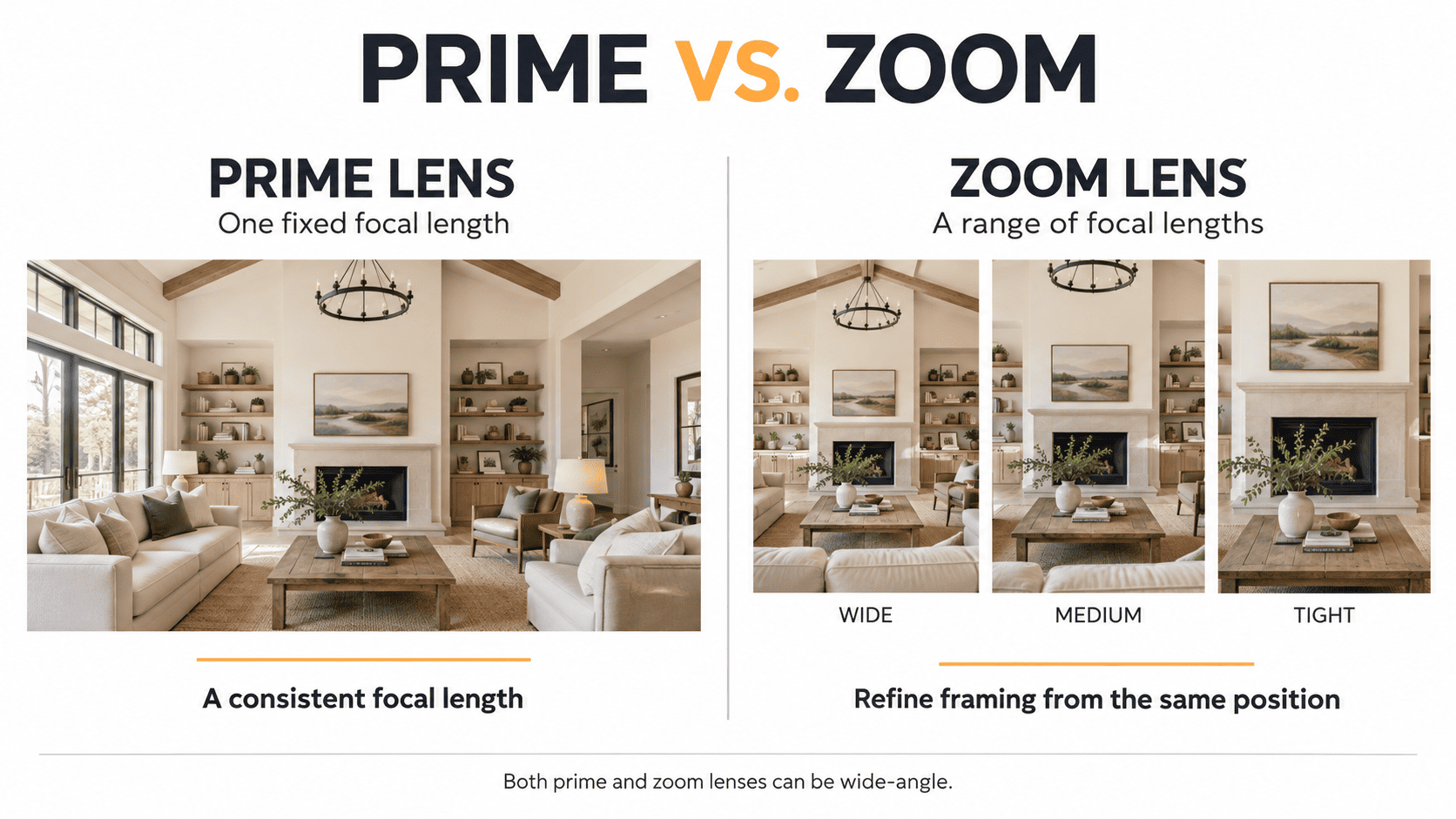
A prime lens has one fixed focal length; a zoom covers a range. Both can be wide-angle lenses, so choosing prime versus zoom is a separate decision from choosing how wide to shoot. Nikon’s prime and zoom explanation describes this distinction.
When a Zoom Lens Is More Practical
When comparing prime vs. zoom lenses for real estate photography, consider how much framing flexibility you need across rooms of different sizes. A zoom is often a practical first interior lens.
A zoom lets you fine-tune framing without moving the tripod for every small adjustment. This can help when moving the camera introduces a door frame, reflection, or foreground obstruction.
Camera position determines perspective, while changing focal length from the same position changes field of view and framing. Choose the viewpoint first, then use the zoom ring to refine the composition.
When a Prime Lens Makes Sense
A prime lens makes sense when one focal length consistently suits your assignments. A wide-angle prime can fit a compact kit, while primes with standard focal lengths can be useful for details and selective-focus compositions.
Some prime optics offer faster maximum apertures or lighter form factors than equivalent zooms, though this varies by specific lens design. Choosing a prime does not automatically guarantee superior sharpness, lower cost, or reduced weight.
For a photographer selecting their primary interior lens, the key question is whether relying strictly on a prime lens for real estate photography provides enough framing versatility across the diverse properties they will encounter.
Do You Need f/2.8 for Real Estate Photography?
No—f/2.8 is not a requirement for professional property photographs. Its value depends on whether you need the additional light at capture, rather than on the lens being labeled “professional.”
At the same shutter speed and ISO, f/2.8 admits approximately twice as much light as f/4, before differences in lens transmission. Canon’s aperture guide describes the relationship between aperture and depth of field.
When f/4 or a Slower Lens Is Enough
For static interior photography on a tripod, photographers can typically utilize longer shutter speeds rather than relying on wider apertures. Ensuring acceptable depth of field throughout a room often requires stopping down beyond f/4 anyway.
If an f/2.8 lens and an f/4 lens are both used at f/8 with the same shutter speed and ISO, their maximum apertures do not create an exposure advantage. Actual transmission and optical performance may still differ.
Consequently, an f/4 zoom or a variable-aperture lens often serves as a practical, cost-effective tool when your primary workflow consists of tripod-based real estate capture.
When a Faster Lens Is Worth Considering
A fast lens for interiors can help when you cannot use a slower shutter speed, such as during handheld low-light shooting or when photographing moving subjects. It is usually less important for static rooms photographed on a tripod.
These optics also facilitate selective focus techniques for detailed close-ups. However, the trade-off is a shallower depth of field, which works against you when the goal is keeping an entire room sharp from foreground to background.
For video, check any crop applied in high-frame-rate recording modes or by electronic stabilization. Judge lens speed alongside the field of view available in the mode you intend to use.
How to Choose the Right Real Estate Photography Lens
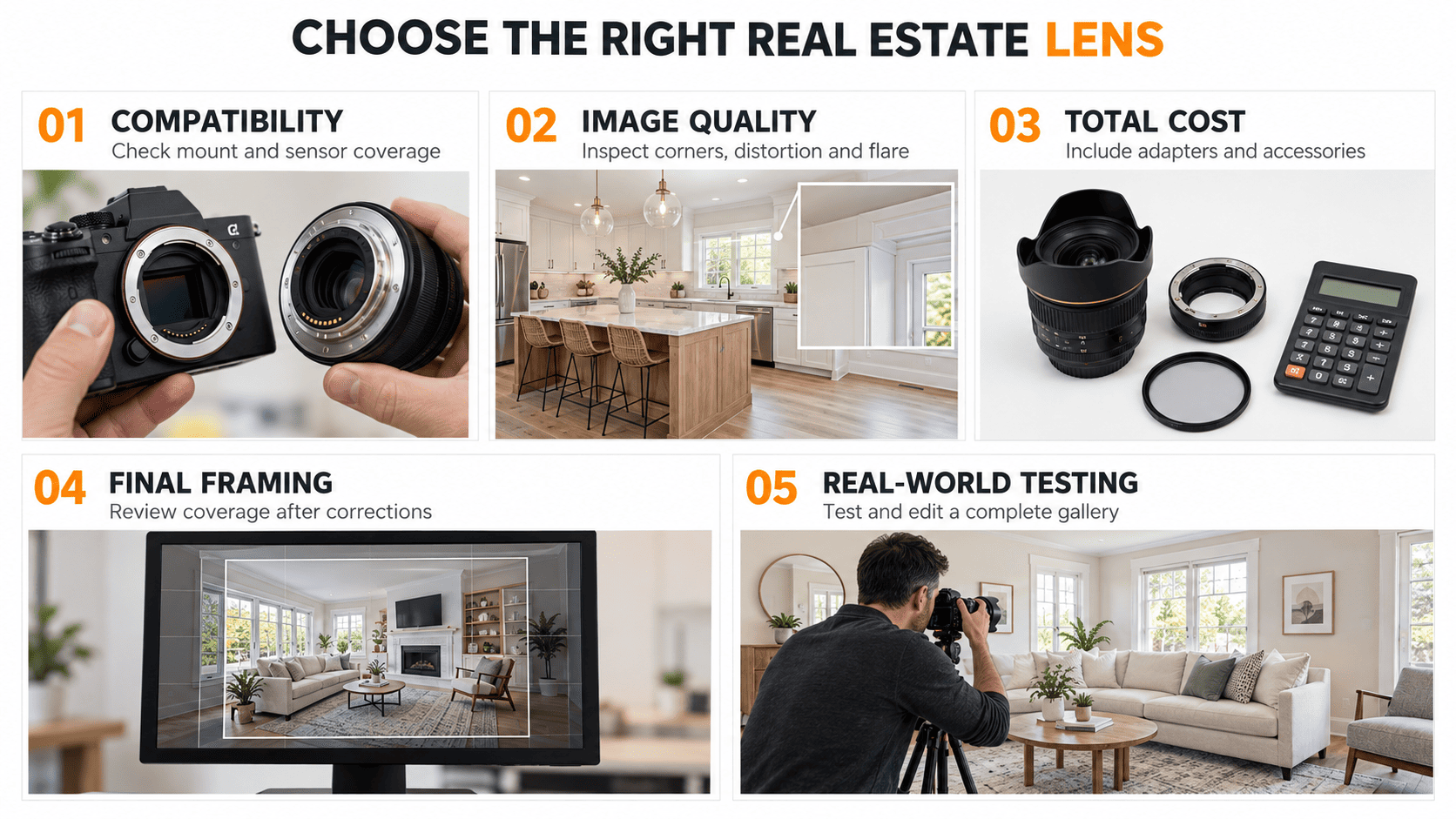
Choose a lens around the files you need to deliver. Coverage, corrected image quality and compatibility matter more than buying the widest or fastest model available.
Camera Mount, Sensor Size and Crop Factor
Identify the mount first: Canon EF or RF, Nikon F or Z, or the relevant mount for another brand. Then check body compatibility and sensor coverage. Canon’s EF-S and RF-S designations identify APS-C lenses within their respective systems.
A compatible full-frame lens provides a narrower field of view on APS-C than on full frame. On a compatible full-frame body, an APS-C lens may require or trigger crop mode. Check the camera’s behavior and resulting output resolution.
Crop factor helps compare framing. Nikon’s focal-length guide explains how focal length relates to angle of view.
Corner Sharpness, Distortion and Flare
Interior photographs routinely place essential architectural details away from the center of the frame: cabinet edges, door frames, ceiling trim, and furniture often sit near the image corners.
Review sample images captured at the exact focal lengths and apertures you plan to use in production. Pay close attention to corner softness, chromatic aberration along high-contrast edges, and lens flare around bright windows.
Distinguish optical distortion, such as barrel or pincushion curvature, from converging verticals caused by camera tilt. Lens profiles address supported optical distortion, while geometry tools address perspective and alignment.
Budget and Total Lens Cost
Factor in the cost of filters, lens adapters, and other essential accessories when establishing your total purchasing budget. If your setup requires a lens adapter, carefully verify feature compatibility, such as autofocus and electronic communication, between your specific camera body and lens combination.
Used or refurbished lenses can lower the purchase cost. Check condition, autofocus, aperture operation, optical performance, warranty, and repair options before using one professionally.
The best budget lens for real estate photography should provide sufficient coverage and usable corrected images within the cost of your complete setup. Compare lens and accessory costs together rather than judging the lens price alone.
Lens Corrections and Final Framing
Lens profiles can correct supported optical distortion and vignetting, while geometry tools address perspective and alignment. Adobe recommends applying suitable lens profiles before using Upright perspective correction in Lightroom Classic. See its official correction guidance.
Corrections can change the final crop. Leave appropriate space around important features and inspect the exported photograph before judging whether a lens provides enough coverage.
Software cannot restore a room feature that was never captured or fully recover detail lost to poor focus.
Read more: Step-by-Step Tutorial for Editing Real Estate Photos in Lightroom
Testing a Lens Before Buying
Rent or borrow the lens and test it in a small room, an open living area, and a room with bright windows. Use your normal tripod, lighting, and exposure workflow, and test the focal lengths and apertures you expect to use.
Inspect images after lens-profile and geometry corrections, then compare exports at the same output dimensions. Check corner detail, straight lines, and whether sufficient coverage remains after cropping.
Process a complete property gallery and record the camera, lens, focal lengths, apertures, correction settings, remaining coverage, and editing time. Judge whether the workflow produces consistent images with an acceptable amount of correction and processing.
Read more: Step-by-Step Real Estate HDR Photo Editing Tips
Frequently Asked Questions
What Is the Best Lens for Real Estate Photography?
For many photographers, the best starting point is a wide-angle zoom compatible with their camera and sensor. A range around 16–35mm on full frame, or a comparable APS-C ultra-wide range, provides useful flexibility. The best specific model depends on budget and shooting requirements.
Is a 16–35mm Lens Good for Real Estate Photography?
Yes, on a full-frame camera it is a versatile range for interiors and tighter compositions. On APS-C, its narrower field of view can make it less suitable as the only lens for small rooms.
Is 24mm Wide Enough for Interiors?
Sometimes. On full frame, 24mm can work well in larger rooms or when there is enough camera distance. Compact spaces may need wider coverage. Always specify sensor format when discussing whether a focal length is wide enough.
Can You Use an 18–55mm Kit Lens?
Yes, for suitable exterior views, details and larger spaces. On APS-C, its widest setting is approximately equivalent to 27–28.8mm on full frame, which can be restrictive for small interiors.
Is a 50mm Lens Useful for Real Estate Photography?
Yes, mainly for details and tighter compositions where working distance permits. It usually cannot replace a wide-angle lens for complete room coverage.
Can You Use a Fisheye Lens for Property Photos?
A fisheye is generally unsuitable for conventional listing photographs because its curved rendering changes architectural lines. A rectilinear wide-angle lens is usually more appropriate. Fisheye lenses can serve specialized panoramic workflows.
Can Editing Fix Photos Taken with the Wrong Lens?
Editing can correct some optical distortion and perspective problems. It cannot fully compensate for missing coverage, an unsuitable camera position or severe edge stretching without compromises in framing and detail.
Conclusion
The best lens for real estate photography is the one that fits your camera, covers your typical spaces and produces usable results after correction. Start with a suitable wide-angle zoom, then add specialist or detail lenses when your assignments justify them.
Compare full-frame and APS-C options separately, test the focal lengths you expect to use and pay for f/2.8 when its additional light serves a real need. Good camera placement and controlled capture remain essential regardless of lens price.
Once the images are captured, consistent exposure, color and perspective help turn them into a cohesive property gallery. Rotider supports that final stage through real estate photo editing, helping photographers and media teams prepare images for professional listing delivery.

.png)



-1.png)