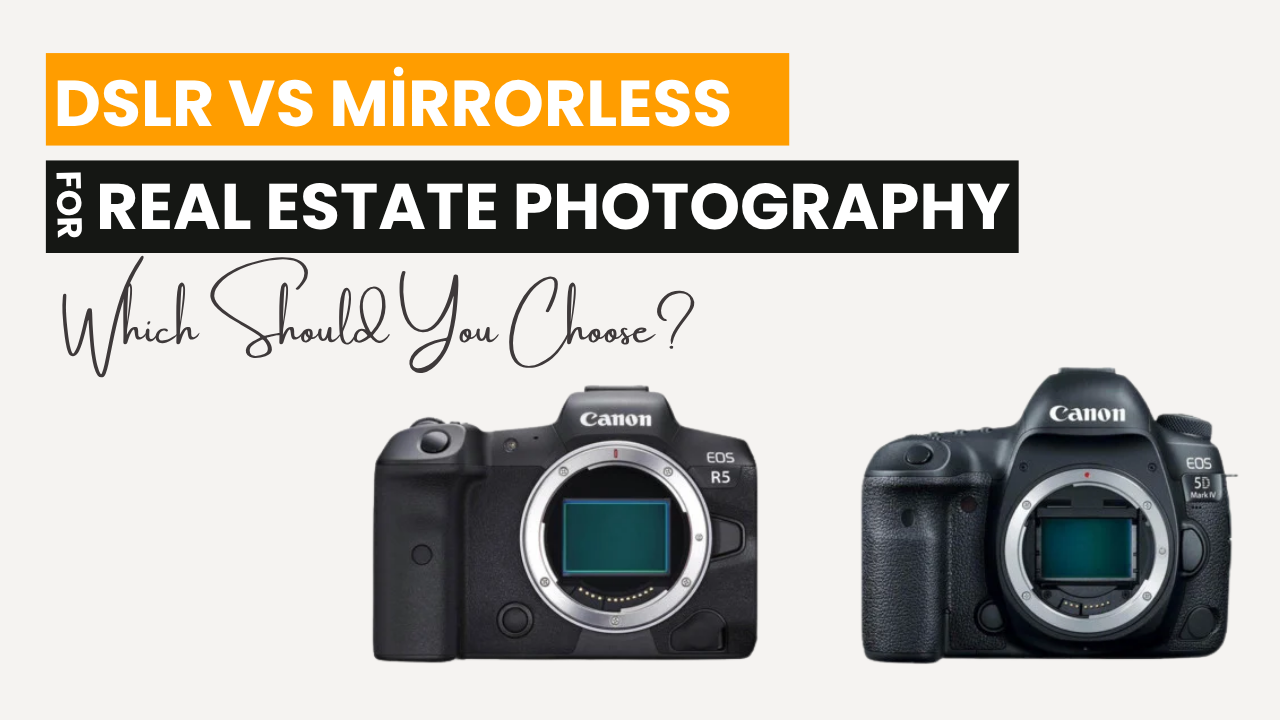
Choosing between DSLR and mirrorless cameras for real estate photography comes down to workflow, lens availability, and budget. A capable DSLR real estate camera can still produce professional listing images, while a suitable mirrorless model may offer more convenient exposure previews and photo-and-video features.
This guide compares viewing, bracketing, lenses, handling, video, and post-production to help photographers decide whether to keep an existing system or build a new one.
What Is the Difference Between a DSLR and a Mirrorless Camera?
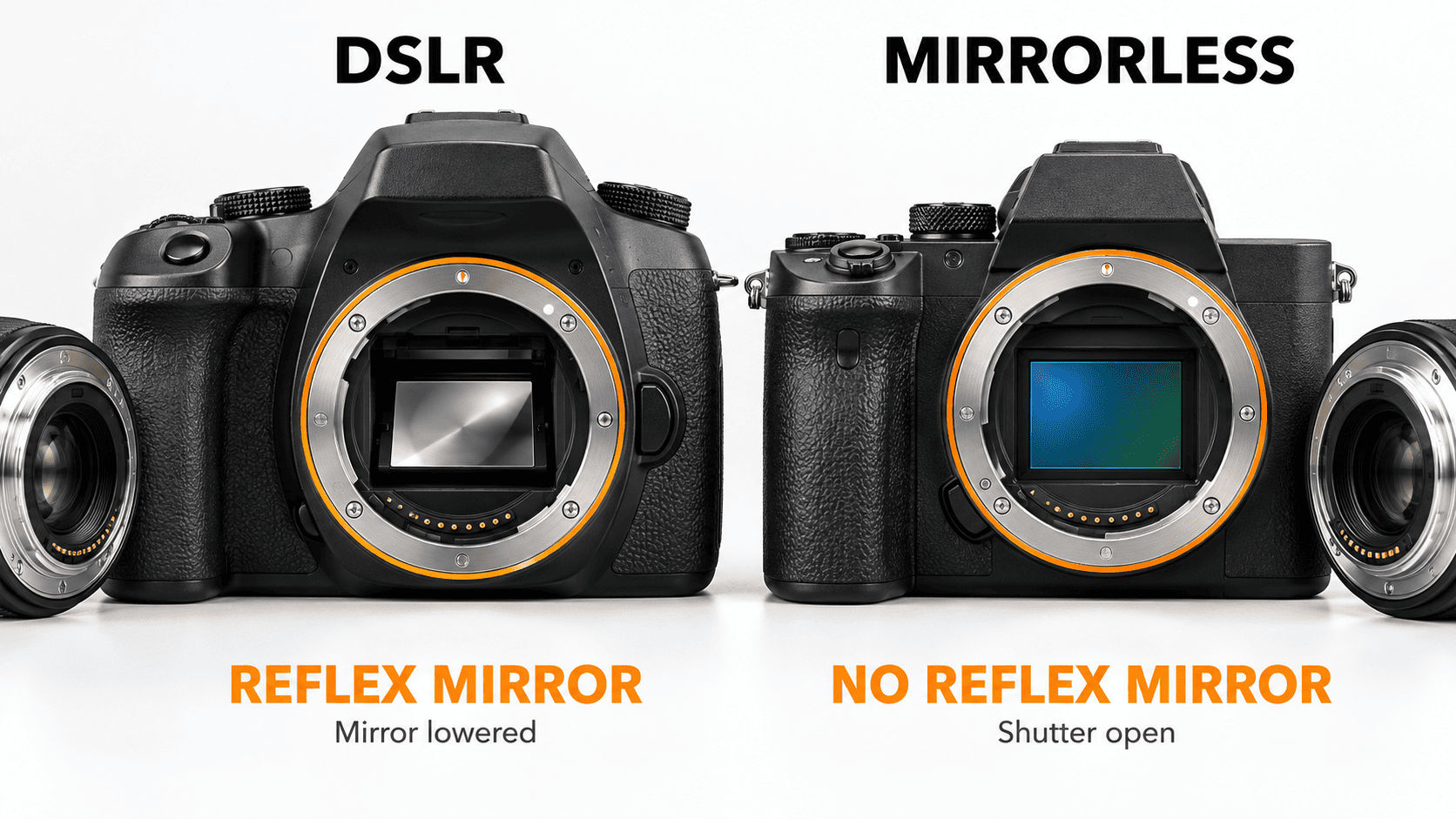
Both platforms feature interchangeable lenses and capture industry-standard RAW files. The defining difference lies in the optical path to the sensor and how the photographer views the scene.
How DSLR Cameras Work
A DSLR uses a mirror to direct light toward an optical viewfinder through a prism or mirror-based viewing assembly. During photographic exposure, the mirror moves out of the sensor’s light path, briefly interrupting the optical view.
An optical viewfinder does not simulate exposure or white balance. Photographers use the exposure meter, test images, or Live View to assess these settings. Many DSLRs offer longer battery life when used primarily through the optical viewfinder.
How Mirrorless Cameras Work
Mirrorless cameras use the sensor to provide a live image on an electronic viewfinder (EVF), where fitted, or rear screen.
Mirrorless cameras can preview exposure and white balance through the EVF or rear screen. Depth-of-field preview depends on the camera’s settings and preview functions. These displays help with capture decisions but do not show the full recovery potential of a RAW file.
Removing the mirror assembly allows shorter flange distances and can reduce body size. Compatible adapters can allow selected DSLR lenses to be used on mirrorless bodies, but available functions depend on the lens, adapter, and camera combination.
Canon’s explanation of how DSLR and mirrorless systems work confirms that both formats can provide excellent image quality; the practical differences are primarily in viewing, handling, lens design and supporting features.
DSLR vs Mirrorless for Real Estate Photography
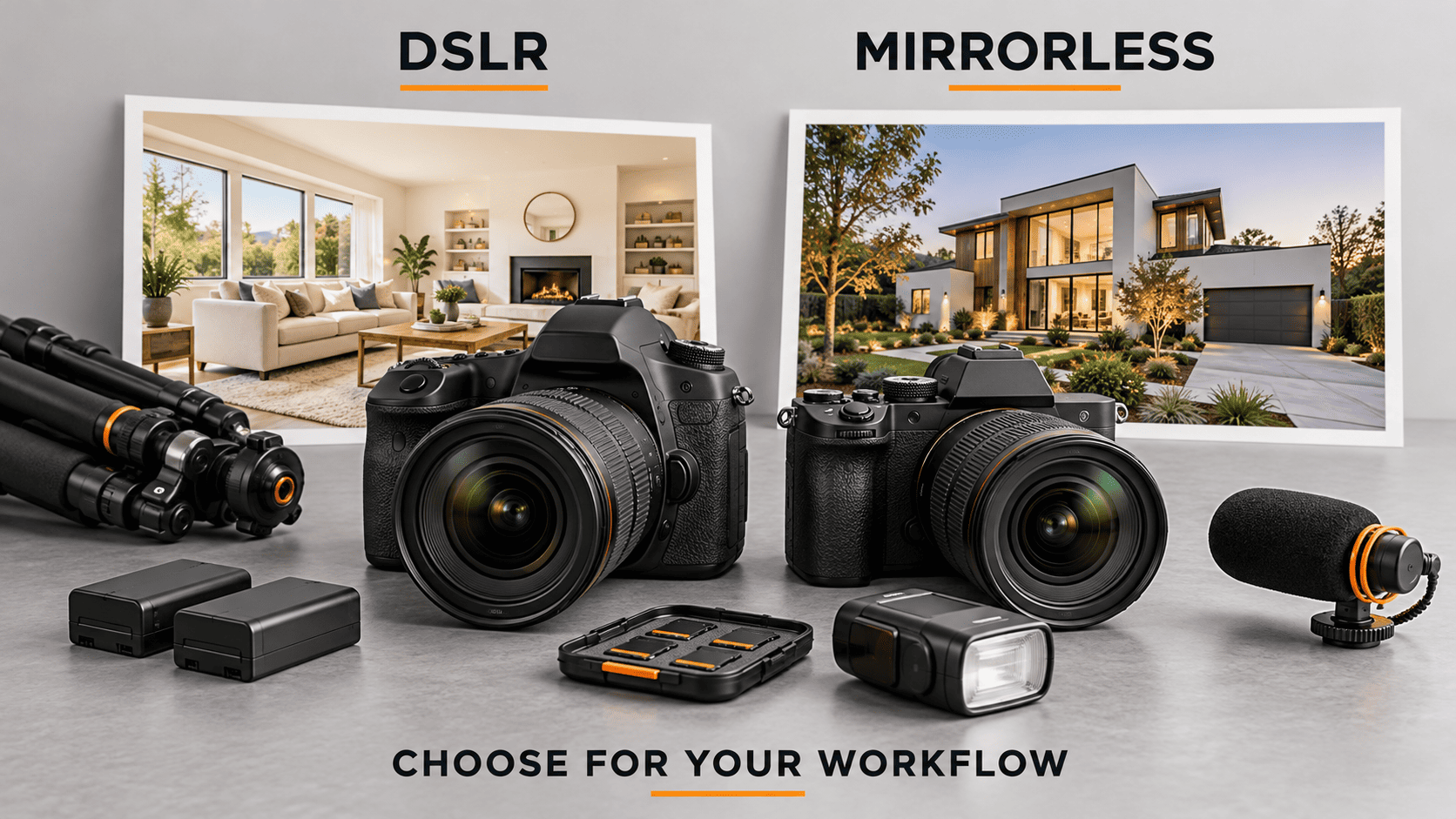
Image Quality & Dynamic Range
A DSLR and mirrorless camera with comparable sensors and lenses can produce similar image quality under controlled conditions. Dynamic range and shadow noise depend on the specific sensor, exposure, and processing rather than the mirror mechanism. For high-contrast interiors, use sufficient bracket coverage or an appropriate lighting method when one exposure cannot retain the required detail.
Viewfinders & Exposure Preview
-
Optical viewfinder (DSLR): Provides a direct optical view. Assess exposure with the meter and captured images.
-
Electronic viewfinder (mirrorless): Can preview exposure and white balance, which is useful when moving between rooms with different lighting.
Do not rely solely on EVF or LCD previews. Use the in-camera histogram and highlight warnings as capture aids, then assess recoverable detail in the RAW files during processing.
Bracketing Workflow & Shutter Mechanics
Reliable auto exposure bracketing (AEB) is more relevant to static interiors than maximum burst speed. Check whether the camera can capture the required sequence without repeated menu changes or disturbing the framing.
-
Fully electronic shutter: Can provide silent capture, but banding and rolling-shutter effects depend on sensor readout, shutter speed, lighting, and movement. Confirm any flash restrictions.
-
Mechanical or electronic front-curtain shutter (EFCS): May reduce some problems associated with fully electronic capture. Test the chosen mode and shutter speed under the property’s lighting, and check flash compatibility.
Wide-Angle Lens Ecosystem
Before choosing a body, confirm that suitable wide-angle lenses are available within budget:
-
DSLR Systems: Benefit from decades of lens development and a thriving, cost-effective pre-owned market (Canon EF, Nikon F mounts).
-
Mirrorless systems: Offer native wide-angle lenses and, in some systems, support adapted DSLR lenses. Check lens performance and adapter compatibility before planning a phased upgrade.
Handling & Ergonomics
-
Mirrorless: Some bodies reduce transport bulk, but lens weight and adapter length also affect the complete kit and gimbal balance.
-
DSLR: Some bodies provide substantial grips and familiar physical controls. Compare handling with the actual lens attached, since grip design varies across both camera types.
Battery Life & Power Management
Many DSLRs offer longer battery life through the optical viewfinder, though extensive Live View use can narrow that advantage. Mirrorless runtime varies by model and shooting mode. Carry spare batteries and confirm whether the selected camera supports USB charging or external power during operation.
Autofocus Performance & Low-Light Handling
Many recent mirrorless models provide broad autofocus coverage and subject tracking that can help with handheld detail shots and agent-led videos. Performance varies by camera and lens.
For static interiors on a tripod, single-point autofocus or careful manual focus is often sufficient. Check focus accuracy in the actual scene; lens quality, exposure, and capture consistency may matter more than advanced subject tracking.
Real Estate Video Capabilities (Hybrid Content)
Many recent mirrorless cameras offer useful video features, including continuous autofocus, Log recording, monitoring tools, and stabilization on selected models. Compare the features of the specific cameras under consideration.
A DSLR can capture controlled property video, but recording crops, autofocus, monitoring, and available formats vary by model. For walkthroughs and social reels, choose the system that meets the required deliverables and editing workflow.
DSLR Advantages for Real Estate Photography
.png)
DSLR cameras are no longer the focus of most new system development, but they retain practical advantages for photographers with the right equipment and workflow.
Lower Used-System Cost
A used DSLR real estate camera can be a practical budget option when the complete kit includes a suitable wide-angle lens and the equipment passes inspection
However, buyers should inspect shutter counts, battery health, sensor cleanliness, and repair support before committing.
Established Wide-Angle Lens Selection
Canon EF and Nikon F systems offer extensive wide-angle lens selections, including zooms, primes, and tilt-shift options.
Used DSLR lenses can offer good value when their condition, corner sharpness, distortion, and compatibility meet the assignment’s requirements.
Longer Battery Life
Optical-viewfinder shooting often reduces battery demand compared with continuous sensor and screen operation. Actual runtime depends on the camera, battery condition, and shooting habits.
This streamlines daily field workflows and reduces on-site battery management, though heavy reliance on Live View will naturally increase power draw.
Familiar Professional Controls
Pro-grade DSLRs feature deep handgrips, top status LCDs, and dedicated tactile controls built for durability. Photographers with years of muscle memory can adjust settings instantly without taking their eyes off the scene.
Switching camera systems can temporarily slow shooting while photographers learn new controls and menus.
Mirrorless Advantages for Real Estate Photography
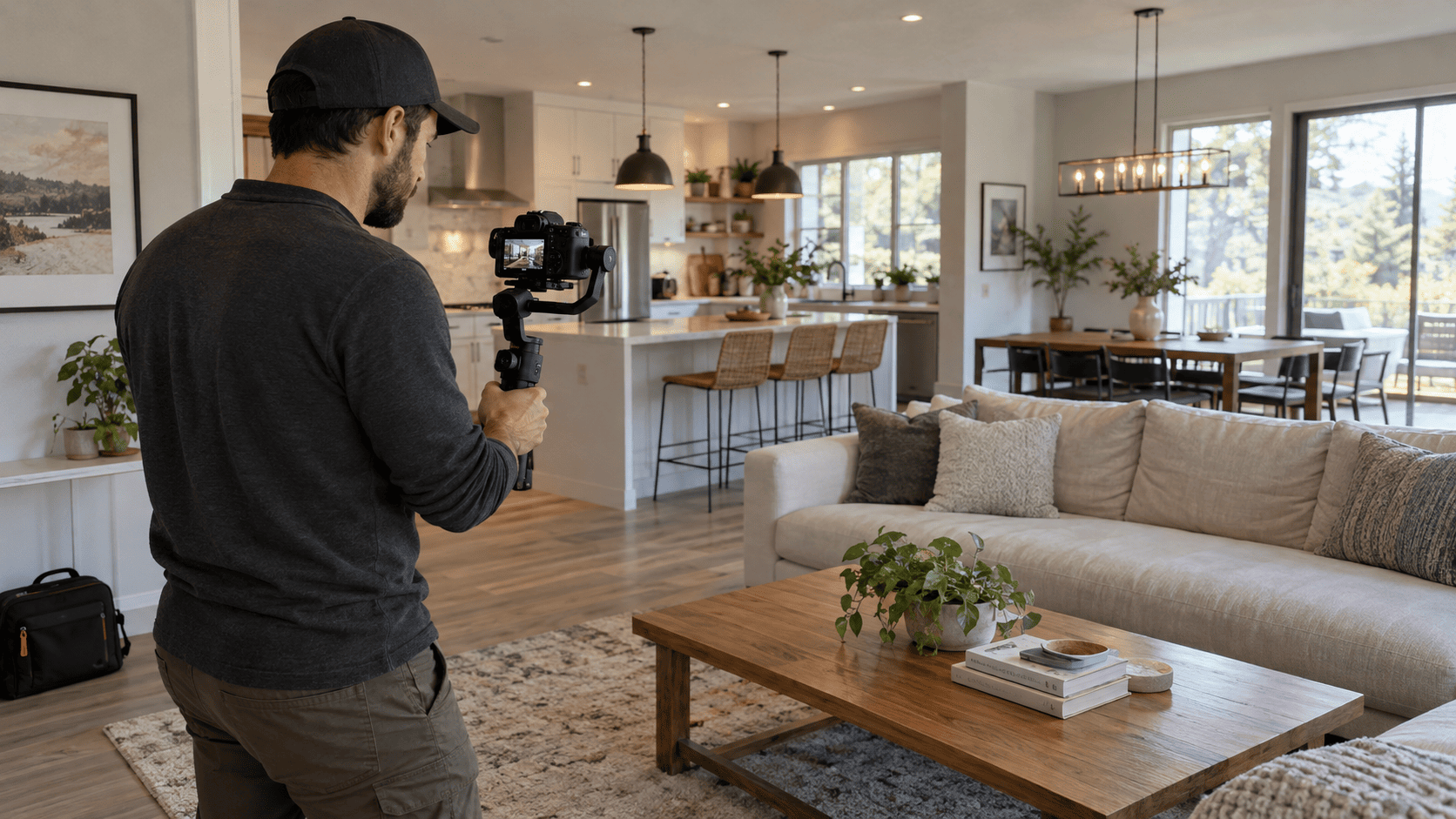
Mirrorless systems align more closely with the current direction of camera and lens development. Their benefits are strongest when photography, video and rapid production are combined.
Live Exposure and White-Balance Preview
Electronic viewfinders can preview changes to exposure and white balance when the relevant simulation settings are enabled. This helps photographers assess settings before capture.
Treat live previews as capture aids. Screen brightness and preview processing affect what you see; review captured frames and assess RAW recovery during editing.
Smaller and Lighter Camera Bodies
Compact camera bodies reduce physical fatigue during multi-property shoot days, providing a clear edge when transitioning between tripods, gimbals, and handheld video rigs.
Still, when assessing your equipment fleet, evaluate the complete kit rather than the body in isolation. Once paired with heavy professional wide-angle zoom lenses, the total weight of both setups often balances out.
Modern Video Features
Modern mirrorless platforms deliver superior autofocus performance, elevated video quality, advanced monitoring tools, and flexible recording formats.
These capabilities empower media teams to maximize single-location shoots, delivering high-res static photos, horizontal walkthrough tours, and vertical social media reels all within a single site visit.
Current Lens and Camera Development
When planning a new system, compare current body and lens options, repair support, and likely replacement availability in the chosen mount. Avoid treating any platform as permanently future-proof.
While DSLR development has slowed, existing DSLR bodies remain fully capable of delivering high-end listing imagery. This industry shift primarily impacts long-term capital planning, equipment maintenance, and fleet expansion strategies for media agencies.
How DSLR and Mirrorless Cameras Perform in Property Workflows
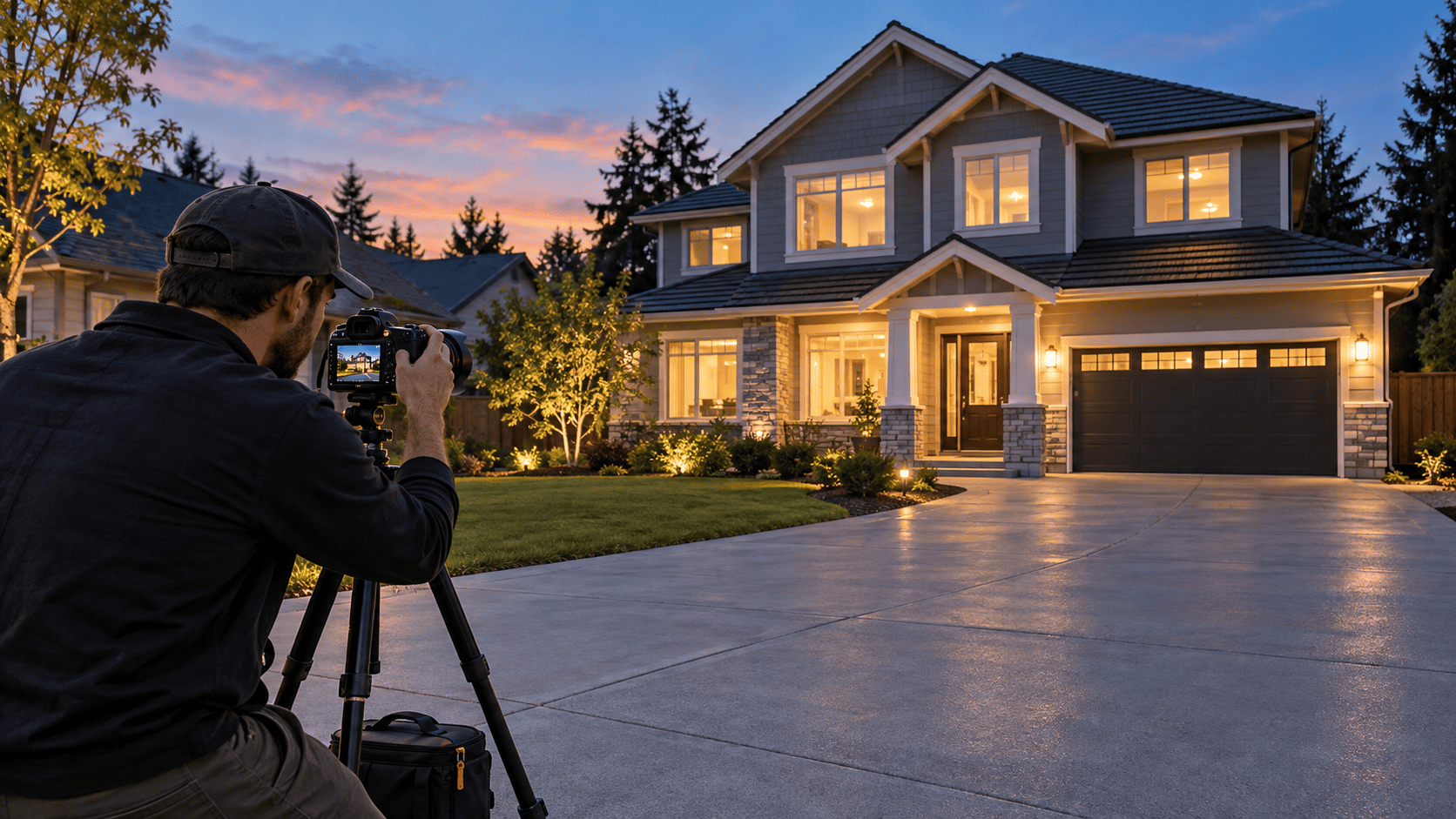
A useful comparison should evaluate how each system performs during an actual property shoot rather than relying on specifications alone.
HDR and Exposure-Bracketed Photography
Both camera types can provide suitable RAW files for HDR blending when exposure, focus, framing, and bracket coverage are controlled. DSLR mirror vibration may be reduced with supported mirror lock-up or Live View settings and an appropriate delay before capture.
Mirrorless cameras have no mirror vibration, but shutter mode and lighting can still affect capture. Test for banding under artificial fixtures rather than assuming one mode will always prevent it.
Read more: Step-by-Step Real Estate HDR Photo Editing Tips
Single-Exposure and Flash Photography
Both camera types can produce detailed, low-noise files in controlled lighting. Evaluate the specific camera’s RAW performance, exposure latitude, and flash synchronization options.
An optical viewfinder shows the scene directly, while an EVF may brighten the display for framing in dim interiors. If exposure simulation makes the scene too dark when using flash, adjust or disable it according to the camera’s available settings.
Tripod-Mounted Interior Photography
The size and continuous autofocus advantages of mirrorless systems become far less critical once the camera is locked down on a tripod. Both platforms easily facilitate precise framing, low base ISO settings, and long shutter exposures.
Instead, field ergonomics, such as fully articulating screens, electronic level gauges, focus magnification, and remote shutter control, play a much greater role in accelerating workflow speed than body weight alone. Evaluating these operational tools should be conducted on a model-by-model basis.
Exterior and Twilight Photography
Exterior shoots place heavy demands on weather sealing, highlight control, and fast adaptability under changing natural light. Twilight sessions in particular require rapid adjustments as ambient light levels plummet within minutes.
Live exposure previews on mirrorless systems simplify tracking these light shifts. However, DSLRs remain fully capable when photographers leverage test shots and histogram readouts effectively. Regardless of the platform chosen, rock-solid tripod stability and precise timing during the narrow twilight window remain the true key to success.
Property Videos and Social Content
For teams delivering photos and video, a suitable mirrorless model can offer convenient autofocus, monitoring, stabilization, and recording options. Confirm which features the selected body actually provides.
DSLRs remain usable for controlled video shots. Compare the specific model’s focusing, recording, and monitoring limitations with the services you plan to deliver.
Read more: Best Real Estate Video Editing Software for Experts
DSLR vs. Mirrorless Lens Systems
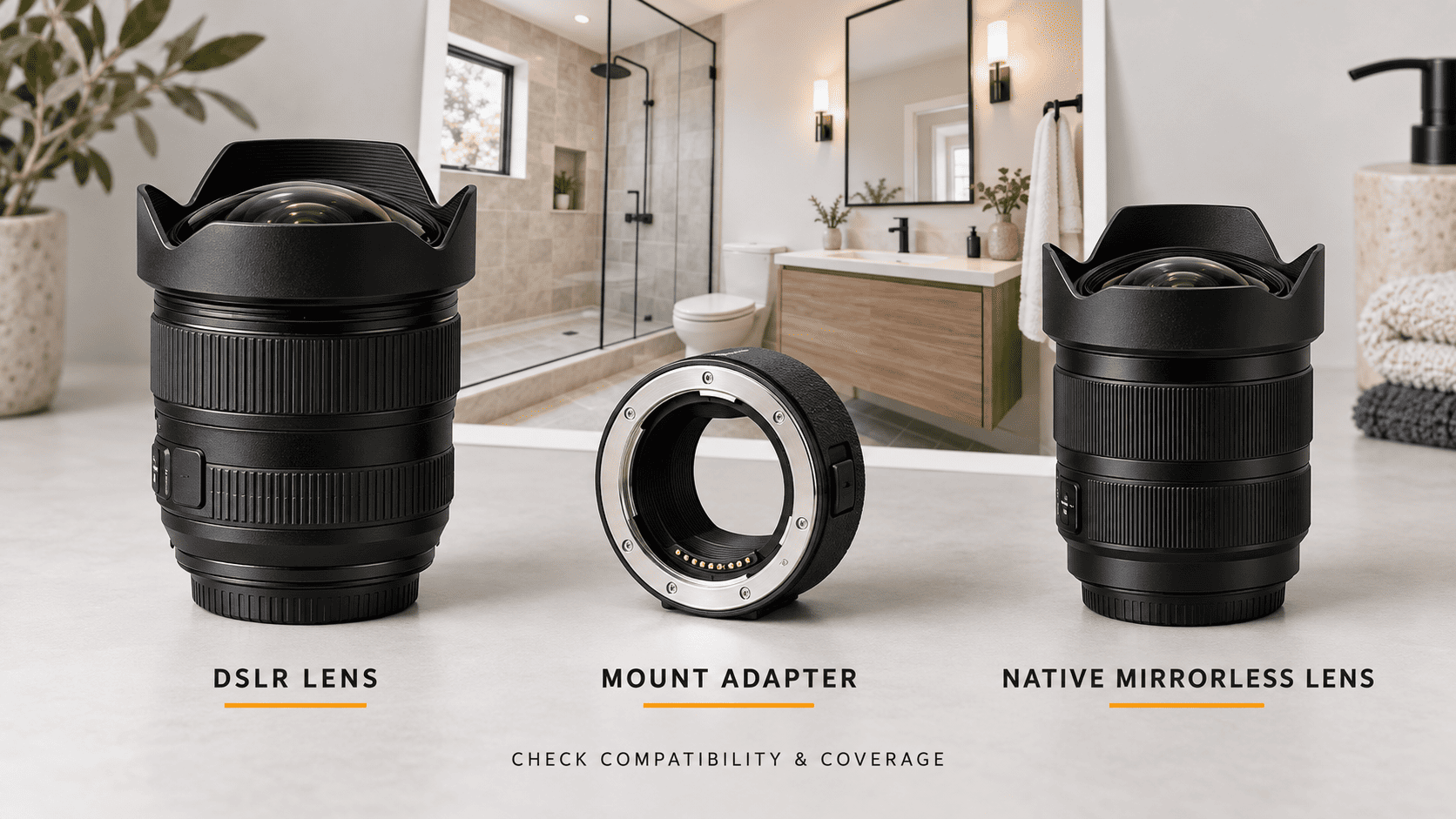
A body comparison is incomplete without examining focal lengths, adapters and the cost of obtaining an appropriate interior lens.
DSLR Wide-Angle Lenses
Legacy DSLR mounts offer an extensive catalog of ultra-wide zooms and high-performance primes. Standard real estate setups typically leverage 14–35mm focal ranges for full-frame sensors and 10–12mm for crop (APS-C) bodies.
Used DSLR lenses may lower total kit cost, depending on pricing and condition. Include repair support and compatible replacement equipment in long-term planning.
Native Mirrorless Wide-Angle Lenses
Native lenses avoid the added length of an adapter and may offer model-specific controls and optimized communication with the body. Compare weight, autofocus, correction profiles, and handling for the actual lens.
However, before committing to a system, agencies must verify that required wide-angle glass is available at a viable price point. A high-end camera body can never compensate for an ill-suited interior lens.
Using DSLR Lenses with an Adapter
Compatible mount adapters can let photographers keep selected DSLR lenses while changing bodies. Canon’s EF-EOS R adapter supports EF and EF-S lenses on compatible EOS R cameras. Nikon’s FTZ II supports many F-mount lenses, but autofocus and other functions vary by lens type. Check the manufacturer’s lens-specific compatibility information.
Nevertheless, verifying lens-specific compatibility remains essential. Autofocus drive speed, optical stabilization, internal correction profiles, and third-party lens performance can vary across combinations. Furthermore, adding an adapter shifts the center of gravity and increases physical length, slightly compromising the sleek form factor expected from a mirrorless upgrade.
Crop Factor and Interior Field of View
Sensor size fundamentally dictates the field of view regardless of whether the camera is mirrorless or DSLR.
At the same camera position, a 16 mm lens provides a wider field of view on full frame than on APS-C. Around 10–12 mm on APS-C provides approximately 15–19.2 mm full-frame-equivalent coverage, depending on crop factor.
This optical distinction is critical when capturing tight interiors such as small bathrooms, compact bedrooms, and studio apartments. Calculating effective field of view prior to purchasing glass ensures production teams select the correct optics for space-constrained shoots.
Should You Upgrade from DSLR to Mirrorless?
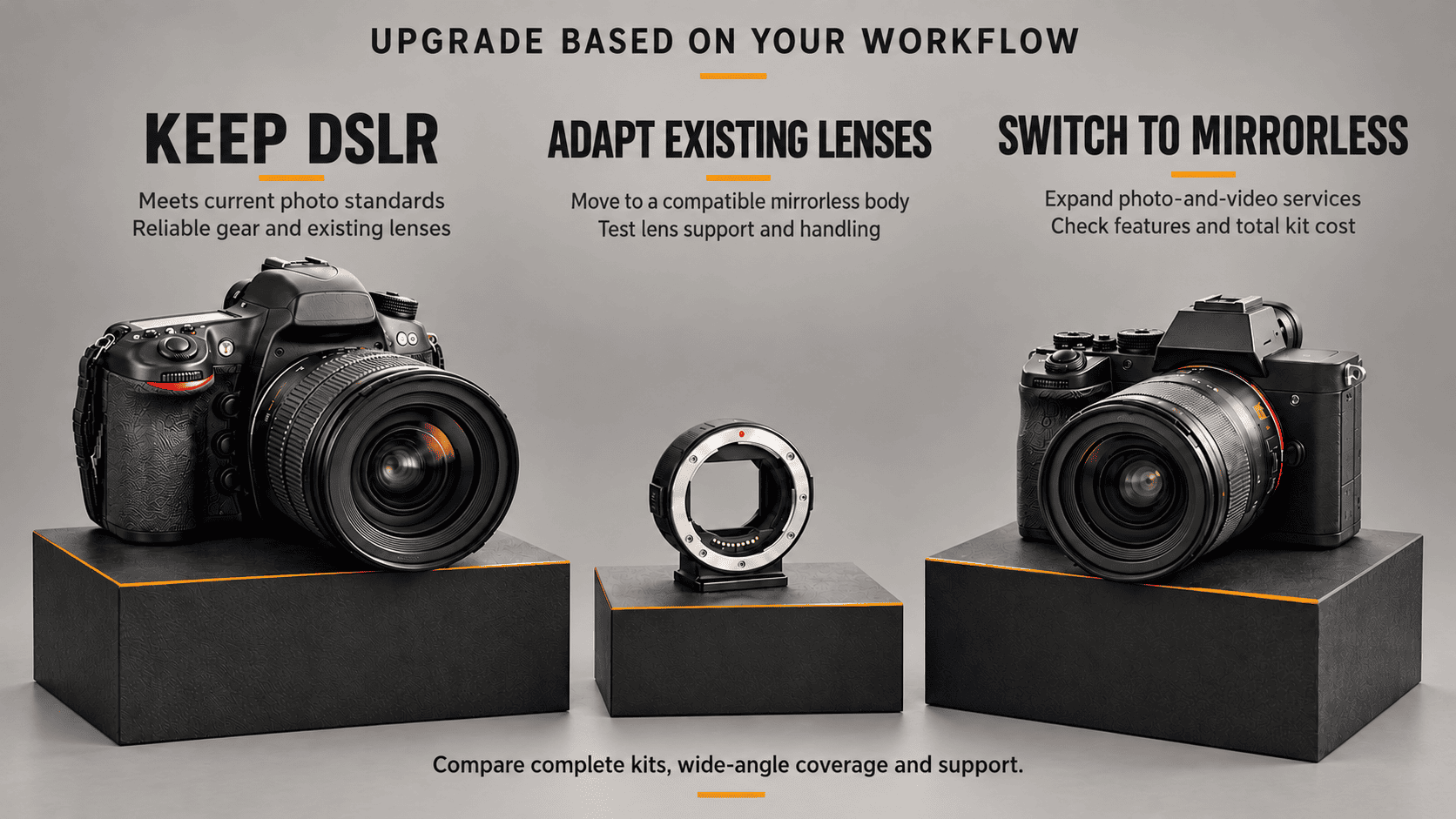
When weighing DSLR vs mirrorless for real estate photography, start with the limitation you need to solve: video performance, exposure preview, equipment reliability, or total system cost
|
Starting point |
Practical direction |
Check before deciding |
|
New photo-and-video kit |
Consider mirrorless |
Video crop, autofocus, stabilization, and lens cost |
|
Existing DSLR meets delivery standards |
Keep the current system |
Condition, repair support, and backup gear |
|
Limited budget for still photography |
Compare used DSLR and mirrorless kits |
Complete kit price and wide-angle coverage |
|
Existing DSLR lenses; new body needed |
Consider adapted mirrorless |
Lens compatibility, supported functions, and handling |
When Keeping a DSLR Makes Sense
Keep your DSLR real estate camera if it reliably captures the RAW files and exposure sequences needed for your current services
Holding onto your current system is particularly advantageous when:
-
Focusing on static photography: Primary workflows rely heavily on locked-down tripod setups.
-
Leveraging existing glass: Modern, high-performance wide-angle lenses are already part of your kit.
-
Minimal video demands: Video production is not a core offering or key revenue stream.
-
Workflow familiarity: Long battery life and physical control ergonomics foster high operational speed.
-
Capital allocation: Compare whether lighting, lenses, backup equipment, or business development would address a more important limitation than a new body.
When Switching to Mirrorless Makes Sense
Transitioning to a mirrorless ecosystem becomes a strategic priority when expanding services into real estate video walkthroughs, vertical social media content, or bundled hybrid media packages.
Upgrading is equally justified when legacy DSLR bodies suffer from feature limitations, lack appropriate wide-angle glass, deliver inconsistent Live View performance, or become cost-prohibitive to service and repair.
For photographers building a new kit, mirrorless is often a practical choice, especially when video is part of the service. Compare total kit cost, support, and lens availability before deciding.
When an Adapter Is a Practical Transition
Smart adapters offer a practical financial buffer during system migrations. Studios can acquire a modern mirrorless body while retaining proven DSLR glass, systematically phasing in native optics as budget permits.
A phased transition works best when existing lenses meet the required image standard and support the necessary functions through the adapter. Test focus, stabilization, correction profiles, and handling before using the kit on paid assignments.
Which Camera Type Is Better for Different Users?
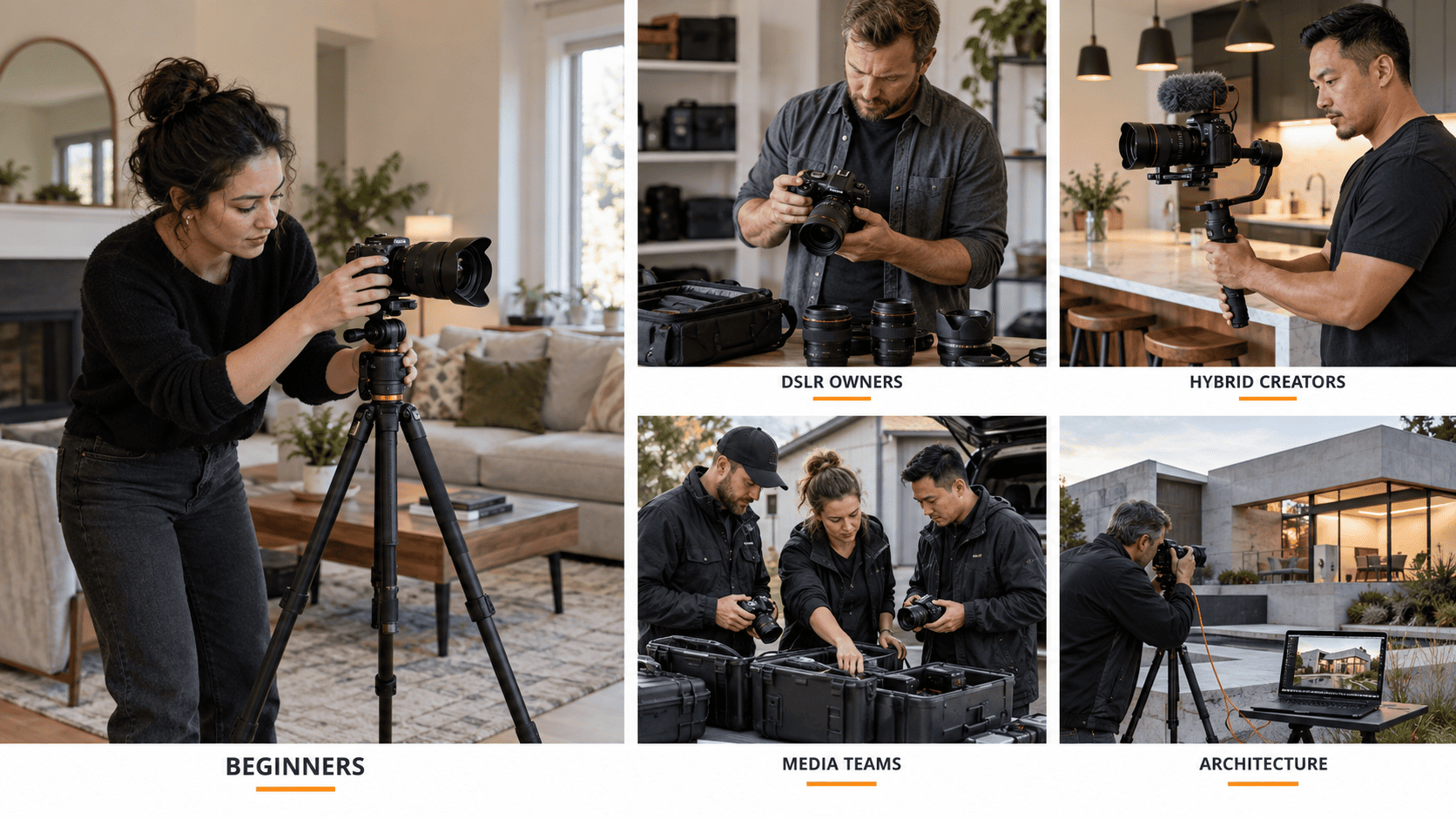
There is no universal winner. The appropriate choice depends on the photographer’s starting point and services.
Beginner Real Estate Photographers
For emerging creators and new media studios, the ideal entry point is generally an accessible mirrorless body that supports reliable RAW output, consistent Auto Exposure Bracketing (AEB), and compatibility with suitable ultra-wide optics.
Alternatively, a used DSLR kit remains a compelling budget option if the total package offers substantial cost savings and has undergone rigorous technical inspection. Under no circumstances should optical quality or tripod stability be sacrificed merely to acquire a newer camera body.
Established DSLR Photographers
A professional photographer does not need to replace a well-functioning DSLR simply because newer mirrorless options are available.
The most compelling reasons to upgrade are improved video capabilities, more convenient exposure previewing, reduced gear weight, or declining support for current camera bodies.
Photo-and-Video Creators
A suitable mirrorless model can be a practical choice for hybrid creators. Compare continuous autofocus, stabilization, frame-rate options, monitoring, and recording formats rather than assuming every mirrorless body provides the same capabilities.
Nevertheless, the selected camera must still generate codecs and file sizes that remain manageable within the studio's existing editing pipeline and storage system.
High-Volume Media Companies
Media agencies should prioritize standardization, reliability, and gear interchangeability. Standardizing on a single camera ecosystem across all team members streamlines onboarding, simplifies shared lens allocation, ensures consistent on-set setups, and maintains uniformity during post-production.
While mirrorless platforms offer a stronger foundation for long-term growth, an abrupt transition can introduce color science discrepancies and inconsistent exposure sequences. New camera bodies should always undergo rigorous internal testing prior to full-scale agency deployment.
Luxury and Architectural Photographers
Luxury and architectural work may require higher resolution, specialized lenses, tethering and detailed color control.
Both professional DSLR and mirrorless systems can satisfy these requirements. Mirrorless offers the broader future upgrade path, while established DSLR systems may provide affordable access to proven tilt-shift and ultra-wide lenses.
How Camera Type Affects Post-Production
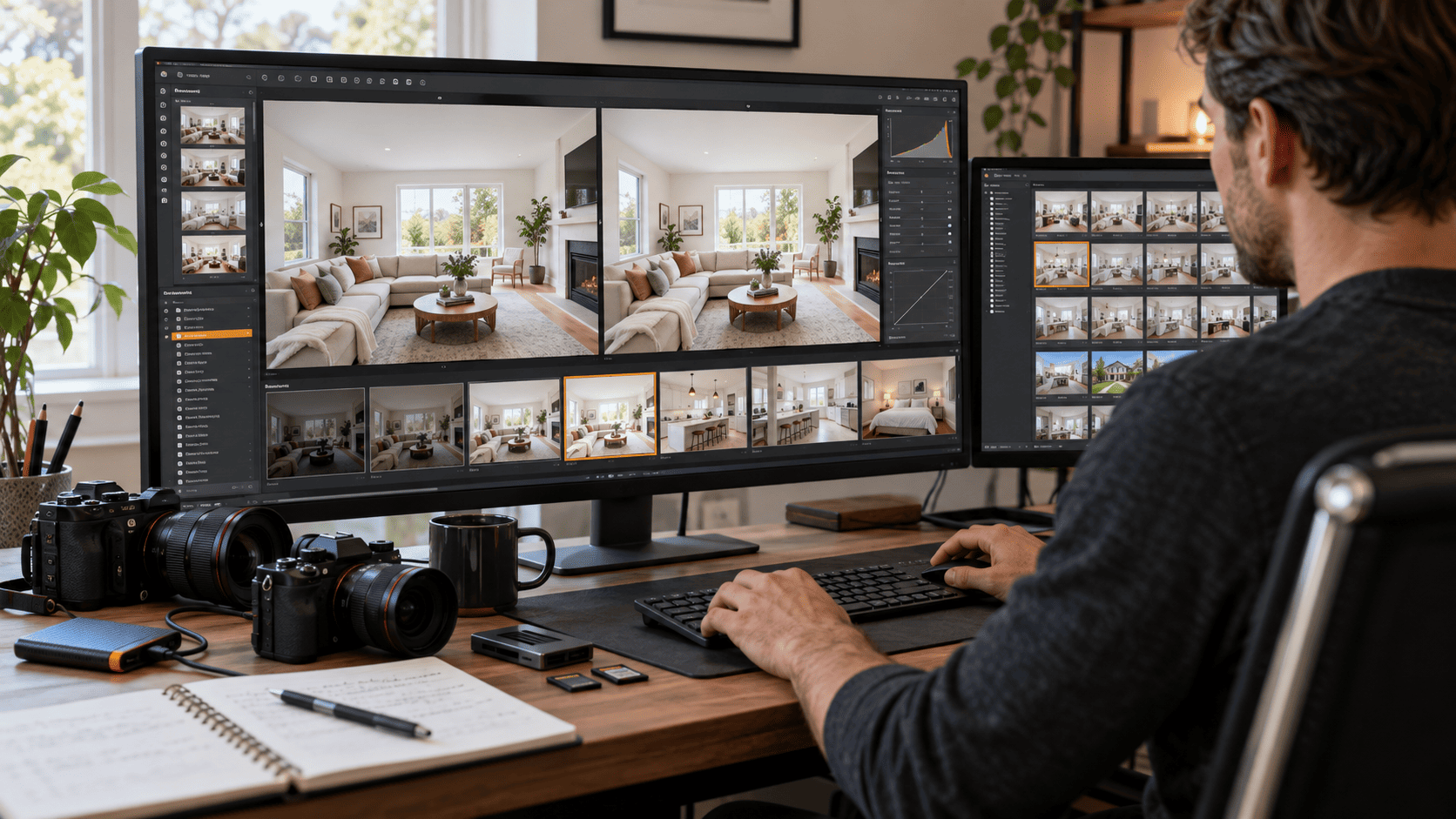
Changing camera systems influences more than capture. It can alter file size, color response, lens corrections, bracket grouping and processing time.
RAW Files and Color Consistency
Different camera models often render colors and white balance differently, even under identical exposure settings. When introducing a new camera platform, media teams should evaluate full project image sets rather than isolated individual frames.
Camera profiles, editing presets, and reference files may require recalibration. The primary goal is achieving consistent, cohesive final output across different photographers and properties, rather than producing identical unedited RAW files.
HDR Bracket Organization
A consistent shooting order and exposure bracketing step interval allow editors to accurately identify and merge HDR bracket sets. Both DSLR and mirrorless systems effectively support streamlined HDR workflows when camera settings are fully standardized.
Files should be grouped logically by room or capture sequence. Renaming, reordering, or deleting individual frames prior to upload can disrupt automated batch processing and compromise workflow reliability.
Read more: 10 Tips to Take Your HDR Real Estate Photography to the Next Level
Resolution and Processing Requirements
Higher-resolution cameras can generate larger files regardless of whether they are DSLR or mirrorless. RAW bit depth, compression, and exposure count also affect storage and processing. In bracketed workflows, multiple source files per delivered image increase transfer, backup, merge, and export requirements.
Photographers should execute a complete end-to-end test workflow before upgrading. A camera that enhances fine detail but doubles post-processing time may ultimately hinder high-volume production operations.
Maintaining Consistency During a System Change
System migrations should be implemented through a controlled testing protocol. Production teams should capture the exact same scene using equivalent fields of view on both camera formats, running all files through standard post-processing pipelines.
Compare highlight and shadow recovery, color matching, corner sharpness, lens distortion, and editing time. Update capture guidelines and approved reference images before introducing new equipment across the team.
While professional post-production can mitigate noticeable discrepancies between systems, it cannot compensate for fundamental shooting errors such as inconsistent framing, missing angles, motion blur, or clipped sensor data.
Frequently Asked Questions
Is a DSLR Still Good for Real Estate Photography?
Yes. A DSLR remains suitable when it captures RAW files, provides reliable exposure bracketing and works with an appropriate wide-angle lens. A modern mirrorless camera may offer a more convenient workflow, but it does not make a capable DSLR unusable.
Is Mirrorless Better for Interior Photography?
Mirrorless is often more convenient because an electronic viewfinder can preview exposure and white balance. However, both systems can produce professional interior photographs when used with proper exposure, composition and lens selection.
Does Mirrorless Produce Better Image Quality Than DSLR?
Not inherently. Image quality depends on the individual sensor, lens, RAW processing and capture technique. A newer mirrorless camera may outperform an older DSLR, but the absence of a mirror does not directly improve image quality.
Can I Use DSLR Lenses on a Mirrorless Camera?
Often, yes. Canon EF and EF-S lenses can be used on compatible EOS R cameras with an EF-EOS R adapter, while many Nikon F-mount lenses can be used on Z-series cameras through an FTZ adapter. Compatibility should be checked for each lens.
Should Beginners Buy a DSLR or Mirrorless Camera?
Most beginners buying new equipment should choose mirrorless because it provides a clearer future upgrade path. A used DSLR remains worthwhile when it allows the photographer to purchase a better wide-angle lens, tripod and complete working kit within budget.
Is a Used DSLR Worth Buying for Real Estate Photography?
Yes, provided its sensor, shutter, card slots, controls and bracketing functions are in good condition. The availability of a compatible ultra-wide lens and future repair support should also be confirmed.
Do You Need Mirrorless for Property Videos?
No. A DSLR can be used for controlled property video. Many recent mirrorless models provide more convenient autofocus, monitoring, and recording options, but the choice should be based on the specific camera and required deliverables.
Which Is Better for HDR Real Estate Photography?
Neither system has an automatic image-quality advantage. The better HDR camera is the one that provides reliable bracketing, stable operation, clean RAW files and an efficient method for grouping exposure sequences.
Conclusion
For photographers building a new system, mirrorless is often a practical choice, especially when video is part of the service. A reliable DSLR can remain suitable for still photography when it provides the lens coverage, RAW quality, and bracketing controls required for delivery. Upgrade when the complete system resolves a specific production limitation and justifies its cost.
Compare lenses, battery requirements, support, and post-production workload alongside body specifications. Rotider supports consistent delivery through standardized editing and quality control for suitable DSLR and mirrorless source files.
.png)



.webp)