
.png)
Choosing between full frame vs crop sensor for real estate photography comes down to workflow compatibility rather than absolute format superiority. While full-frame bodies excel in low-light dynamic range and ultra-wide optics, APS-C systems deliver commercial-grade results when paired with 10–12mm lenses and proper exposure bracketing. This guide evaluates key hardware, lighting, and financial considerations to help you select the optimal camera setup for your business.
Do You Need Full Frame for Real Estate Photography?
.png)
Not necessarily. Modern APS-C cameras can provide sufficient resolution and RAW editing flexibility for many residential listing, rental, and digital marketing workflows
Full-frame hardware provides distinct advantages in low-light environments, high-end architectural assignments, or complex hybrid video production. However, these system benefits cannot replace foundational skills like exposure management, framing, lighting technique, and focal length selection.
For emerging service providers, investing in an APS-C body paired with an ultra-wide lens, a sturdy tripod, and lighting gear offers a significantly better return on investment than exhausting the budget on a full-frame camera body alone.
Full Frame vs. Crop Sensor at a Glance
|
Factor |
Full frame |
APS-C crop sensor |
|
Sensor size |
Approximately 36 × 24mm |
Approximately 23.5 × 15.6mm, depending on brand |
|
Interior field of view |
Easier access to established 14–35mm wide-angle ranges |
Requires approximately 9–16mm lenses for similar coverage |
|
Dynamic range |
Often provides more exposure flexibility |
Can perform well, but results depend on the specific sensor |
|
Low-light performance |
Generally cleaner at higher ISO settings |
Usually produces more noise at equivalent high-ISO output |
|
Depth of field |
Shallower at equivalent framing and aperture |
Greater depth of field can help keep rooms in focus |
|
Equipment size |
Bodies and professional lenses are usually larger |
Smaller and lighter systems are widely available |
|
Complete system cost |
Generally higher |
Usually more accessible |
|
File size |
Depends on resolution, bit depth and compression |
Also depends on resolution, not sensor size alone |
|
Best suited to |
Luxury, architecture and demanding hybrid production |
Beginners, residential work and cost-conscious studios |
Neither sensor format inherently guarantees superior image quality. A modern APS-C camera can easily outperform an older full-frame body in resolution, autofocus accuracy, video capabilities, and overall usability. Comparing specific camera specifications alongside compatible lens ecosystems remains essential.
Read more: Best Camera for Real Estate Photography in 2026
What Is the Difference Between Full Frame and Crop Sensors?
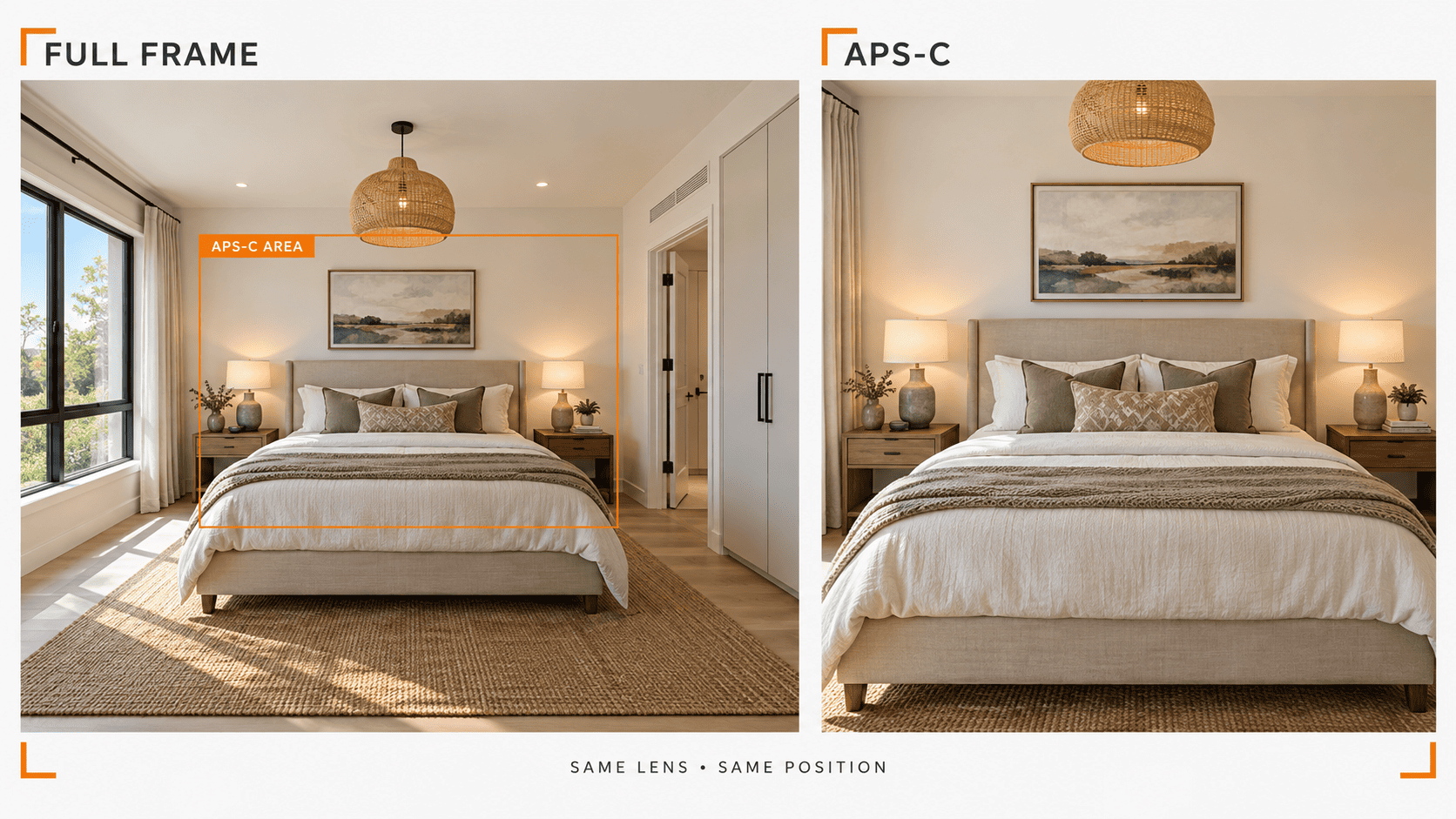
The fundamental difference stems from physical sensor size, which determines how much of the lens's image circle is captured. This directly impacts field of view, low-light performance, depth of field, and overall camera form factor.
Full-Frame Sensors
In crop sensor vs full frame interiors considerations, full-frame sensors (36 × 24mm) retain a native 1:1 field of view. A 16mm lens delivers its true ultra-wide perspective, seamlessly aligning with standard interior focal ranges like 14–24mm or 16–35mm. Additionally, the larger sensor surface area enhances low-light sensitivity and dynamic range, depending on hardware generation and image processing.
APS-C Crop Sensors
APS-C sensors are smaller than full-frame (~23.5 × 15.6mm), capturing a smaller portion of the image circle and yielding a narrower field of view. Canon details its 1.6x crop factor for APS-C systems, whereas Nikon specifies a 1.5x crop factor for its DX format (aligned with Sony and Fujifilm).
Crop factor does not change a lens's physical focal length; a 10mm optics remains 10mm. It merely represents the full-frame equivalent focal length needed to yield a matching field of view in APS-C real estate photography.
How Crop Factor Changes the Field of View
A 16mm lens on an APS-C sensor (1.5x–1.6x crop factor) yields a full-frame equivalent field of view of 24–25.6mm.
In tight quarters like small bedrooms or bathrooms, this 24–26mm perspective is often too narrow to capture the space effectively. Consequently, APS-C photographers require dedicated 10–12mm ultra-wide lenses to achieve the standard 15–19mm full-frame equivalent.
How Sensor Size Affects Real Estate Photography
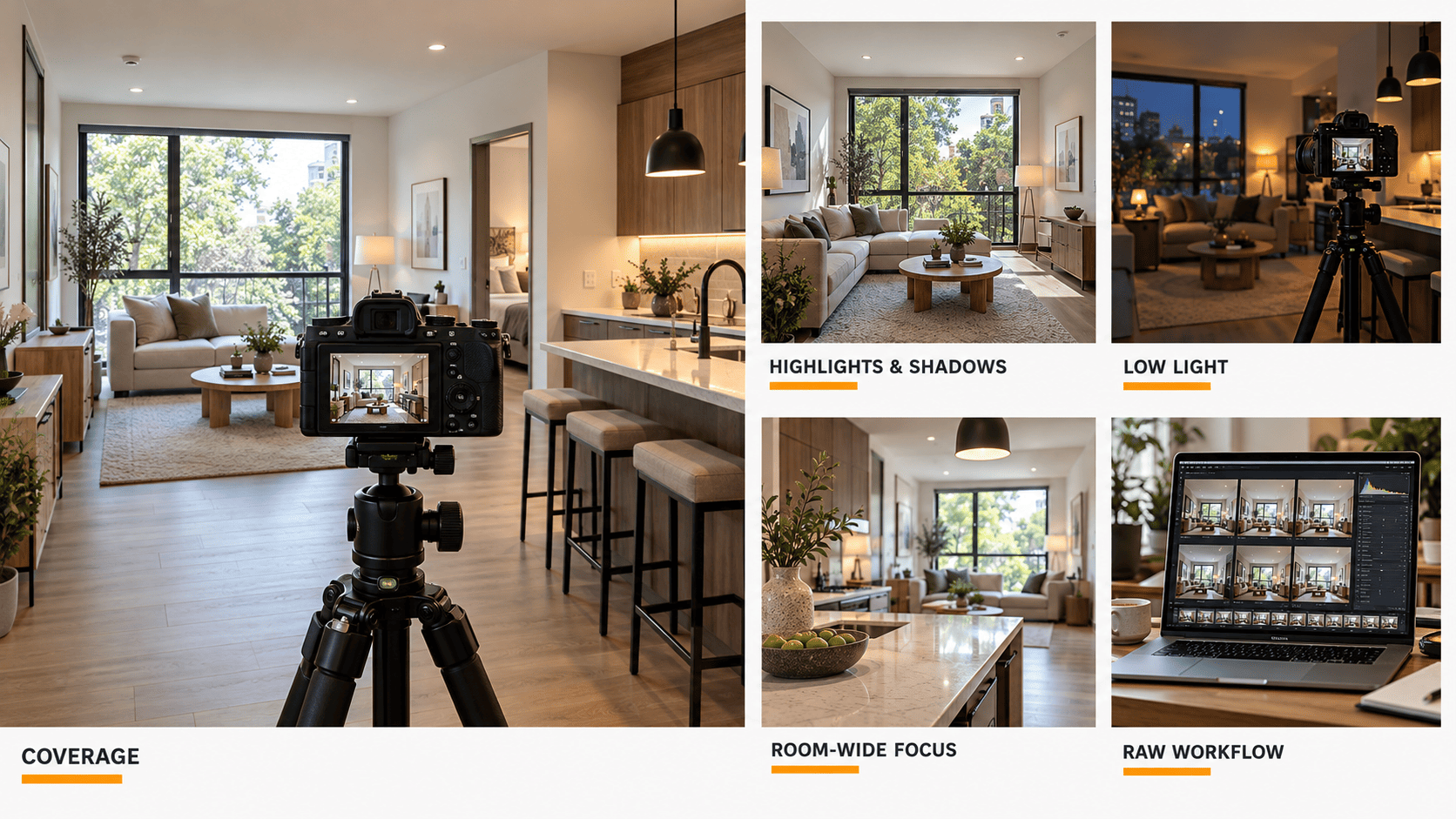
Sensor size affects several parts of the capture process, but its importance varies with the property, lighting method and final output.
Wide-Angle Coverage in Small Interiors
Field of view represents the primary operational difference between sensor formats. Full-frame cameras pair naturally with 14–24mm or 16–35mm glass, while APS-C setups require dedicated 10–18mm or 10–20mm lenses to achieve an equivalent perspective.
However, photographers should avoid overusing maximum ultra-wide angles, which stretch edge elements and artificially exaggerate foreground elements. Perspective distortion depends on camera placement, and barrel distortion stems from optical design—a crop sensor itself does not inherently cause image distortion.
Dynamic Range for Bright Windows and Dark Rooms
Interior photography requires managing extreme contrast between dark indoor shadows and bright exterior windows. When evaluating crop sensor vs full frame interiors, full-frame cameras generally provide wider dynamic range than same-generation APS-C models, offering greater latitude for highlight and shadow recovery. However, dynamic range also depends on sensor design, resolution, base ISO, and RAW file processing.
Even full-frame sensors struggle to capture extreme brightness ranges in a single frame. Consequently, exposure bracketing or flash integration remains necessary to preserve window details and prevent highlight clipping.
Low-Light Performance and Image Noise
Full-frame sensors gather more light, yielding cleaner files at elevated ISOs. This edge benefits handheld interior shooting, twilight capture, and real estate video production, where expanding shutter speed is constrained.
This advantage diminishes when capturing static scenes on a tripod. Photographers can lock in base ISO, use slower shutter speeds, and execute exposure bracketing rather than relying on high-ISO noise reduction.
Consequently, a current-generation APS-C body operating at base ISO can deliver cleaner results than an older full-frame camera with suboptimal exposure. Evaluating actual RAW files provides a far more objective comparison than assuming sensor size dictates final image quality.
Depth of Field and Keeping Rooms in Focus
At a matching field of view and aperture setting, APS-C sensors inherently yield a deeper depth of field than full-frame. This is a practical advantage for real estate media, where maintaining sharp focus across the entire room is essential.
While full-frame bodies excel at shallow depth of field for detail and lifestyle shots, blurred backgrounds are rarely a priority for standard property listings.
Depth of field ultimately depends on focal length, focus distance, and camera placement, making sensor size just one variable in the overall optical setup.
Resolution, File Size and Editing Flexibility
Sensor size and resolution are distinct specifications. An APS-C camera can easily surpass a full-frame body in megapixel count, as demonstrated by the 40.2 MP Fujifilm X-T5.
Higher resolution offers greater flexibility for cropping, perspective correction, and large-format printing. However, it generates larger RAW files, requiring more computing power when merging 3- to 5-frame exposure brackets.
File size is dictated by megapixels, bit depth, and compression method rather than sensor format alone. Photographers should test their current hardware and storage workflow before upgrading to a higher-resolution body.
Crop Sensor vs. Full Frame for Interior Photography
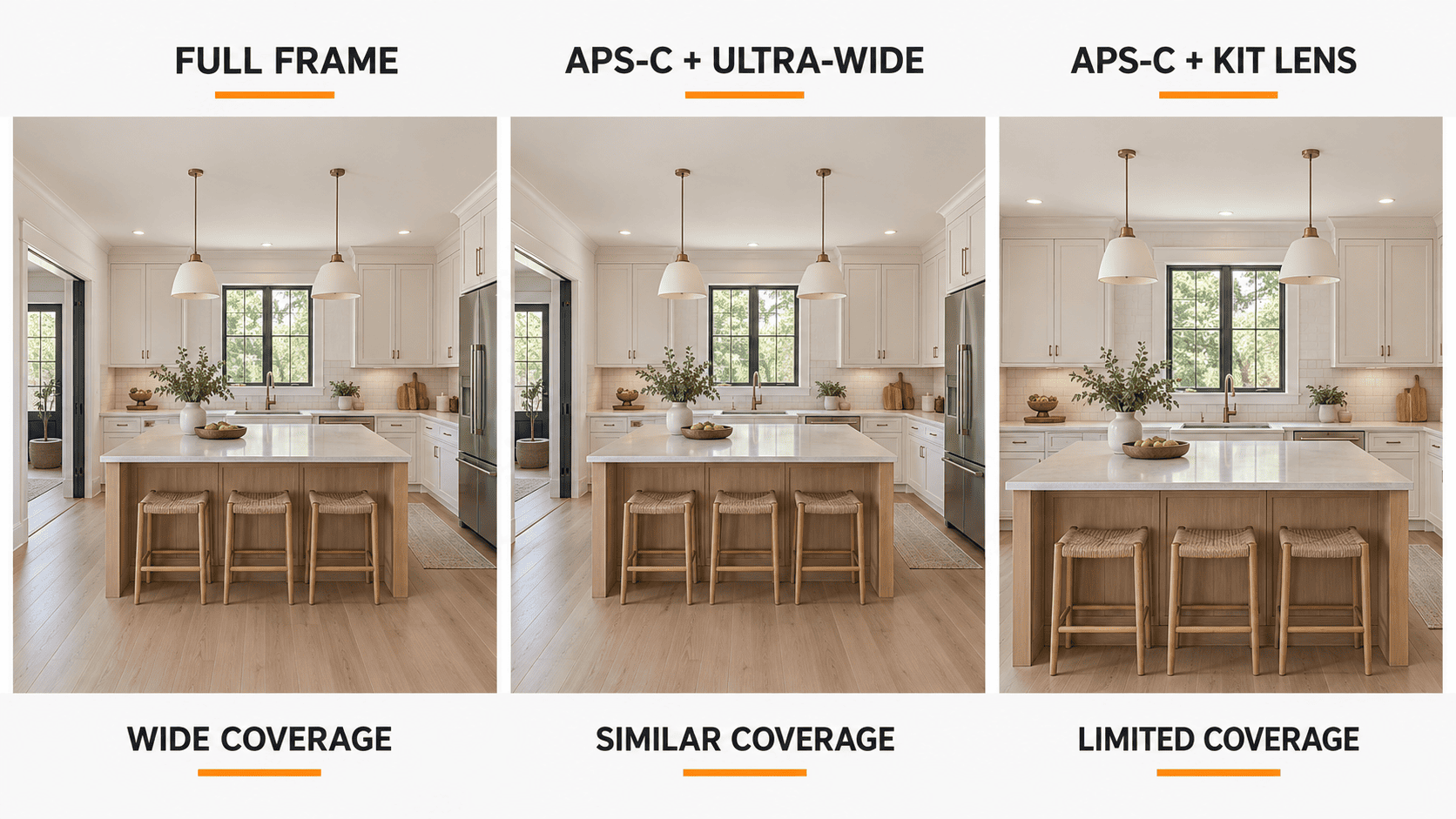
The most useful way to compare the two formats is to calculate the focal length required for a similar angle of view.
|
Full-frame field of view |
1.5x APS-C lens |
Canon 1.6x APS-C lens |
|
14mm |
Approximately 9.3mm |
Approximately 8.8mm |
|
16mm |
Approximately 10.7mm |
10mm |
|
18mm |
12mm |
Approximately 11.3mm |
|
20mm |
Approximately 13.3mm |
12.5mm |
|
24mm |
16mm |
15mm |
These figures compare approximate angles of view. They do not mean the lenses become physically identical or produce the same depth of field, optical distortion or corner performance.
Full-Frame and APS-C Lens Equivalents
A standard 16–35mm lens on full-frame translates to roughly 10–22mm on Canon APS-C or 11–23mm on 1.5x crop bodies.
This makes dedicated crop ultra-wide optics—such as the Canon RF-S 10–18mm or Nikon NIKKOR Z DX 12–28mm—essential tools for APS-C real estate photography.
Beyond focal range, evaluate corner sharpness, flare resistance, optical distortion, and lens profile support. An ultra-wide lens with severe edge softness forces post-capture cropping and distortion corrections, negating the advantage of its wide field of view.
Canon’s 1.6x Crop Factor
A 10mm lens on Canon APS-C yields a 16mm full-frame equivalent field of view, whereas 18mm translates to 28.8mm.
Consequently, standard 18–45mm kit lenses are typically too narrow for compact interior spaces. While usable for exterior shots, architectural details, or open layouts, investing in a dedicated ultra-wide lens is essential for complete property coverage.
Nikon, Sony and Fujifilm’s 1.5x Crop Factor
On a 1.5x crop APS-C system, a 10mm lens delivers a 15mm full-frame equivalent field of view, while 12mm yields an 18mm equivalent.
This focal range effectively covers most interior layouts, proving that when evaluating do you need full frame for real estate, a well-equipped crop setup delivers. Photographers should avoid defaulting to the ultra-widest focal length for every room; shifting from 10mm to 12mm produces far more natural spatial proportions when space allows.
Why an 18mm APS-C Kit Lens Is Often Not Wide Enough
An 18mm lens on an APS-C body (1.5x–1.6x crop factor) translates to a 27–28.8mm full-frame equivalent field of view.
This angle is often too narrow for small bathrooms, secondary bedrooms, hallways, and tight kitchens, forcing photographers against walls and compromising spatial composition. The issue lies not with the APS-C sensor itself, but with selecting an inadequate focal length in full frame vs crop sensor for real estate photography.
Full Frame vs. APS-C: Advantages and Limitations
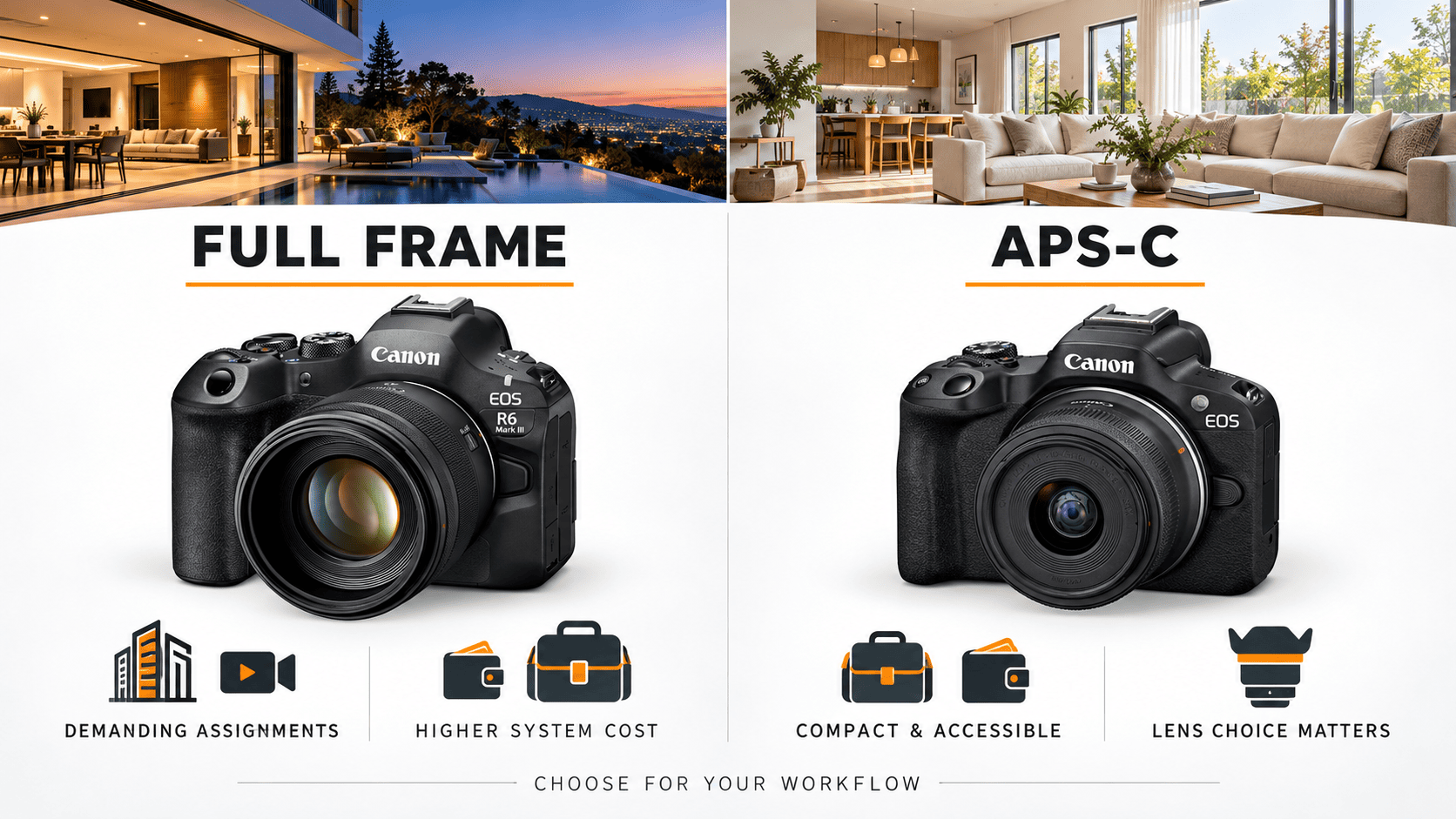
Advantages of Full Frame for Real Estate Photography
Full-frame sensors simplify ultra-wide shooting by utilizing pro-grade lenses directly without crop factor conversions. This offers a distinct operational advantage in tight interior spaces or multi-lens team workflows.
Overall, the larger sensor format delivers superior flexibility in high-contrast lighting and high-ISO scenarios. It also excels at shallow depth of field, large-format commercial printing, and demanding hybrid photo-video production.
Beyond the sensor itself, full-frame camera systems typically offer pro-level build features, including dual memory card slots, robust weather sealing, extensive customization, and access to premium native optics.
Limitations of Full-Frame Systems
The primary drawback is high total system investment—encompassing bodies, dedicated ultra-wide lenses, backup gear, and storage media. Full-frame systems are heavier and often include redundant features for real estate media, such as ultra-fast burst rates or complex subject-tracking autofocus.
Upgrading to full-frame does not automatically drive higher profitability. When evaluating do you need full frame for real estate, if massive RAW files slow down ingestion, HDR merging, QA, and delivery without adding tangible client value, higher-end hardware ultimately degrades workflow efficiency.
Advantages of APS-C for Real Estate Photography
APS-C systems provide a lower entry cost and leave more budget for the lens, tripod, flash and backup equipment. This makes them attractive to beginners and photographers testing the market before committing to a larger system.
The smaller equipment is easier to carry across multiple appointments. Greater depth of field can also help maintain room sharpness without requiring very small apertures.
Current APS-C cameras provide enough resolution for online listings, social media, brochures and many commercial applications. When paired with the correct ultra-wide lens, their field-of-view limitation can be managed effectively.
Limitations of APS-C Systems
APS-C cameras require shorter focal lengths for wide interior coverage. Depending on the camera mount, the selection of high-quality native ultra-wide lenses may be smaller than the full-frame selection.
High-ISO files may show more noise, and difficult shadow recovery can require more careful exposure. These limitations become more visible in handheld video, twilight work and mixed-light scenes than in controlled tripod-based photography.
Some entry-level APS-C bodies also omit professional workflow features such as dual card slots, extensive bracketing controls or robust weather sealing. Those are camera-model limitations rather than unavoidable characteristics of the sensor format.
Which Sensor Is Right for Your Real Estate Photography Work?
For Beginner Real Estate Photographers
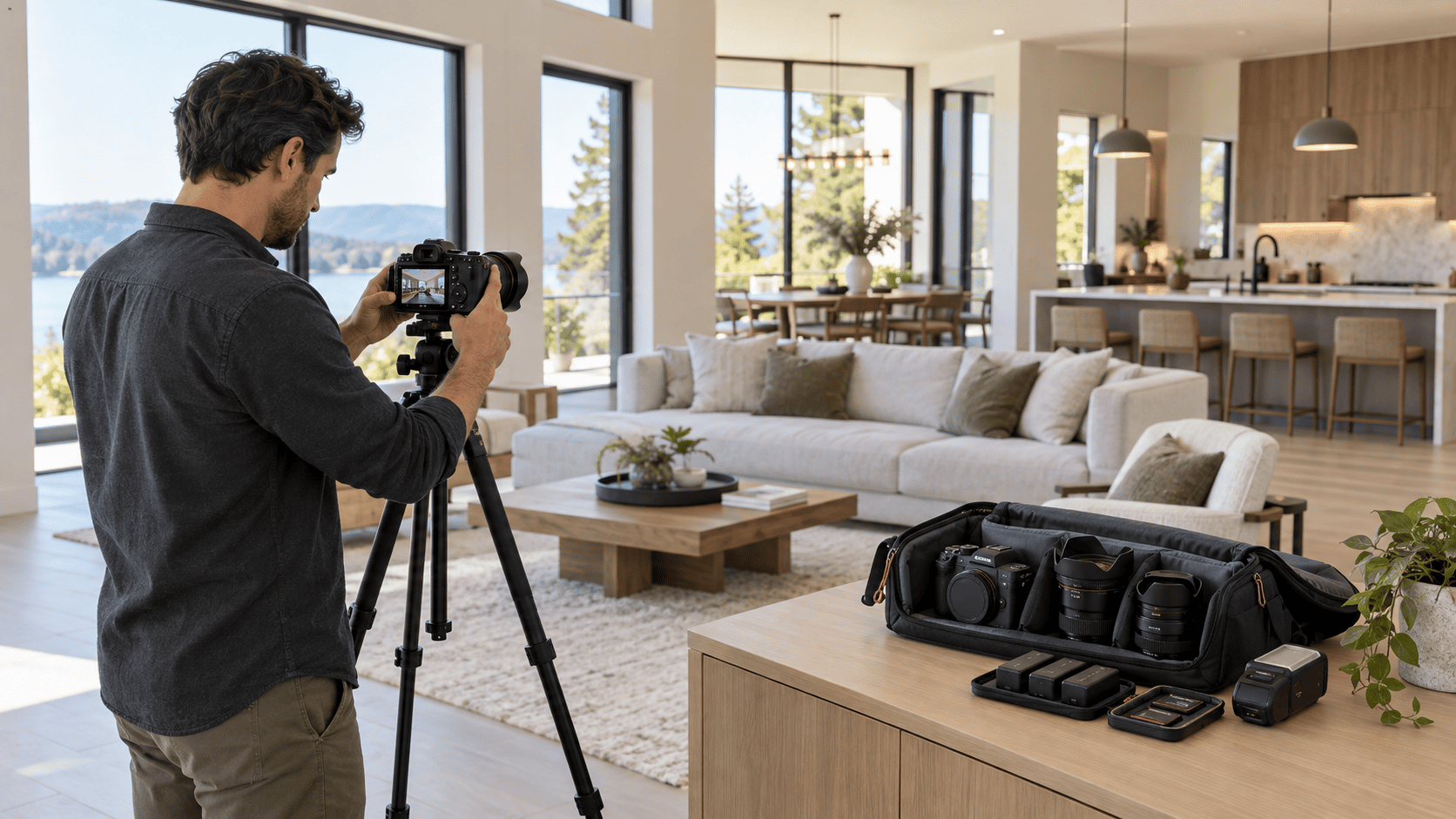
In evaluating full frame vs crop sensor for real estate photography, APS-C offers a practical entry point for budget-conscious professionals. Saved capital is better allocated toward dedicated ultra-wide optics, sturdy tripods, spare batteries, and lighting systems.
Investing in a full-frame body is counterproductive if it constrains your budget to a 24–70mm kit lens, which is too narrow for interior coverage. While certified pre-owned full-frame systems can be viable, always evaluate total system costs rather than focusing solely on the body price.
For Residential Listing Photography
In evaluating full frame vs crop sensor for real estate photography, APS-C offers a practical entry point for budget-conscious professionals. Saved capital is better allocated toward dedicated ultra-wide optics, sturdy tripods, spare batteries, and lighting systems.
Investing in a full-frame body is counterproductive if it constrains your budget to a 24–70mm kit lens, which is too narrow for interior coverage. While certified pre-owned full-frame systems can be viable, always evaluate total system costs rather than focusing solely on the body price.
For Luxury and Architectural Photography
Overall, when analyzing full frame vs crop sensor for real estate photography, full-frame cameras offer a superior long-term solution for high-end residential, commercial spaces, and architectural photography. These projects typically demand higher resolution files, greater editing latitude, tilt-shift lens compatibility, and advanced exposure control.
However, sensor size alone does not dictate architectural accuracy. Critical factors such as camera height, lens quality, composition, vertical alignment, lighting technique, and post-processing remain essential.
High-resolution APS-C cameras can still perform exceptionally well, particularly when shooting at base ISO under controlled lighting. Ultimately, the final decision should be guided by output requirements rather than the property's listing price.
For Hybrid Photo and Video Production
Full-frame sensors deliver better low-light video quality and easier subject isolation, but actual video performance depends heavily on the specific camera model. Certain cameras apply a sensor crop in specific recording modes or higher frame rates, effectively narrowing the wide-angle field of view that prompted choosing full-frame in the first place.
Hybrid creators should thoroughly evaluate recording resolutions, video crop factors, rolling shutter artifacts, image stabilization, overheating limits, codecs, and media card requirements. Sensor format alone is insufficient to judge a camera's overall video capability.
An APS-C system serves as a highly practical hybrid option when paired with suitable ultra-wide lenses. Its compact footprint improves handheld maneuverability and simplifies gimbal balancing during video walk-throughs
For High-Volume Real Estate Media Teams
Workflow standardization outweighs theoretical image quality differences. Real estate media agencies benefit significantly when photographers use compatible lenses, identical bracketing sequences, uniform camera profiles, and predictable folder structures.
When evaluating full frame vs crop sensor for real estate photography at an enterprise level, full-frame systems offer a broader professional ecosystem, while APS-C substantially reduces fleet equipment costs. Both setups work effectively provided backup gear is on hand and the editing team receives consistent file deliveries.
Mixing sensor formats across a team requires careful validation, as variations in resolution, color rendering, and equivalent focal lengths can result in inconsistent image sets across property listings.
What Does Each Camera System Really Cost?
Camera Body and Wide-Angle Lens
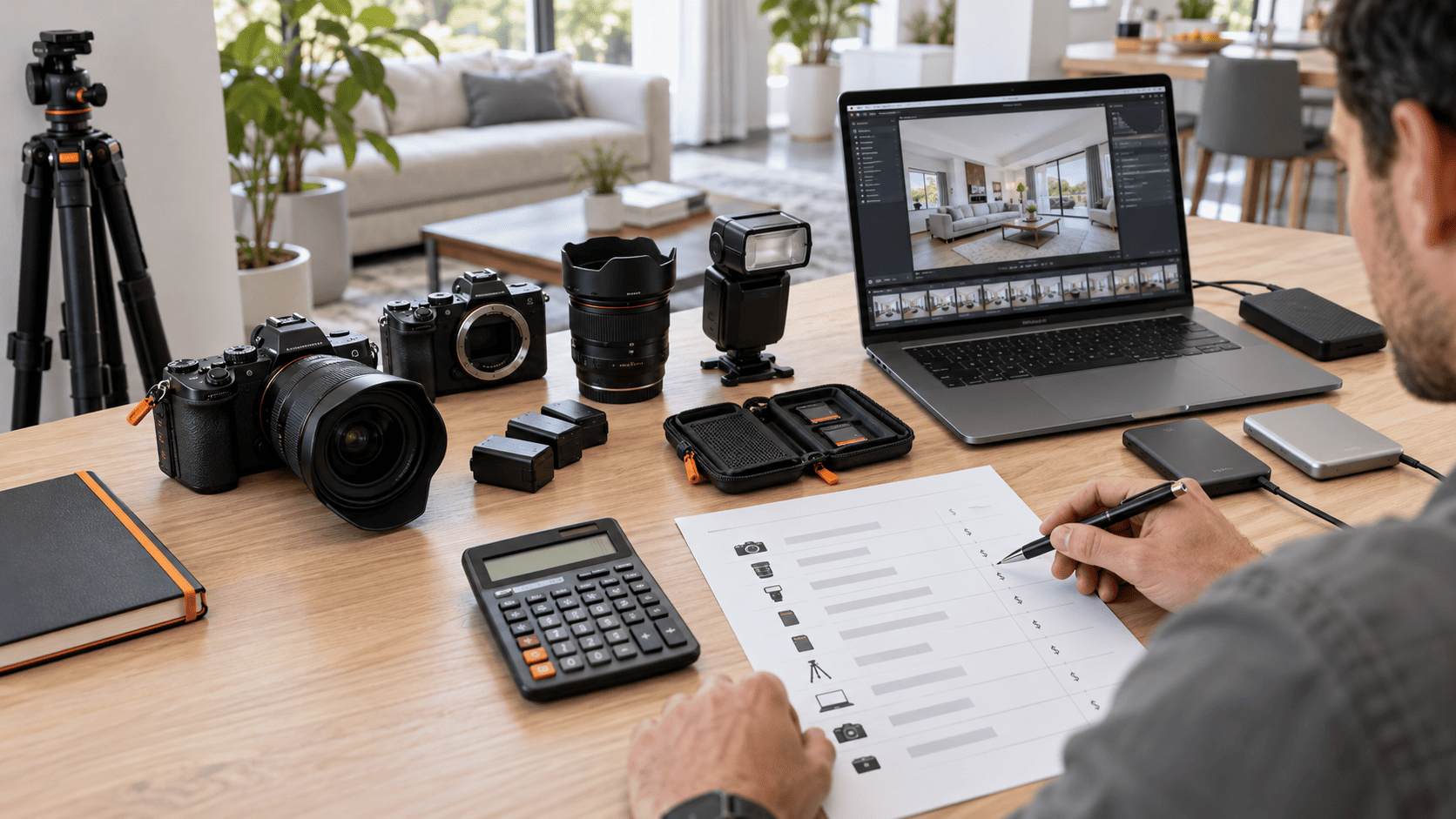
The camera body is merely the initial expenditure. A complete real estate photography kit must include a suitable ultra-wide-angle lens, a sturdy tripod, reliable memory cards, spare batteries, and dedicated flash equipment.
APS-C bodies generally carry lower price tags, and native crop lenses are often more affordable. However, this cost advantage shrinks if a system lacks capable first-party ultra-wide optics, forcing reliance on premium third-party glass.
Full-frame platforms demand a higher upfront investment, but they grant access to a broader, more robust lineup of professional lenses. Photographers should evaluate specific body-and-lens combinations tailored to their operational needs rather than basing decisions solely on camera body prices.
Batteries, Cards and Backup Equipment
Professional production demands spare batteries, highly reliable memory cards, charging gear, and a complete redundancy strategy. An entry-level body with a low initial price tag can quickly become expensive once a secondary body and supporting accessories are factored in.
Dual card slots mitigate the risk of image loss, while maintaining matching backup bodies simplifies lens and battery logistics. When weighing full frame vs crop sensor for real estate photography, these operational workflow factors often prove far more vital than subtle differences in sensor performance.
Storage and Processing Requirements
Higher-resolution cameras produce significantly larger file sizes regardless of sensor format. Exposure bracketing in 3 or 5-frame sequences multiplies storage demands dramatically even before post-processing begins.
Calculating true operational costs must account for high-speed memory cards, local backups, cloud storage, workstation performance, data transfer times, and editing overhead. A camera system generating double the data volume must deliver a proportional ROI to justify the additional processing workload.
Future Lens and Camera Upgrades
Purchasing lenses with a future upgrade path in mind is a sound strategy, but it requires careful verification of lens mount compatibility. Certain crop-sensor lenses can be mounted on full-frame mirrorless bodies, but they typically trigger an automatic crop mode or cause severe vignetting. Other combinations may require mount adapters or prove completely incompatible.
When planning optics, never assume every full-frame lens performs flawlessly on an APS-C body, or that crop lenses are entirely unusable on full-frame systems. Always consult manufacturer specifications before committing to a purchase.
How Sensor Choice Affects HDR, Flambient and Post-Production
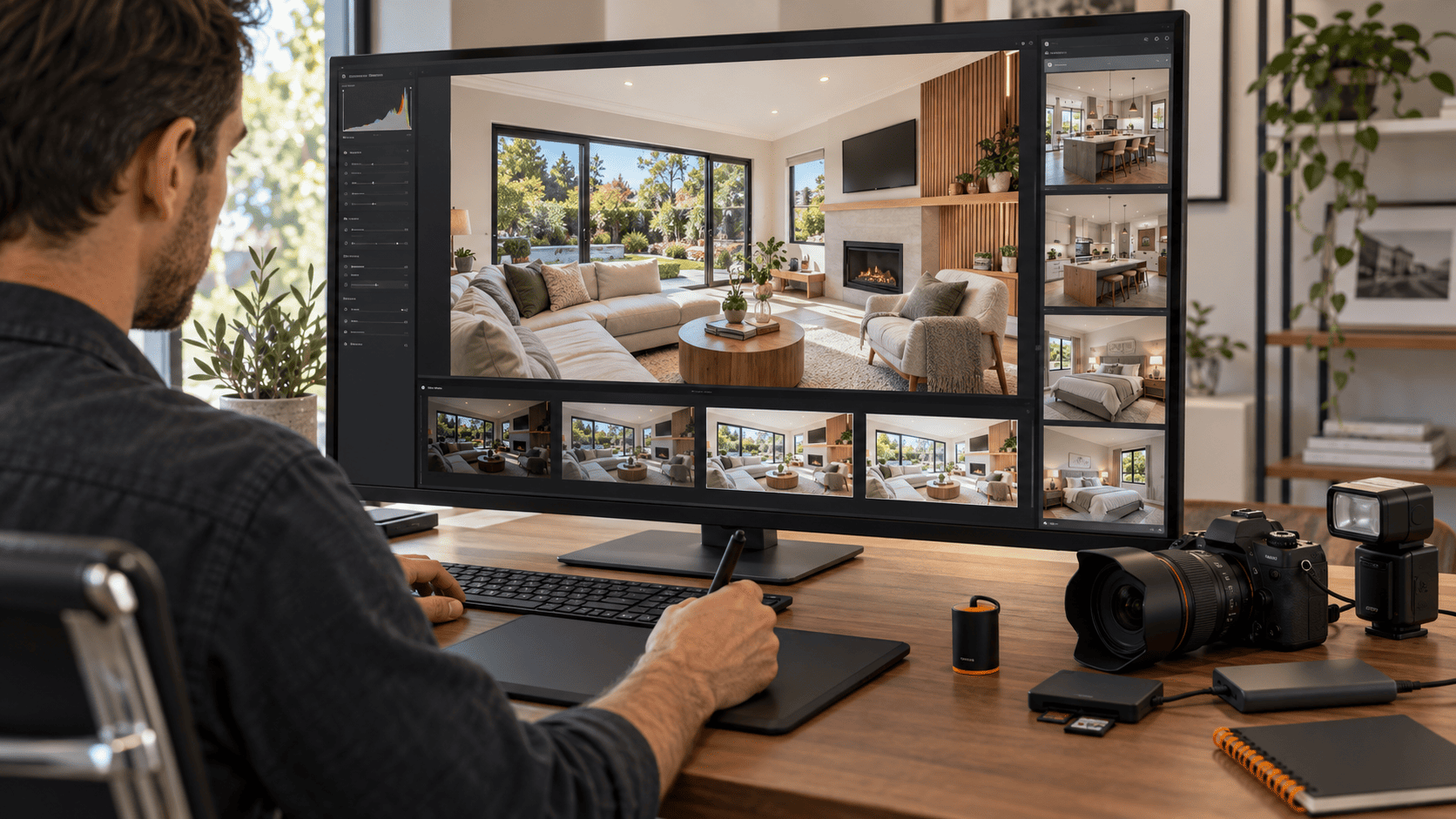
The camera format influences post-production, but capture consistency usually matters more than the sensor label.
Exposure Bracketing and RAW Recovery
A camera with reliable automatic exposure bracketing can produce evenly spaced source files without repeated menu changes. Stable brackets are easier to group, align and merge.
Full-frame RAW files may provide more flexibility in difficult shadows and highlights, but bracketing is still necessary when the scene exceeds the usable range of one exposure. Adobe confirms that Lightroom can merge multiple exposure-bracketed photographs into a single HDR image.
Photographers should check the available number of frames, EV spacing and sequence controls before buying a camera. These workflow details are often more important than a small sensor-specification advantage.
Read more: 10 Tips to Take Your HDR Real Estate Photography to the Next Level
Noise, Color and Window Detail
Low-light exposure on APS-C sensors can exhibit noise or color shifts earlier when shadows are aggressively lifted. While full-frame cameras offer greater dynamic range in post-processing, clipped highlights remain unrecoverable on both formats.
Proper exposure bracketing captures exterior details in darker exposures while securing interior shadow detail in brighter frames. Editors can then blend optimal image data without pushing any single exposure beyond its sensor limits.
Window views must retain a natural appearance. Artificially forcing contrast or inserting non-existent detail is fundamentally different from recovering authentic dynamic range from original raw files.
HDR and Flambient Processing
An HDR workflow blends multiple exposures to balance shadow detail, retain color accuracy, and resolve severe contrast around window views.
For this approach, maintaining a rigid tripod setup, locked focal length, structured exposure grouping, and systematic file naming are critical. Even the most advanced camera sensor cannot compensate for missing bracketed frames or improper exposure steps.
In the scope of full frame vs crop sensor for real estate photography, full-frame sensors deliver broader dynamic range per frame, yet APS-C systems yield exceptional final results as long as the bracketed set provides complete data for HDR post-processing.
Read more: Flambient Photography vs. HDR: What’s the Difference?
File Size and Complete-Gallery Consistency
Evaluating a camera system must be based on the complete final deliverable rather than an isolated RAW file. The editing workflow relies on importing, grouping, HDR blending, color matching, and exporting images with complete room-to-room consistency.
Excessively high-resolution files lengthen processing timelines and data transfer speeds. Furthermore, color rendering and white balance variations across different camera lines introduce significant editing overhead when multiple photographers cover a single listing.
Media teams should rigorously test camera profiles and establish benchmark reference sets prior to onboarding new hardware. Visual uniformity across the entire property listing holds far greater value than peak image quality in any single hero shot..
Read more: Step-by-Step Tutorial for Editing Real Estate Photos in Lightroom
How to Test Full Frame and APS-C Before Buying
.png)
Use Equivalent Focal Lengths
Always compare lenses based on equivalent fields of view. Comparing a 16mm lens on a full-frame body directly to a 16mm lens on APS-C produces an inaccurate framing comparison.
A more valid comparison pairs a 16mm focal length on full-frame with approximately 10mm on Canon APS-C (1.6x crop factor), or 10–11mm on standard 1.5x crop systems. Throughout testing, ensure the camera position remains strictly fixed and consistent.
Photograph a Small Room and a Bright Window
Test systems under real-world shooting scenarios: a tight powder room, a dim interior facing a bright exterior window, a kitchen with mixed color temperatures, and an exterior shoot at twilight.
These environments clearly demonstrate whether your wide-angle coverage is adequate and test the raw files' ability to retain critical highlight and shadow detail.
Compare RAW Files, Not Camera Previews
In-camera LCD previews are heavily influenced by internal JPEG processing, picture profiles, screen brightness, and manufacturer default settings. Consequently, they fail to provide a reliable benchmark for actual RAW file latitude and editing potential.
To conduct a rigorous evaluation, process files using matching output resolutions and equivalent adjustment parameters. Carefully assess window detail recovery, shadow noise, corner sharpness, color fidelity, and perspective accuracy.
Edit a Complete Property Gallery
A sensor comparison should include the full workflow. Capture and edit an entire listing rather than testing one room.
Measure import time, bracket grouping, HDR alignment, correction effort, export speed and total storage. Review whether brightness and color remain consistent from room to room.
Compare Workflow Time and Total Cost
Calculate the complete system cost and the time required to produce approved files. Include the camera, lens, accessories, storage and editing workload.
The correct system is the one that meets the delivery standard without creating unnecessary cost or production friction.
Frequently Asked Questions
Is APS-C Good Enough for Real Estate Photography?
Yes. A modern APS-C camera can produce professional real estate photographs when paired with an appropriate ultra-wide lens and a controlled RAW, HDR or flambient workflow. The primary limitation is achieving sufficient wide-angle coverage in small interiors.
Is Full Frame Better for Interior Photography?
Full frame generally provides easier access to ultra-wide lenses, stronger high-ISO performance and more exposure flexibility. However, APS-C can produce equally usable listing images in controlled conditions. Full frame provides more margin, not an automatic guarantee of better work.
What Focal Length Is Best for APS-C Real Estate Photography?
Approximately 10–18mm on Canon APS-C and 10–20mm or 12–24mm on a 1.5x APS-C system cover useful interior ranges. The exact choice depends on room size, lens quality and the desired framing.
Is a 10–18mm Lens Wide Enough for Property Interiors?
Yes, a 10–18mm APS-C lens is wide enough for most residential interiors. The widest setting should be used carefully because objects near the edge can appear stretched. Whenever space allows, moving toward 12–16mm can create more natural proportions.
Does Full Frame Have Better Dynamic Range?
Full-frame cameras often provide greater dynamic-range flexibility when compared with APS-C cameras using similar sensor technology. However, performance varies by camera model. Bracketing or flash may still be required for rooms with bright windows.
Does Full Frame Produce Less Distortion?
Not automatically. Perspective distortion is primarily affected by camera position, while barrel distortion depends on lens design. Full frame can make wide coverage easier, but a poor ultra-wide lens or unsuitable camera position can still create distorted-looking interiors.
Can Professional Real Estate Photographers Use Crop-Sensor Cameras?
Yes. Professional results depend on the complete system and workflow. APS-C is suitable when the lens provides enough coverage and the camera supports dependable RAW capture, exposure bracketing and the required level of operational reliability.
Should Beginners Buy APS-C or Used Full Frame?
APS-C is usually the safer choice when it allows the photographer to buy a suitable ultra-wide lens, tripod and lighting equipment. A used full-frame system is worthwhile when its condition is verified and the total package includes the lens required for interiors.
Conclusion
When choosing between full frame vs crop sensor for real estate photography, neither format holds an absolute win. Full-frame offers superior low-light performance and wider lens options, while APS-C provides a cost-effective, lightweight setup with high image quality.
The decision ultimately rests on overall workflow efficiency, from gear and storage to editing overhead. Systems should be judged on final delivered sets rather than spec sheets. With Rotider’s human-vetted HDR editing workflow, photographers can confidently choose the gear that fits their budget while ensuring consistent, high-quality deliverables.





.webp)
.png)