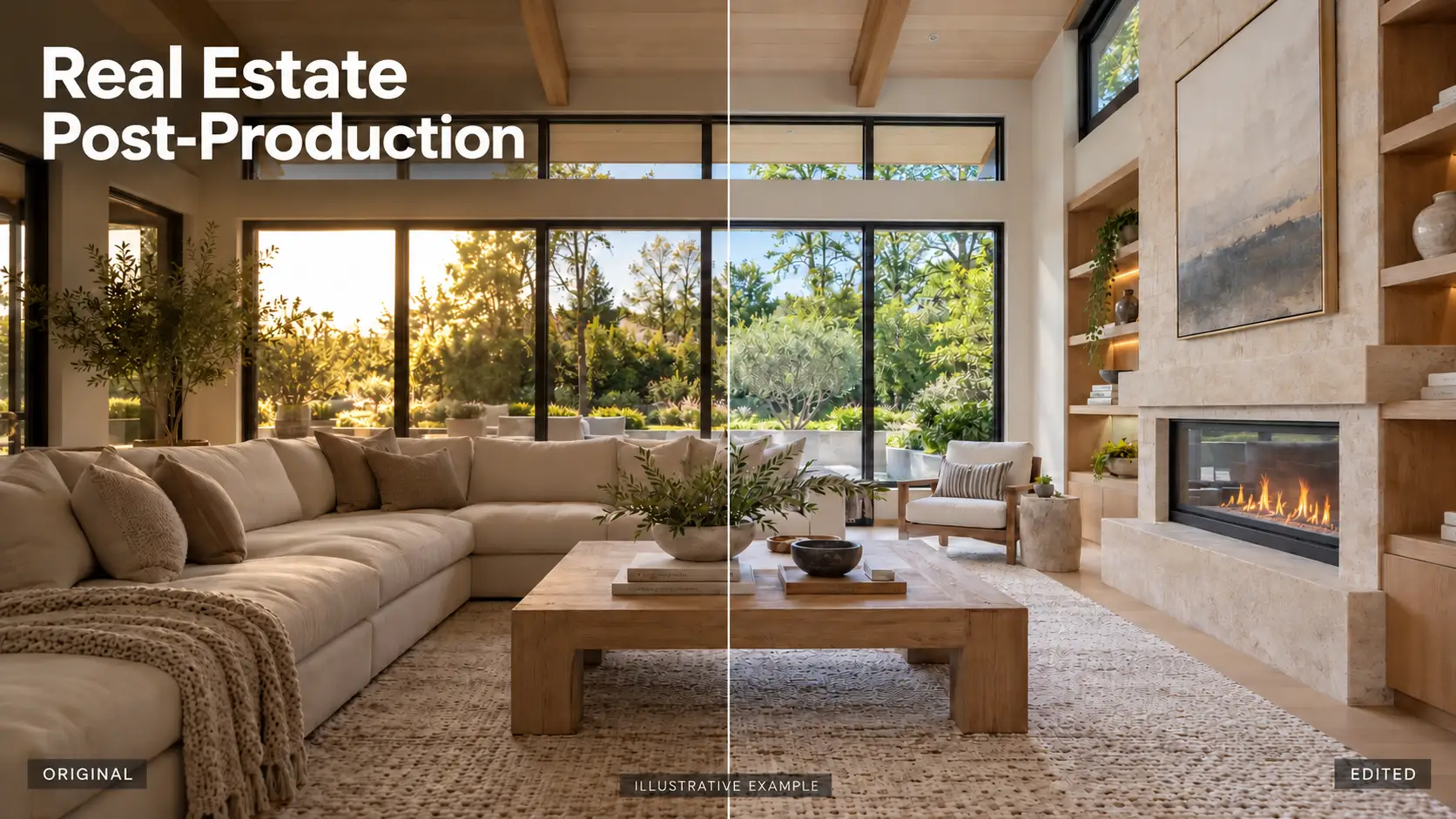
For real estate photographers and media teams, the work does not end when the shoot is complete. As project volume grows, organizing exposure brackets, coordinating photo and video edits, maintaining consistent visual standards, managing revisions and delivering the correct file versions become essential parts of the production process.
This guide explains how real estate post production works from file intake to final delivery, how photo and video workflows differ, when outsourcing makes sense and how to choose a partner that can support consistent, scalable production.
What Is Real Estate Post-Production?
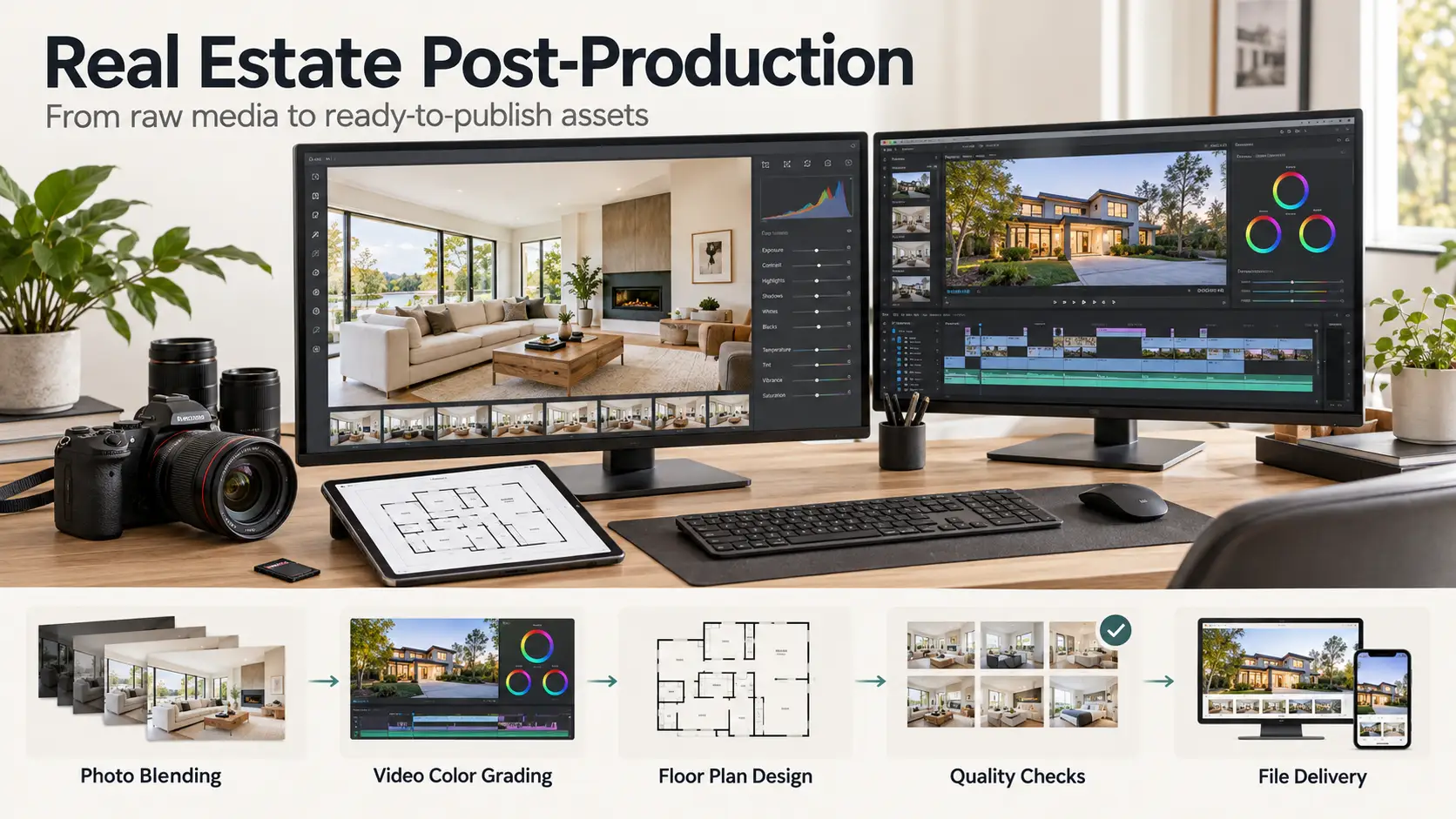 Real Estate Post-Production Explained
Real estate post production is the structured process of converting raw property media into final marketing assets for listings, websites, and social channels. Key tasks include photo blending, video color grading, floor plan design, quality checks, and file delivery.
This process is broader than simple photo editing. A complete system manages source files, applies correct editing guidelines, and ensures quality control before delivery. It also standardizes file formats, naming conventions, and revision handling.
Terms like real estate photography post production, real estate photo post production, and property photo post production cover similar tasks. However, real estate post production is the best umbrella term when managing both photo and video workflows under professional real estate post production services.
Real Estate Post-Production vs Real Estate Photo Editing
Real estate post production encompasses the end-to-end workflow of transforming raw field assets into client-ready media deliverables. While standard photo editing focuses strictly on still imagery, full-scale post-production represents a much broader operational ecosystem.
A photographer outsourcing bracketed exposures for HDR blending requires basic photo editing. Conversely, a real estate media agency delivering aerial drone footage, walkthrough videos, virtual staging, branded graphic overlays, multi-format exports, and final quality control demands a comprehensive real estate post production pipeline.
Distinguishing between the two is vital for defining project scopes, skill requirements, and delivery standards—ensuring creators communicate exact project boundaries when onboarding post-production partners.
Real Estate Photo Editing
Real estate photo editing focuses on refining still images post-capture to deliver a cohesive, listing-ready suite while strictly preserving structural proportions and architectural features.
Standard workflows cover white balance correction, exposure balancing, vertical alignment, lens distortion repair, noise reduction, sharpening, and cropping. Bracketed exposures require HDR blending, whereas flambient captures demand precise integration of ambient and flash frames.
Advanced techniques incorporate localized enhancements: window masking, sky replacement, lawn enhancement, reflection removal, object cleanup, day-to-dusk conversion, and virtual staging, moving well beyond global adjustments.
Whether referenced as property photo post-production or photography editing, the final deliverable remains a polished set of still visuals. Operating as a standalone component within real estate post production, photographers can simply hand off raw assets or bracket sets and receive finalized JPEGs customized to exact style guidelines, file-naming conventions, and export specifications.
Real Estate Post-Production
Comprehensive real estate post production services cover a much broader production ecosystem, integrating still image editing with video post-production, aerial drone processing, virtual staging, motion graphics, audio mixing, branded asset creation, and final delivery prep.
On the photography side, the workflow spans HDR or flambient blending, detailed retouching, perspective correction, virtual twilight, object removal, and quality control. For video, it involves shot culling, sequencing, stabilization, color correction and grading, speed ramping, audio sync, motion graphics overlays, broker branding, and platform-specific exports.
Beyond visual editing, real estate post production encompasses essential backend operations: organizing raw assets, interpreting project briefs, applying brand guidelines, managing revisions, and performing pre-delivery file audits. For media companies serving multiple creators or agents, this often includes white-label communication protocols, standardized folder structures, and uniform file-naming rules.
This extensive operational scope is what separates full-scale post-production from individual editing tasks, establishing a unified pipeline capable of managing complex, multi-format media assets efficiently.
When Do You Need Photo Editing vs Full Real Estate Post-Production?
Choose standalone photo editing when a project strictly requires finished still imagery. This option works well if the photographer handles file culling, client communication, delivery, and archiving internally, but needs technical assistance with HDR or flambient blending, color correction, perspective alignment, or specialized retouching.
A full-scale real estate post production workflow is better suited for multi-asset projects or when you need a provider to manage the broader production pipeline. This includes coordinating property photography, drone footage, walkthrough videos, virtual staging, branded graphics, and multi-ratio file exports under a single umbrella.
Operational volume is another key deciding factor. Individual photographers handling occasional listings may only need standard photo editing. Conversely, growing media agencies managing high daily volume benefit from a structured post-production framework that handles file ingestion, style matching, quality control, revision management, and multi-format delivery.
Many businesses adopt a hybrid model: routing routine photo editing through a dedicated workflow while trusting complex tasks like video, virtual staging, or custom visual work to a full post-production team. The right choice ultimately depends on deliverable requirements, monthly volume, turnaround expectations, and how much operational overhead you prefer to maintain in-house.
What Do Real Estate Post-Production Services Include?
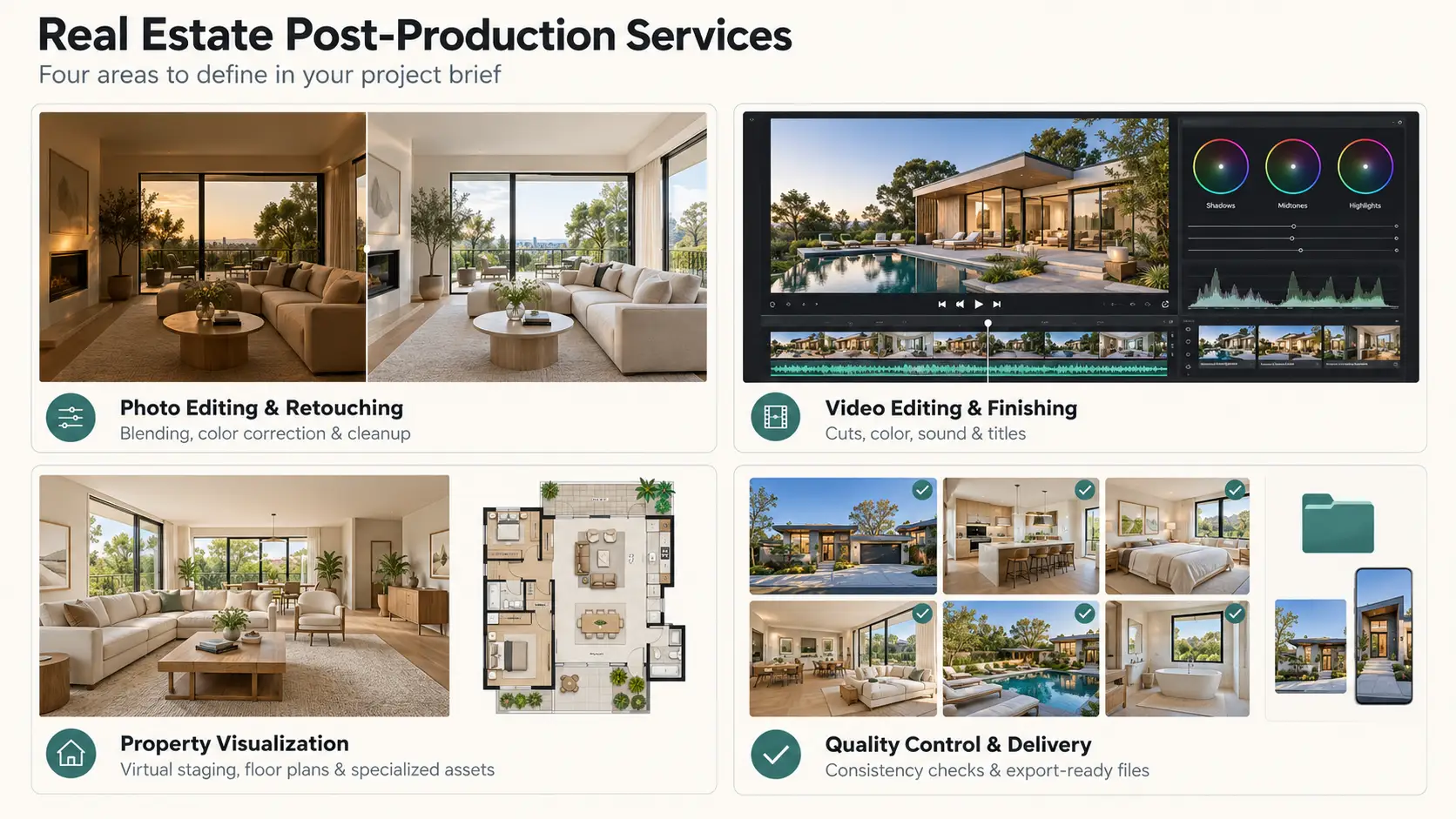 Real Estate Post-Production Services
When evaluating real estate post production services, confirm whether the quoted scope covers still photography, video editing, property visualizations, and final delivery workflows. A complete brief must explicitly outline all required tasks, as "standard editing" definition varies significantly across different real estate photography post production services providers.
Photo editing and retouching
Core real estate photo post production focuses on exposure correction, color adjustment, and architectural alignment. Editors fuse bracketed exposures for HDR, combine flash and ambient shots (flambient), or refine single exposures. Fine-tuning white balance, contrast, lens distortion, noise, and sharpness ensures a clean, realistic finish across the entire gallery.
Advanced property photo post production includes window masking, screen replacement, flash glare removal, sky replacement, day-to-dusk conversion, and object removal. Once approved, images are cropped, resized, and exported for MLS platforms. Clear briefs are essential as providers often classify these advanced options as add-on real estate post production services.
HDR is not simply increasing contrast. It combines differently exposed frames to retain information in bright and dark areas. Adobe’s official Lightroom Classic HDR documentation explains that exposure-bracketed images can be merged into one HDR image and that alignment and deghosting may be needed when frames contain movement.
Read more: Understanding the Benefits of Professional Real Estate Photo Editing
Video editing and finishing
Real estate video post-production begins by organizing raw footage from cameras, drones, and smartphones. Editors select key shots, remove unusable frames, and build a logical flow to showcase property layouts clearly. Stabilization, speed ramping, and transitions are applied intentionally to highlight features without distracting viewers from the home itself.
Finalizing the edit involves exposure balancing, multi-camera color matching, and consistent color grading. Post-production also covers audio leveling, licensed music, voiceovers, text overlays, logos, and property info. Delivering across multiple channels often requires horizontal, vertical, and square cuts, each verified for resolution, frame rates, codecs, and file size limits under professional real estate post production services.
The official DaVinci Resolve training resources separate editing, color correction, audio work, visual effects and delivery into distinct disciplines. That is a useful model for property media as well: a polished video requires more than placing clips on a timeline.
Read more: 18 Pro Tips to Enhance Your Real Estate Video Editing
Property visualization and specialized assets
Certain listings require specialized visuals beyond standard real estate photo post production. Virtual staging fills vacant rooms with digital furniture, while virtual renovation showcases design potential for outdated spaces.
Additionally, day-to-dusk conversions, 2D/3D floor plans, boundary outlines, neighborhood maps, and CGI renderings provide crucial context for off-plan developments. Because these edits significantly alter reality, project briefs must specify conceptual elements and require clear disclosure labels on final deliverables. Leveraging specialized property photo post production and advanced real estate post production services ensures these visual enhancements remain informative, appealing, and fully compliant.
Read more: What Are the Reasons to Use Real Estate Twilight Photos?
Quality control and delivery
Quality control checks whether the work matches the source files, approved visual style and delivery requirements. It should catch problems such as color casts, tilted verticals, halos, incomplete object removal, repeated frames, audio peaks, misspelled property details and incorrect export dimensions.
The delivery stage then packages the approved files with a consistent naming structure. Depending on the project, that may include separate folders for MLS images, full-resolution marketing files, branded videos, unbranded videos and social-media versions.
How Does the Real Estate Post-Production Workflow Work?
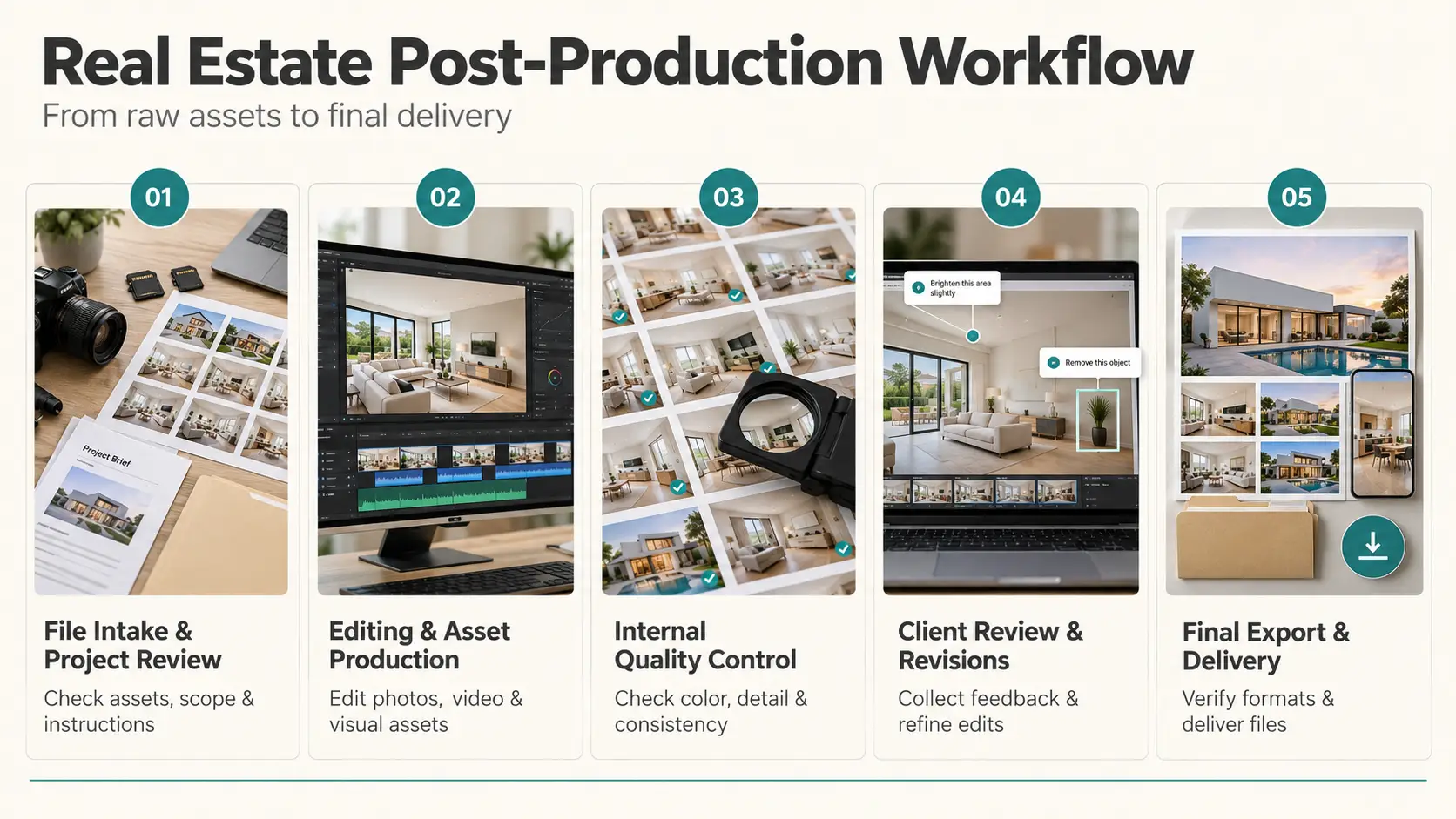 Real Estate Post-Production Workflow
A professional real estate post production workflow is structured around five core stages: asset ingestion, processing and editing, internal quality control (QC), client review, and final delivery. Each phase serves to mitigate specific operational risks, from missing raw assets and misinterpreted briefs to inconsistent color grading and incorrect export settings.
While this pipeline can be streamlined for single-service jobs, its structure becomes indispensable for multi-asset projects involving still photography, drone footage, video walkthroughs, virtual staging, and complex export specs. Maintaining a standardized operational framework ensures visual consistency and complete asset traceability throughout the entire production cycle.
File Intake and Project Review
The asset ingestion phase sets the foundation for real estate post production, beginning when a photographer or media company submits raw files alongside the project brief. Before editing begins, the production team verifies file integrity, asset completeness, and exact alignment with technical instructions.
For photography, this involves auditing RAW files, exposure bracket sets, flash exposures, and file grouping structures. For video assets, editors verify folder hierarchy, resolution, frame rate, camera profiles, audio stems, and aerial drone footage. Identifying corrupt files, missing brackets, or unclear grouping during ingestion prevents production bottlenecks near delivery deadlines.
This intake review also confirms requested deliverables, output counts, visual reference guides, brand guidelines, turnaround times, and export specifications. Complex tasks, such as object removal, virtual staging, day-to-dusk conversions, or social media reformatting, are separated from standard processing. A thorough intake audit ensures a clear editing roadmap and prevents misinterpretations that lead to unnecessary revision cycles.
Editing and Asset Production
Once intake verification is complete, assets move directly into the primary production phase. Assigned editors work strictly according to the approved project brief, reference style guides, and technical specifications for each deliverable.
Still image production covers culling, HDR or flambient blending, exposure balancing, white balance correction, perspective alignment, window masking, retouching, and final image polishing. Specialized requests, such as object removal, virtual twilight, or virtual staging are executed per the agreed project scope.
Video post-production encompasses shot culling, sequencing, stabilization, color correction and grading, speed ramping, audio mixing, music sync, motion graphics, and brand overlays. Custom aspect ratios and cuts are prepared for website embeds, MLS listing platforms, YouTube, Instagram Reels, and other social distribution channels.
Throughout this stage of real estate post production, editors maintain stylistic consistency across the entire asset suite rather than optimizing files in isolation. Still images must exhibit matched exposure, color balance, and window clarity, while video components remain connected through cohesive pacing, color treatment, and audio design.
Internal Quality Control
The initial completed draft must undergo internal quality control (QC) before client delivery, ensuring strict compliance with both project specifications and provider technical standards.
For still photography, QC reviewers inspect exposure levels, color consistency, vertical alignment, window clarity, reflections, masking edges, and potential editing artifacts. The full image suite is cross-referenced to flag and correct any individual rooms exhibiting noticeable brightness shifts or color temperature mismatches (warm/cool casts).
For video deliverables, the quality control process verifies shot sequencing, image stabilization, pacing, color balance, audio levels, text accuracy, logo placement, and transition quality. Reviewers ensure no placeholder text, unused clips, or incorrect listing information remains on the edit timeline.
Finally, file-naming rules, asset counts, aspect ratios, and export parameters are verified. Any flaws identified during internal review are routed back to the production editor for correction prior to client release—a crucial checkpoint in professional real estate post production.
Client Review and Revisions
Following internal approval, the initial draft is delivered for client review. Feedback is cross-referenced against the original brief to clearly distinguish between error corrections and scope changes.
Error corrections address non-compliance with agreed instructions—such as uncorrected color casts, missed object removals, or typos. Scope changes, by contrast, alter or expand the original work order, such as selecting a different sky replacement asset, requesting social media re-cuts, or adding new retouching requests post-delivery.
Clients are encouraged to consolidate feedback into a single, structured revision round. Providing exact file names, frame numbers, timestamps, and explicit directions enables editors to address issues efficiently. Vague requests like "make it look better" or "adjust the color" are difficult to execute consistently without visual references or clearly defined target outcomes.
Re-edited assets undergo a final validation check before re-delivery, a key step in real estate post production that prevents localized fixes from introducing secondary artifacts elsewhere in the image or video timeline.
Final Export and Delivery
Upon final approval, completed assets are exported strictly according to agreed-upon technical specifications. For photography, deliverables typically include full-resolution files, web-optimized versions, or platform-segregated folders. Video assets may require multiple aspect ratios (horizontal, vertical, square) tailored to different resolutions, durations, or branding layouts.
Prior to delivery, the production team conducts a final audit verifying file counts, naming conventions, folder structures, resolution, color space, compression settings, and aspect ratios. The final delivery package contains only approved assets—strictly excluding working drafts, test exports, or internal project files.
Delivery methods should seamlessly integrate with the client's operational workflow, utilizing ordering portals or secure cloud storage systems. Clear data retention policies must also be defined so clients understand the accessibility timeline for both raw assets and finished deliverables.
How Rotider Applies This Post-Production Workflow
Rotider applies this five-stage workflow to both individual projects and recurring, high-volume orders. Each order begins with a review of the submitted files, editing instructions, requested services, turnaround time and delivery specifications. Photo, video, virtual staging and specialized retouching tasks are then assigned according to the project scope.
After production, team leads and quality-control specialists review the completed assets for visual consistency, technical accuracy, file naming and export requirements. Any issues identified during this review are returned to the production editor for correction before delivery. Client revisions are checked against the approved brief, and only finalized assets are included in the final delivery package.
What Should Be Prepared Before Post-Production Begins?
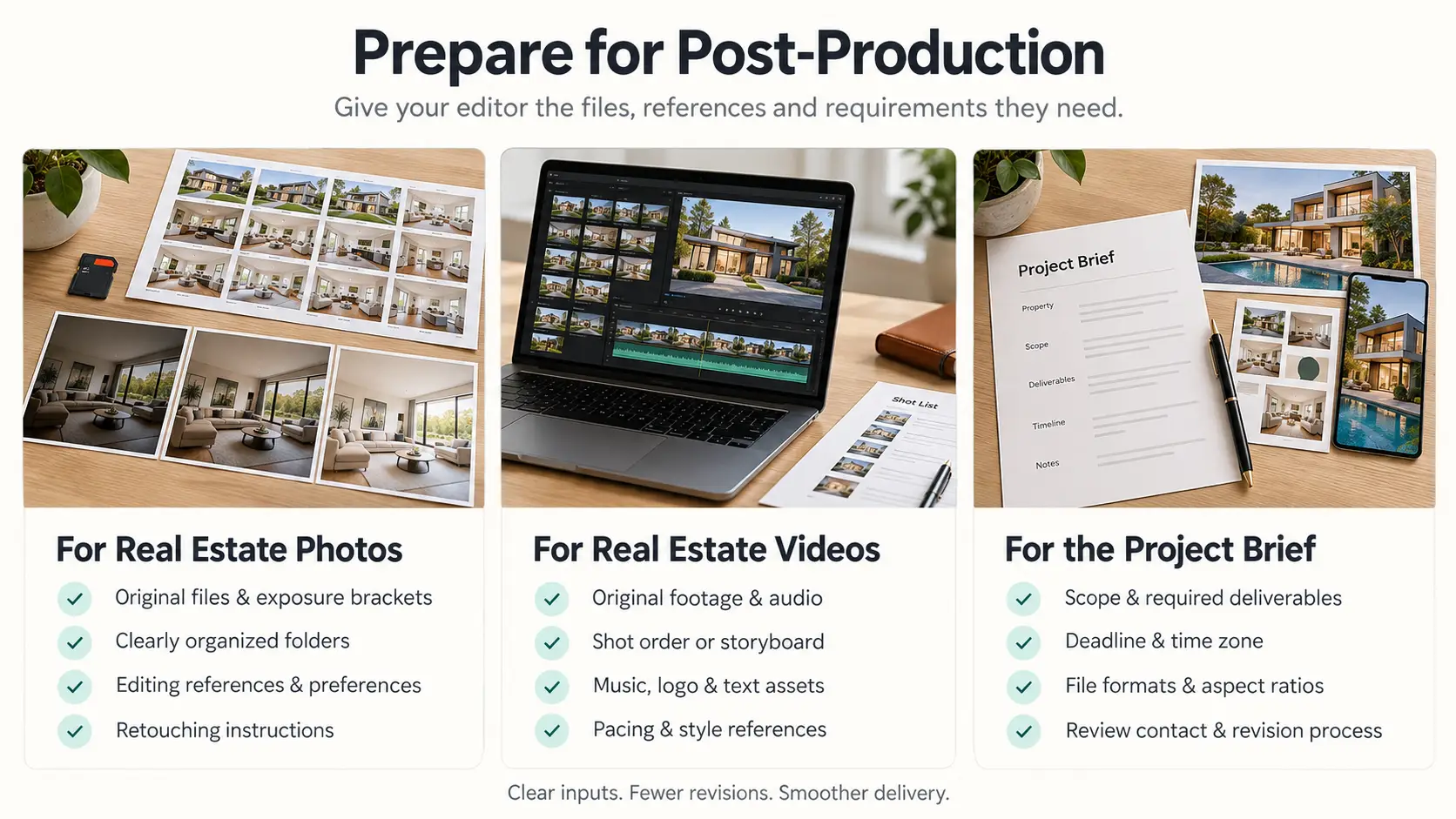 Preparing Files for Real Estate Post-Production
A clear input package reduces revisions more effectively than a long feedback email after delivery. Before work begins, prepare the files, references and output requirements the editor needs to make correct decisions.
For real estate photos
For photo projects, submit original RAW or high-resolution JPEG files while preserving bracketed exposure sequences. When utilizing flambient techniques, include both ambient and flash frames. Clearly mark key hero shots, expected final image counts, and specific requests for window masking, sky replacements, object removal, or virtual dusk edits. Providing reference images, brand presets, or an approved sample gallery gives editors clear visual benchmarks.
The brief should also specify crop ratios, pixel dimensions, color spaces, target file formats, and platform requirements. Avoid deleting extra exposure frames before confirming how the editor will use them; a dark frame may contain essential window details, while a flash frame may be critical for accurate wall color reconstruction. Relying on professional real estate photography post production services ensures proper asset handling through expert real estate photo post production.
For real estate videos
For video projects, maintain your original folder structure and organize camera and drone footage by source. Provide frame rates, resolution details, and camera profiles, especially for Log footage. Including a shot list or brief notes highlights essential property features and must-have scenes for the final edit. Specifying target duration, pacing, and reference videos helps set the storytelling direction before editing begins.
Branding assets should accompany the footage, including high-resolution logos, fonts, brand colors, and lower-third graphic templates. Ensure all property details, captions, voice-overs, and text overlays are fully approved, and clarify music licensing responsibilities up front. Define required aspect ratios and versions for listing portals, websites, and social platforms. Confirm platform compatibility and delivery specs prior to uploading large files to ensure seamless real estate post production services.
For the project brief
The project brief should act as the central source of instructions for the entire order. Include the property name or project identifier, requested services, delivery deadline and relevant time zone. List every expected deliverable, including the number of final images, video length, aspect ratios and separate versions required for websites, listing platforms or social media.
Provide approved branding assets such as high-resolution logos, fonts, brand colors, lower-third templates and examples of previous work. All property details, captions, agent information, voice-overs and on-screen text should be checked before editing begins. The brief should also clarify who is responsible for music licensing and whether the editor may select licensed music from an approved source.
Define the file-naming convention, folder structure and preferred delivery method. If the project includes several services, explain which assets belong together and which deliverables have priority. Separate essential requirements from optional preferences so the post-production team can make appropriate decisions when time or source material is limited.
Finally, identify the person responsible for approvals and explain how revisions should be submitted. One consolidated brief helps photographers, editors and quality-control teams work from the same instructions, reducing conflicting feedback and unnecessary production delays.
When Should You Outsource Real Estate Post-Production?
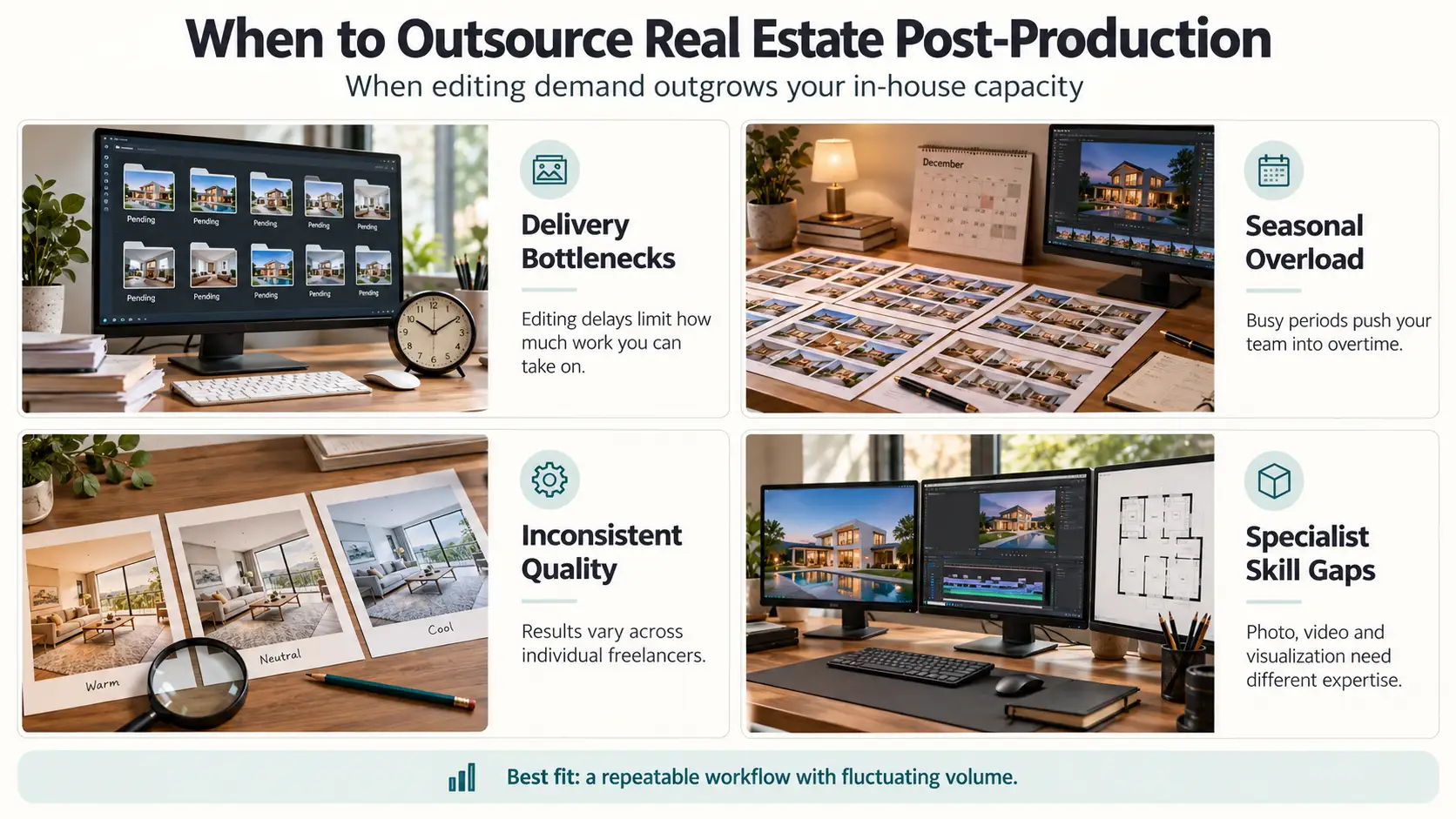 Preparing Files for Real Estate Post-Production
Outsourcing is optimal when editing volume is steady enough to structure, yet fluctuates too much to manage in-house efficiently. Consider this option if delivery delays bottleneck capacity, seasonal spikes force overtime, or reliance on individual freelancers causes inconsistent quality. Outsourcing also bridges skill gaps when one person cannot master photography, videography, and property visualizations simultaneously.
Agencies can outsource real estate photo post production while maintaining direct client relationships. Providers operate under white-label terms, leaving pricing, client communication, and final approvals in your hands. This scalable model suits multi-photographer operations and multi-market agencies, offering reliable backup for in-house teams and freeing key staff from repetitive tasks.
Before transitioning full production, run a representative trial project. Test vendors with standard shots, complex interiors, exteriors, mixed lighting, and at least one revision cycle to evaluate communication and overall real estate post production services. Partnering with proven real estate photography post production services ensures seamless integration into your property photo post production workflow.
What Affects Pricing and Turnaround?
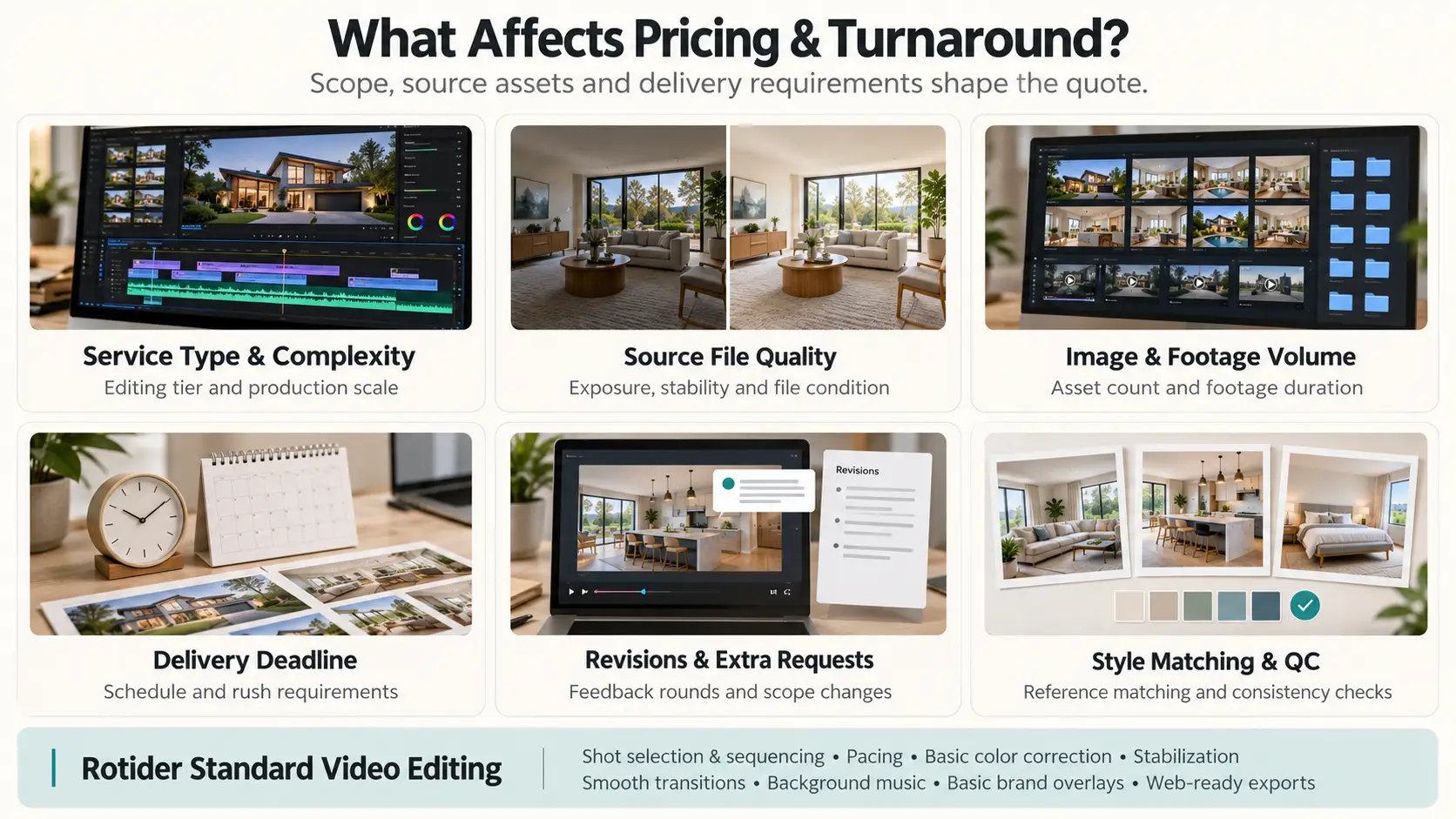 Real Estate Post-Production Pricing and Turnaround
Service Type and Editing Complexity
For video deliverables, pricing and turnaround times are primarily governed by the selected editing tier and overall production scale. Rotider’s Standard package covers core video post-production tasks: shot culling and sequencing, pacing refinement, basic color correction, video stabilization, smooth transitions, background music integration, basic brand overlays, and web-optimized file exports.
Projects transition into Advanced or High-End tiers when requiring more sophisticated real estate post production capabilities: custom color grading, specialized sky replacement, speed ramping, motion graphics, multi-ratio exports, intricate sound design, Foley sound effects, spatial audio, or complex visual effects (VFX). Additional features—such as masking, voice-over integration, callout titles, and Google Earth data integration—are itemized based on technical complexity.
Ultimately, total project cost and production timelines are calculated based on the chosen editing tier, raw asset volume, final video duration, add-on requests, output specs, and target deadline. Official pricing and turnaround commitments are finalized following a technical audit of the raw footage and project brief.
Source File Quality
Properly captured raw assets and structured file organization allow editors to work far more efficiently. Sharp RAW files, consistent exposure brackets, and clearly labeled folder structures minimize asset search time and eliminate preventable technical bottlenecks.
Conversely, misaligned bracket sets, blown highlights, heavy image noise, motion blur, and erratic white balance require extensive corrective labor. In fact, certain severe capture-level defects cannot be fully restored during real estate post production, regardless of budget or turnaround allowances.
For video workflows, unstable footage, mismatched frame rates, missing camera profile metadata, and poor audio recordings significantly extend production timelines. Editors must invest substantial effort into footage stabilization, multi-camera color matching, noise reduction, and culling usable moments from unorganized raw media.
Input asset quality directly dictates both project quotes and the final deliverable standard. Submitting higher file volumes cannot compensate for severe capture errors, out-of-focus shots, or unrecoverable highlight detail.
Image or Footage Volume
Project volume directly impacts turnaround times, file management protocols, and quality control requirements. A standard 20-photo deliverable moves through the pipeline far faster than a 100-image commercial property order; similarly, sifting through hours of unculled raw footage requires significantly more review time than editing a pre-selected set of clips.
Consistent, high-volume demand optimizes the real estate post production pipeline when clients maintain uniform file structures, capture methodologies, and editing briefs. Editors can seamlessly apply established style guides, eliminating redundant setup steps across similar projects.
However, volume-based discounts cannot eliminate the labor required for highly complex visual tasks. Processing 100 standard edits requires a fundamentally different pricing structure and delivery schedule than executing 100 intricate object removals or heavy retouching requests.
Service providers must also manage production capacity responsibly. Scaling up to accommodate high-volume orders is only effective when the team can uphold strict quality standards without delaying other active projects in the pipeline.
Delivery Deadline
Tight rush deadlines force providers to re-prioritize production queues, allocate extra editing personnel, or dedicate immediate resources. This typically incurs rush fees, particularly for orders involving advanced photo retouching, complex video editing, or multi-format exports.
Deadlines must be explicitly defined by date, time, and time zone. Vague terms like "tomorrow morning" create operational misalignments, especially when clients and real estate post production teams operate across different global time zones.
A realistic production timeline must account for every pipeline stage: file transfer, intake audits, processing, internal quality control (QC), and final rendering. When client review steps are required prior to final release, revision turnaround must be built into the schedule rather than treated as an open-ended extension.
Rush delivery requests require prior confirmation before uploading assets. Submitting high-volume orders with tight turnaround windows without prior authorization does not guarantee that a provider has the active capacity to execute safely without compromising quality standards.
Revisions and Additional Requests
Revision scope directly influences total production costs. Corrective edits required due to deliverables non-compliant with the approved brief must be clearly distinguished from new scope additions introduced after processing has commenced.
Modifying a previously selected sky replacement asset, requesting additional object removals, adding new video aspect ratios, or altering confirmed text content all represent scope changes. Such adjustments may require budget revisions and delivery timeline updates.
Furthermore, ambiguous instructions frequently cause unnecessary revision cycles within real estate post production. Without specific guidelines regarding target exposure, window view visibility, or brand reference standards, delivered assets may be technically flawless yet fail to align with the client's visual expectations.
Consolidating feedback into a single, structured review round is far more effective than routing fragmented edit requests from multiple stakeholders. Providing precise file names, frame indices, timestamps, and explicit replacement instructions enables the production team to execute changes accurately and efficiently.
Style Matching and Quality Control
Matching an established visual style requires an intentional calibration phase. Service providers typically review past portfolios, run test edits on sample assets, and document precise parameters for brightness, color balance, contrast, window view handling, sky assets, and video pacing.
While this setup phase requires extra time during initial onboarding, it significantly reduces revision cycles on future projects. Recurring real estate post production workflows achieve maximum efficiency once clear, unified standards are applied consistently across every order.
Quality control (QC) protocols also directly influence project pricing and turnaround times. A basic pipeline may rely solely on editor self-checks, whereas a fully managed production workflow incorporates independent reviews by team leads or dedicated QC specialists prior to release.
Adding review layers extends internal processing time, but drastically minimizes client-facing revisions and safeguards consistency across high-volume orders or large commercial portfolios. The appropriate QC tier depends on project value, order volume, brand sensitivity, and the potential cost of downstream errors.
To receive accurate project quotes, photographers and media companies should provide representative raw assets, detailed scopes of work, anticipated volumes, delivery specifications, and approved style guide references. This enables service providers to estimate actual operational workload rather than relying on baseline entry pricing that may not reflect true project demands.
How to Choose Real Estate Post-Production Services
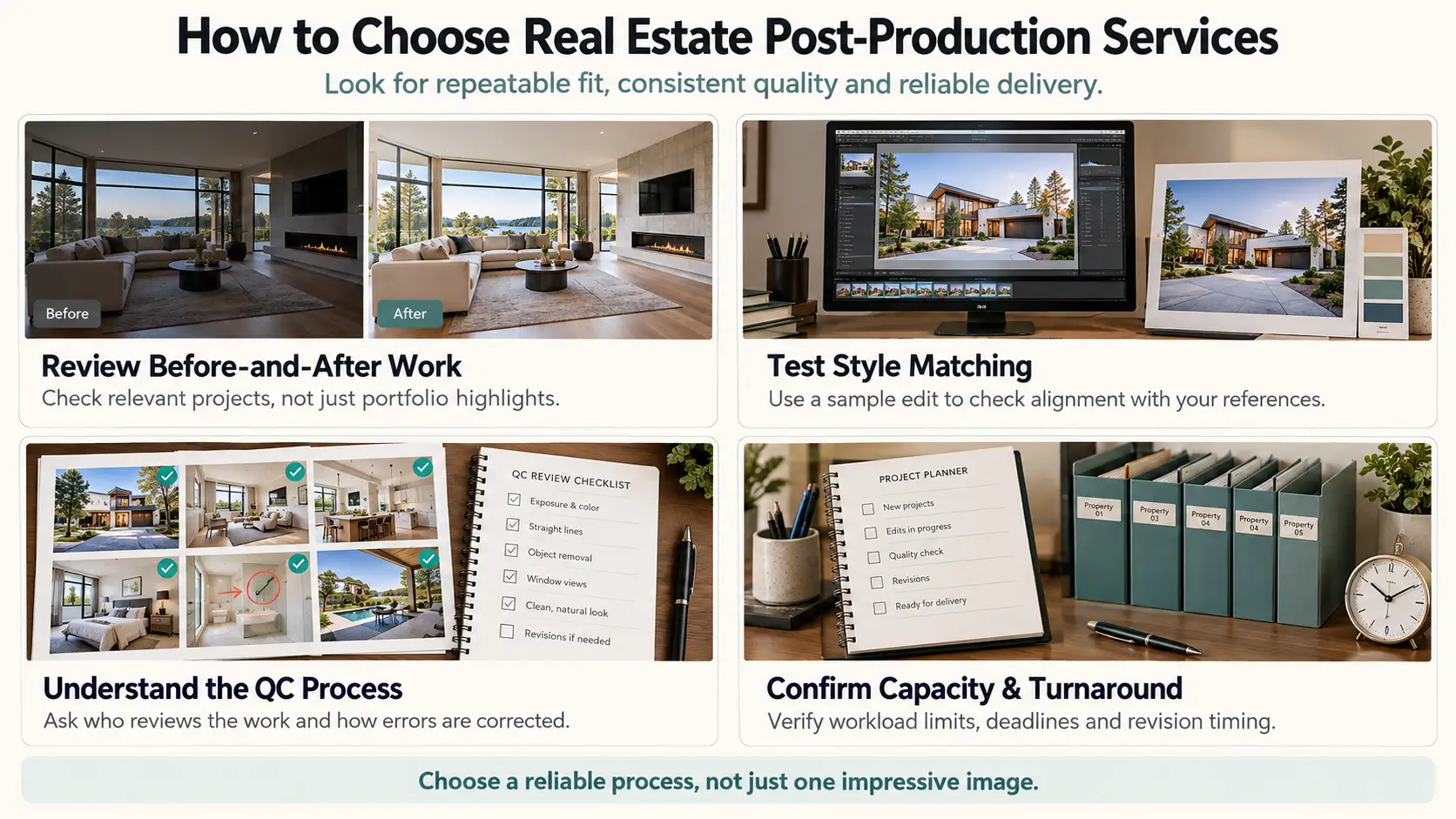 Choosing Real Estate Post-Production Services
Choose a provider based on repeatable fit, not the best image in a portfolio. Strong real estate post production services should be able to explain how they receive instructions, calibrate style, review work, manage deadlines and correct errors.
Review relevant before-and-after work
Ask for examples that match your capture method, property type and target market. A luxury flambient portfolio does not automatically prove that the provider can process high-volume HDR work, and still-image expertise does not demonstrate video capability.
Test style matching
Supply several approved reference images and describe what matters: brightness, window intensity, wall neutrality, exterior greens, shadow depth and overall contrast. Then compare the test as a complete gallery, not only as individual files.
Understand the quality-control process
Ask whether the final reviewer is separate from the editor, which checks are documented and how recurring errors are tracked. “Every image is reviewed” is less useful than a clear explanation of what the review covers.
Confirm capacity and turnaround
Request realistic limits for normal days and peak periods. Clarify when the turnaround clock begins, which time zone applies and whether weekends or major holidays are included.
Read the revision policy
Separate corrections to the original brief from new requests. A useful policy defines included revisions, response time and the point at which a style change becomes a new order.
Check white-label and communication boundaries
If the provider works behind your brand, confirm that it will not contact your end client, reuse client work without permission or place its own branding in deliverables.
Verify file handling and retention
Ask how files are transferred, who can access them, how long they are retained and how deletion requests are handled. For sensitive or high-value projects, include these expectations in the agreement.
Run a representative paid test
A test project should use normal production files and real instructions. Score the result for visual quality, consistency, turnaround, communication, file organization and revision accuracy. One unusually clean image is not a valid capacity test.
Conclusion
Real estate post production is not simply the time between a photo shoot and file delivery. It is a production system that connects capture, creative work, accuracy, quality control and client service.
The most reliable workflow begins with complete source files and a clear brief, applies the correct editing method, reviews the property as a full set and delivers clearly organized versions. As volume grows, the right mix of in-house expertise, automation and outsourced support can expand capacity without giving up brand control.
Choose tools and partners by testing real work. Measure first-pass approval, revision rate, turnaround and consistency—not just the lowest price or fastest advertised delivery. The result should be polished enough to market the property effectively and disciplined enough to remain credible.