
The 2026 property tax election results point to different approaches to tax relief across Florida, North Carolina, Louisiana, and Oklahoma. Results remain unofficial, and any effect on individual tax bills depends on eligibility and implementation.
This guide explains the four state measures and what real estate agents should verify before discussing potential savings with buyers and sellers.
What the Major State Results Actually Change
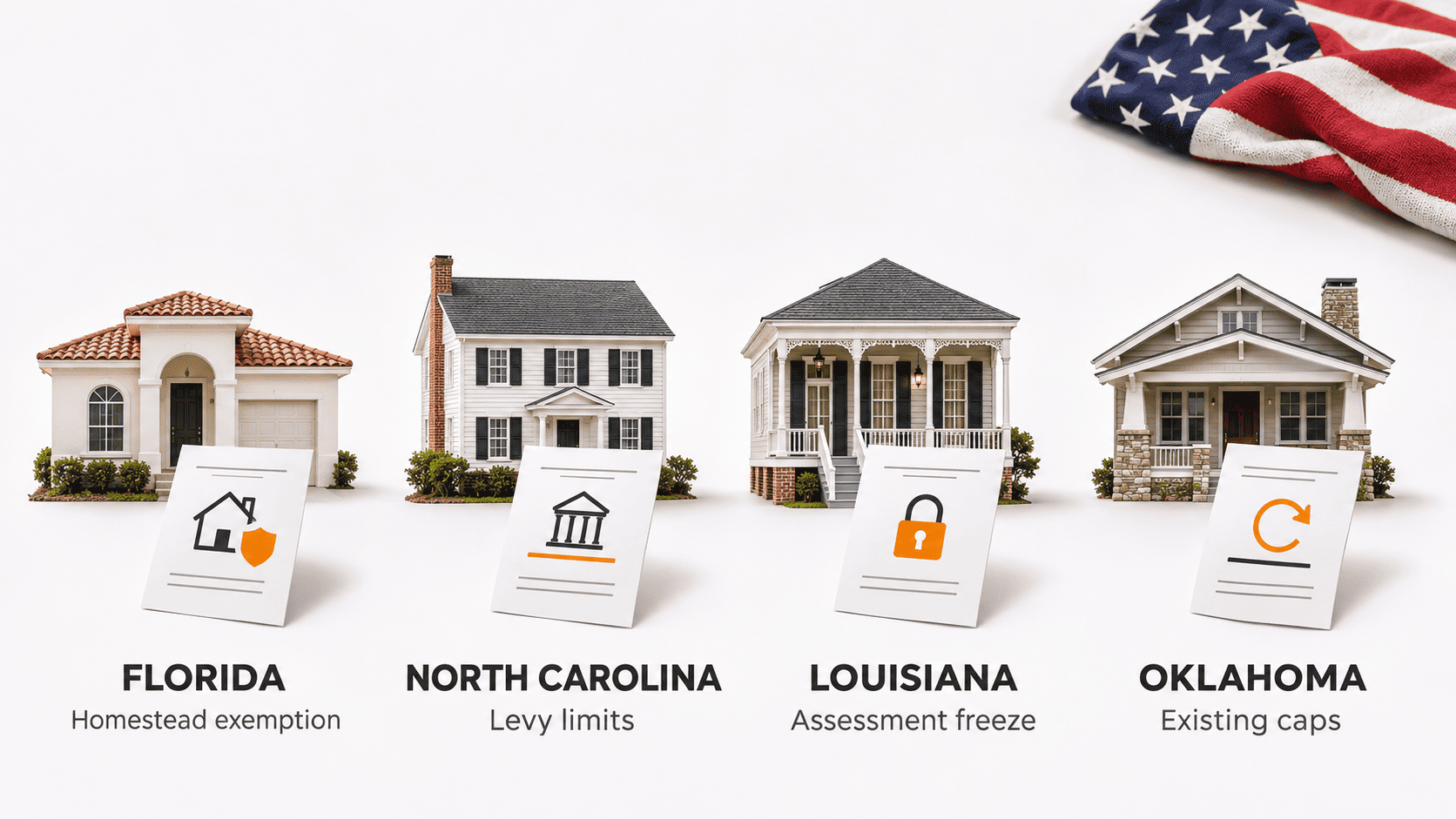
Florida: Larger Homestead Exemptions, With Important Eligibility Rules
Florida’s unofficial election results indicate that approximately 62% of voters approved Amendment 3, clearing the required 60% passage threshold.
According to the Florida Department of State’s amendment summary, the amendment increases the homestead exemption for non-school property taxes to $150,000 in 2027 and $250,000 in 2028, with inflation adjustments beginning in 2029. It also lowers the annual assessment growth cap for non-homestead properties from 10% to 5%. The amendment takes effect on January 1, 2027, with the larger exemption phased in over two years.
Eligibility rules determine when an owner can receive the larger exemption. People who are not Florida residents as of December 31, 2026, initially receive the existing exemption upon qualifying. For these owners, the larger exemption begins in the fifth year of the homestead exemption, subject to the constitutional requirements. The larger exemption does not apply to school district levies.
Practical takeaway: Verify buyer residency and exemption eligibility before discussing potential savings. An existing Florida resident and a new arrival may qualify for the larger exemption on different timelines.
North Carolina: A Levy Limit Still Needs Legislative Details
According to preliminary results reported by Public Radio East, North Carolina voters approved a constitutional amendment requiring statutory caps on local property tax revenue growth. However, the measure does not establish a specific percentage cap within the constitutional text.
North Carolina House Bill 1089 requires the General Assembly to enact laws limiting property tax levy growth and allows exceptions. The constitutional amendment takes effect upon certification of the referendum results.
The next question is how lawmakers will define the limits and exceptions.
A property tax levy is the total amount of property tax a local government imposes. A levy limit differs from a cap on an individual owner’s bill.
Practical takeaway: Agents can explain the policy framework, but property-specific savings estimates remain premature. Future legislation will determine the limits, exceptions and implementation rules.
Louisiana: Expanded Eligibility for an Assessment Freeze
Louisiana’s Amendment 9 received approximately 58% support in the preliminary count reported by Ballotpedia. The measure expands the income eligibility threshold for the state’s special assessment level program.
The Lafayette Parish Assessor’s explanation identifies the change as an increase from the inflation-adjusted threshold of $102,700 to $150,000, effective January 1, 2027. Inflation adjustments to the new threshold begin in 2028. The program serves qualifying homeowners, including seniors and certain people with disabilities.
The distinction is between expanding eligibility and reducing an assessment. The assessor explains that the program generally holds an eligible property’s assessed value in place; the amendment does not itself reduce that value.
Practical takeaway: A household below the new income threshold should still confirm the other eligibility requirements and application process with its parish assessor. The higher threshold is not a universal property tax exemption.
Oklahoma: A Rejected Proposal Leaves Existing Assessment Caps in Place
Oklahoma voters rejected State Question 847, according to election-night reporting by Oklahoma Voice.
As outlined in Ballotpedia’s explanation of the measure, the proposal would have lowered annual growth limits used in property valuations for tax calculations beginning in 2027:
-
From 3% to 1.75% for homestead and agricultural property.
-
From 5% to 4% for most other locally assessed real property.
Its rejection means those proposed lower caps do not take effect through this measure. It does not, by itself, establish whether an individual owner’s next bill will increase or decrease.
Practical takeaway: Distinguish proposed benefits from adopted rules, particularly when clients have seen campaign material describing the lower caps. The Oklahoma State Election Board cautions that election-night results remain unofficial until certification.
A Tax Exemption, an Assessment Cap, and a Levy Limit Do Different Things
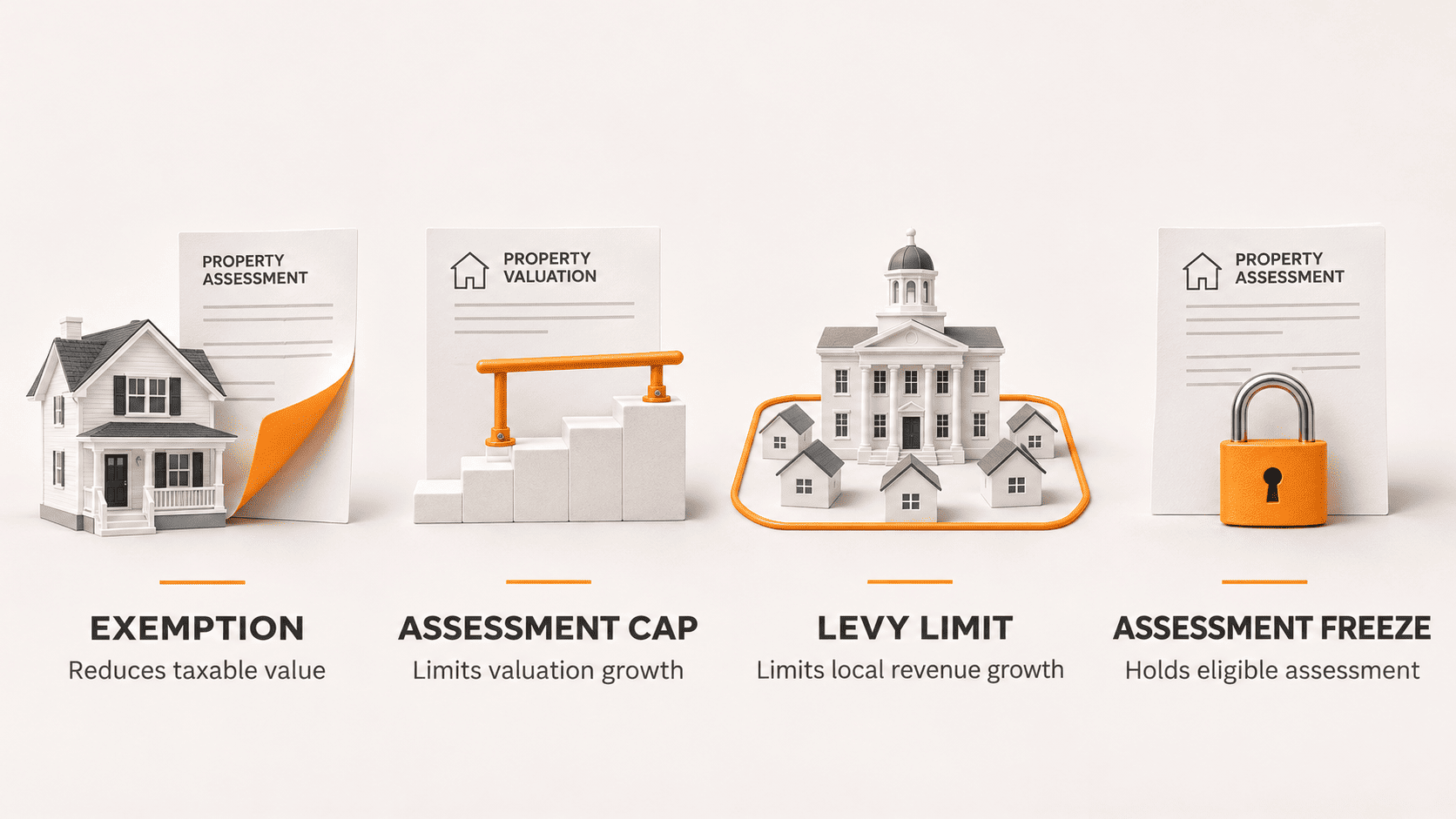
The state results are easier to interpret when the underlying mechanisms are separated. Comparing them as though they were equivalent “tax cuts” can lead to inaccurate expectations.
Homestead Exemptions Reduce Taxable Value
A homestead exemption typically excludes a specified portion of a primary residence’s assessed value from taxation. The tax savings depend on the applicable local rates and which levies the exemption covers.
Florida illustrates why the scope matters: the larger exemption applies to non-school levies, so it does not reduce every part of the bill proportionally.
Assessment Caps Limit Valuation Growth
An assessment cap restricts how quickly a value used for taxation can increase under specified conditions.
That value is one input into a tax calculation. A valuation cap should not automatically be presented as a matching cap on the total bill. Florida’s non-homestead change and Oklahoma’s rejected proposal both concern valuation growth.
Levy Limits Restrict Local Property Tax Revenue Growth
A levy limit operates at the level of a taxing authority’s revenue rather than simply freezing each property’s valuation.
The limits and permitted exceptions determine how this type of restriction works in practice.
Assessment Freezes Apply to Qualifying Homeowners
An assessment freeze generally holds an eligible owner’s assessment at a qualifying level. It does not necessarily freeze the tax rate applied to that assessment.
Louisiana’s special assessment provisions explicitly allow millage rates to change. Consequently, a frozen assessment and a permanently fixed tax bill are different promises.
Rotider’s Take: Judge Tax Relief by Who Qualifies, Not the Headline

At Rotider, we believe the most useful way to evaluate these results is to ask three questions: Who qualifies, what part of the cost changes, and when does the benefit begin?
That approach gives agents a stronger basis for client conversations than treating every successful measure as immediate, broadly available savings.
Existing Owners and New Buyers May See Different Benefits
A property’s current assessment and exemptions may reflect the present owner’s circumstances. Buyers should check whether a transfer changes the assessment or available benefits.
Florida illustrates the distinction because eligibility for the larger exemption depends partly on residency as of December 31, 2026.
When reviewing a listing’s tax history, use past bills as a starting point. Confirm the buyer’s exemptions and any reassessment rules before estimating future taxes.
Lower Property Taxes Address Only Part of Housing Affordability
A tax benefit can matter to a household’s budget. But evaluating affordability also requires looking at the purchase price, financing, insurance, maintenance, and any association fees.
This is why we would avoid drawing a straight line from “tax relief passed” to “buyers can now afford more.” The size and timing of the benefit must first be established for the household concerned.
For agents, the more useful conversation concerns the buyer’s complete ownership budget and which costs are confirmed, estimated or still uncertain.
Read more: U.S. Home Sellers Outnumber Buyers by 63%—So Why Is Buying Still So Hard?
Local Budget Decisions Will Shape the Longer-Term Impact
Household tax relief also raises questions about local budgets. In Florida, WUSF’s coverage of Amendment 3 highlights the potential loss of revenue used by local governments.
Rotider’s view is that the next stage deserves as much attention as the election result. How will affected jurisdictions implement the change? What will their adopted budgets show? Will other charges change?
These are questions to monitor, not outcomes to assume. Claims that a measure will inevitably produce service cuts, higher fees, or stronger property values require evidence beyond the ballot result.
What Real Estate Agents Should Verify Before Advising Clients
Agents can make this news useful by helping clients identify the right questions and directing them to the relevant local authorities.
Property Location, Use, and Buyer Eligibility
Start with the property’s jurisdiction and intended use. A primary residence, rental property, and second home may be treated differently.
Then establish which eligibility conditions need confirmation. Depending on the program, those may include residency, age, disability status, income, or an existing homestead exemption.
A useful client question is: “Which benefits would you personally qualify for on this property?”
Effective Dates and Application Requirements
Separate the election date from the effective date, application deadline, and first affected tax year.
Check each program’s implementation schedule separately; the first year of a benefit and the start of inflation adjustments may differ.
Clients should confirm whether an application is required and which documents their assessor needs.
How a Purchase Could Change the Property’s Tax Assessment
Before using a current bill in an ownership estimate, ask the local assessor or property appraiser:
-
Will the transfer trigger a reassessment?
-
Which current exemptions or special assessment benefits will continue?
-
Which benefits must the buyer apply for?
-
Does an official estimator account for the buyer’s circumstances?
Where the answer is pending, label the estimate accordingly. A clear explanation of uncertainty is more useful than a precise-looking figure based on the wrong eligibility assumptions.
What Happens Next After the Election?
Certification of Election Results
Preliminary returns report the vote count, while certification establishes the official result. Oklahoma’s election board lists November 10, 2026, for certification of state and federal results, unless a contest or recount delays certification.
Agents sharing election updates should preserve that distinction and check for changes before repeating figures.
Implementing Legislation and Local Guidance
Some measures specify benefits and dates, while others require further legislative action. Monitor implementing laws and local assessor guidance before updating client estimates.
Follow-up coverage should focus on the rules that determine actual eligibility and calculations.
Updated Assessments and Property Tax Bills
The final test is how an adopted policy appears in local assessments, exemption decisions, and bills.
For real estate professionals, the strongest takeaway from the 2026 property tax election results is to connect the result to the property and the person. A measure passing is the beginning of that analysis. What matters is the property tax estimate that applies to the buyer’s circumstances.
Conclusion
The 2026 property tax election results are a starting point for understanding potential tax relief, not a guarantee of lower bills. Eligibility, effective dates, and local implementation determine what each measure means for a particular homeowner.
For real estate agents, the priority is to turn policy headlines into clear, property-specific questions. Verify the applicable rules with local authorities, distinguish confirmed benefits from estimates, and help clients consider property taxes within their complete ownership budget.