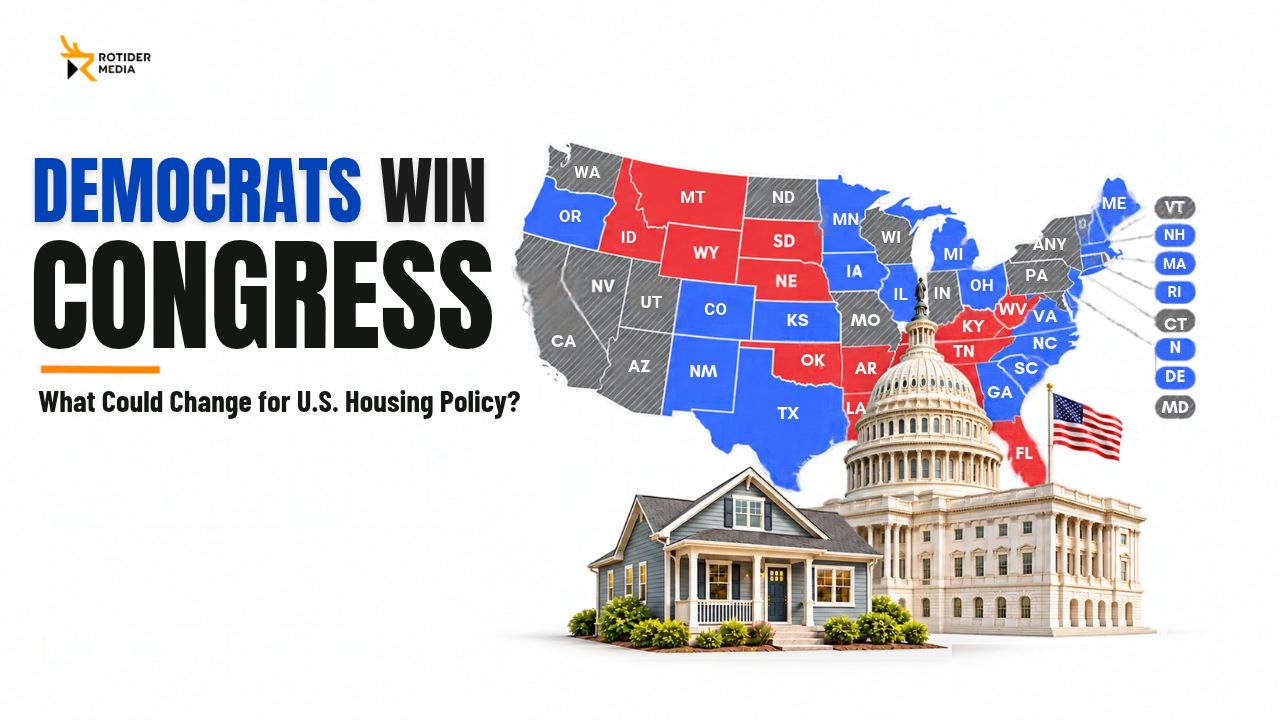
Democrats’ victories in the 2026 congressional elections have renewed attention to Democratic housing policy, including housing supply, buyer assistance, rental support and changes affecting large investors. The next Congress begins its term on January 3, 2027; the election result does not itself enact these proposals.
In its November 4 post-election analysis, the National Association of Home Builders highlights opportunities for bipartisan housing legislation under the incoming Democratic-controlled Congress and the Republican administration. Divided government will shape which proposals advance and how they change during negotiations.
For real estate professionals, the practical task is to distinguish policy proposals from benefits clients can use. Depending on the proposal, implementation may require new legislation, funding, agency guidance or rulemaking. Some changes may also be possible under existing legal authority.
Below are the priorities to monitor, their legislative status and the questions that determine their relevance to clients.
What Democratic Control Could Change in the Next Congress

Greater Influence Over the Legislative Agenda
Congressional majorities have substantial influence over floor schedules, committee oversight and federal spending negotiations.
In the real estate sector, this structural control creates opportunities to revisit policy proposals concerning development financing, homebuyer assistance initiatives, rental housing programs, and institutional investor activity.
The party does not have a single housing plan. Senate Democrats and groups such as the New Democrat Coalition have published distinct agendas, so individual proposals should not be treated as commitments shared by every Democratic lawmaker.
A Republican White House Still Shapes the Outcome
A congressional majority cannot enact legislation on its own. A Republican president retains the power to veto bills, making bipartisan negotiations important to the prospects of many housing proposals.
For most legislation subject to a filibuster, invoking cloture requires three-fifths of senators duly chosen and sworn, normally 60 votes. That threshold differs from the vote required for final passage. Overriding a presidential veto requires two-thirds of members voting in each chamber, with a quorum present. These procedures make the size of a majority and the prospects for bipartisan support important to advancing housing legislation.
A New Majority Does Not Immediately Change Housing Costs
Agents should avoid translating the result directly into a forecast for home prices, mortgage rates, or transaction volume.
A useful policy assessment follows the full chain: what lawmakers propose, what Congress passes, how agencies implement it, and which households or projects qualify. The time between those stages can be substantial.
Democratic Housing Policy Priorities to Watch
.png)
Increasing Housing Supply and Affordable Housing Investment
The New Democrat Coalition’s affordability agenda calls for reducing regulatory barriers and expanding home building. Its priorities include:
-
Repurposing vacant commercial space and underutilized land into residential housing.
-
Accelerating modern construction methods, such as modular and off-site manufacturing.
-
Strengthening federal financing mechanisms to support accessory dwelling units (ADUs).
-
Expanding state allocations for the Low-Income Housing Tax Credit (LIHTC) to incentivize affordable housing production.
The coalition also calls for more flexibility in using federal resources to build and rehabilitate housing. These are caucus priorities, not guarantees that particular projects will receive funding or approval.
Developers should ask which projects would qualify, whether the measures would help close financing gaps and which local approval barriers would remain.
Helping First-Time and First-Generation Buyers
Senate Democrats’ “Opportunity Starts at Home” agenda proposes down payment assistance, especially for first-time and first-generation homebuyers. It also identifies mortgage insurance costs, closing costs and access to portable and assumable mortgages as areas for reform.
Unveiled on January 15, 2026, the agenda sets out policy priorities; it does not itself create an application-ready assistance program.
Before describing assistance as available, agents should verify income limits, buyer definitions, funding, participating lenders and application dates.
Restricting Advantages for Large Institutional Investors
Another priority concerns the tax treatment of large corporate landlords.
On February 24, 2026, Senators Elizabeth Warren and Jeff Merkley introduced the American Homeownership Act. According to the sponsors’ announcement, the bill would end certain tax deductions and federal benefits for covered investors and use the resulting savings to support housing programs. These are the proposal’s stated aims, not demonstrated outcomes.
GovInfo’s introduced version of S.3904 records its introduction and referral to the Senate Finance Committee. That version is not enacted law; check the bill’s latest actions before reporting its current legislative status.
Assess any final law or implementing rule by its definitions, investor-size thresholds, exceptions and effective dates. General references to investor restrictions do not establish whether small landlords or individual rental-property owners would be covered.
Expanding Rental Assistance and Tenant Protections
The Senate Democratic housing policy agenda calls for expanded rental assistance, investment in Housing Choice Vouchers and protections for tenants organizing resident associations. It also proposes action on unfair evictions and rental fees described by the agenda as predatory.
Expanded rental assistance could help eligible tenants meet rent payments. New tenant protections could change lease administration, operating procedures and dispute handling, depending on the final rules.
Owners and managers should assess each proposal separately, checking its coverage, funding and compliance requirements.
What Is Already Law and What Still Needs Congressional Action?
|
Policy or measure |
Status |
What to verify |
|
New Democrat Coalition agenda |
Published policy priorities |
Specific bills and changes already enacted |
|
Opportunity Starts at Home |
Senate Democratic agenda |
Bill text, eligibility and funding |
|
American Homeownership Act (S.3904) |
Introduced bill version; not enacted law |
Latest actions, amendments and covered investors |
|
21st Century ROAD to Housing Act |
Enacted July 11, 2026 |
Effective provisions and implementation |
Existing Bipartisan Housing Measures
Housing policy did not begin with the election.
The 21st Century ROAD to Housing Act became law on July 11, 2026, as Public Law 119-101. The bipartisan package addresses housing construction barriers, federal housing programs and financing. Its enacted provisions form part of the baseline against which new proposals should be assessed.
New legislation may supplement or amend existing law. An earlier agenda should not be treated as a complete account of what remains unenacted; compare each proposal with current law.
Democratic Housing Proposals Remain Works in Progress
A policy platform, an introduced bill, and an enacted law represent different legislative stages.
For each proposal discussed in a market update, identify its legislative status:
-
A stated policy priority lacking formal bill text.
-
A bill introduced in the House or Senate and referred to a committee.
-
A measure passed by one or both legislative chambers.
-
Enacted legislation awaiting implementation or agency rulemaking, where required.
-
An operational program actively accepting client applications.
Check the date and scope of each record. An introduced bill’s text does not by itself establish its latest status or whether similar provisions became law elsewhere.
Funding and Implementation Will Determine the Reach
Even after legislation passes, practical access may depend on appropriations, agency guidance, participating institutions, and local administration.
For example, a program’s existence does not establish whether funding will cover every qualified applicant. Similarly, a development incentive must be evaluated against the financing and approval requirements of an actual project.
What Could These Policies Mean for the Housing Market?

More Construction Could Expand Supply Over Time
Supply-side measures aim to make new development possible or accelerate viable projects. Their usefulness depends on which barriers they address.
A financial incentive may help a project with a financing gap but have limited immediate effect if infrastructure or local approvals remain the main constraint.
Track housing announcements through permits, construction starts, completions and occupancy. Funding commitments alone do not show how many homes will reach the market.
Buyer Assistance Could Improve Access, With Local Constraints
Down payment assistance targets an upfront barrier to buying. Its usefulness also depends on whether the household qualifies for a mortgage and can afford ongoing ownership costs.
The effect also depends on how readily the local market can add homes. Where entry-level inventory is limited, evaluate buyer assistance alongside efforts to expand supply.
The effect on prices will depend on program design and local market conditions.
Investor Rules Could Affect Some Markets More Than Others
The effect of institutional-investor rules would depend on which firms, properties and transactions the final legislation covers.
Agents should assess how active covered investors are in their local market. Restrictions affecting a concentrated segment of single-family rentals do not, by themselves, establish a nationwide effect on home prices or buyer competition.
Why Federal Housing Policy and Local Property Taxes Must Be Read Separately
Federal tax incentives for housing development and property tax measures on state ballots are separate policy channels.
For example, Florida’s Amendment 3 addresses homestead exemptions and non-homestead assessment growth. North Carolina’s property tax amendment directs its legislature to establish limits on local property tax levy increases. Their provisions come from those state measures, rather than from the party winning Congress.
Agents should therefore assess a client’s property tax position through the applicable jurisdiction and eligibility rules. A national election headline cannot establish a household’s future tax bill.
Rotider’s Take: Measure Progress by Delivery, Not Announcements
Ask Whether a Policy Adds Homes or Expands Purchasing Power
Rotider’s view is that the most useful way to assess Democratic housing policy is to identify the market barrier each proposal addresses.
Does it help finance new homes, reduce upfront buying costs, support rent payments or change investor incentives?
These goals can complement one another, but they are not interchangeable. Assess whether the measures help households access suitable housing at costs they can sustain.
Follow the Implementation Timeline
Track the applicable legal authority, any required funding and the date a measure becomes usable or enforceable.
A policy becomes relevant to a client when its rules apply to that person, property or transaction. Until then, agents can explain the proposal while distinguishing potential benefits from confirmed eligibility and available assistance.
Translate National Policy Into Local Client Questions
For buyers, check whether assistance is available through a participating lender. For developers, verify whether the project qualifies for funding. For landlords, identify which reporting or operating requirements would apply.
The value of market commentary lies in connecting national developments to decisions clients can verify locally.
Read more: U.S. Home Sellers Outnumber Buyers by 63%—So Why Is Buying Still So Hard?
What Real Estate Agents Should Watch Next
The most consequential developments will be those that advance proposals from legislative debate into administrative execution:
-
Committee priorities and scheduled legislative hearings.
-
Revised statutory bill language and bipartisan compromise agreements.
-
Budget appropriations and program funding mechanisms.
-
Federal agency guidance, borrower eligibility rules, and official effective dates.
-
Local municipality participation and formal application window openings.
Democrats’ congressional victories create an opportunity to advance their housing priorities. For agents and brokerages, the practical value lies in tracking which proposals become available programs, enforceable rules or completed housing and explaining those changes accurately to clients.